


Metal detecting for gold in the UK is a genuine activity with genuine finds. Scotland has produced significant natural gold discoveries, including the Douglas Nugget found in a Scottish river in 2018 and valued at £50,000. Devon has also produced a £4,000 nugget found by a detectorist, while Welsh gold from the Dolgellau area has been used in royal wedding rings for generations.
What makes UK gold detecting different is the type of gold and the ground where it is found. Much of the natural gold recreational prospectors find is fine alluvial gold, while gold-bearing river gravels can also be highly mineralised. A detector that performs well on coins in ordinary farmland is therefore not automatically suitable for small gold nuggets in a Scottish stream.
The legal side also needs proper attention. Landowner permission matters, and Scotland has its own Treasure Trove system for significant archaeological and historical finds. Choosing the right machine is only one part of getting started, so the best approach is to understand the geology, ground conditions, detector technology, and legal position before spending serious money.
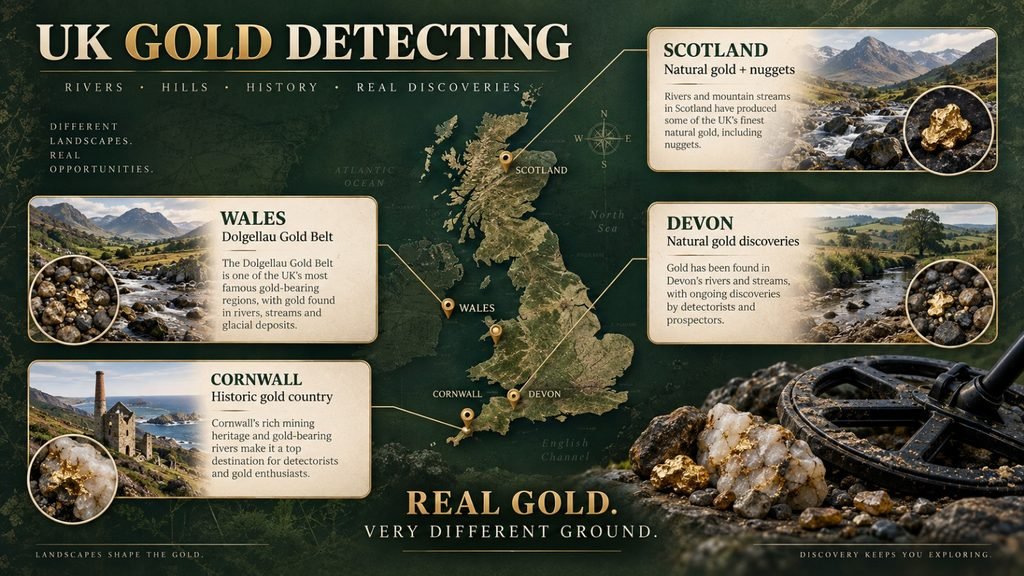
The UK has several areas with documented gold deposits, but Scotland is generally the strongest region for recreational gold prospecting. Wales has the country’s most historically significant gold belt around Dolgellau, while Cornwall, Devon, and parts of the Lake District have also produced natural gold. Understanding the geology behind these areas helps prospectors see where gold is more likely to occur and why certain rivers and upland areas attract attention.
The Dolgellau Gold Belt in Gwynedd is one of the UK’s most historically important gold-producing areas. Gold mining in the region dates back to the nineteenth century, with the Clogau St David’s and Gwynfynydd mines becoming particularly associated with Welsh gold. The area has also supplied gold used in royal wedding rings, beginning with Princess Marina’s ring in 1935.
Natural gold was concentrated in the region’s quartz-bearing geology and subsequently transported into river systems. The River Mawddach and its tributaries are therefore important when considering alluvial gold in the area, although the presence of gold does not mean every stretch of river will produce detectable nuggets.
Access is a separate issue from geology. Much of the Dolgellau area falls within Eryri, and land access and prospecting permissions need to be checked before searching. Anyone planning serious prospecting in the region should also understand the wider rules around detecting and land access, which are covered in the metal detecting in Wales guide.
Scotland has arguably the strongest reputation for recreational gold prospecting in the UK, supported by both historic production and more recent discoveries. Kildonan Burn in Sutherland became associated with the Scottish gold rush of 1868 and continues to attract prospectors. Wanlockhead and Leadhills in South Lanarkshire also have a long history of gold mining dating back to the early 1500s.
The 2018 discovery of the Douglas Nugget showed that substantial natural gold can still be found in Scottish rivers. The nugget was valued at £50,000, although its exact location was not disclosed. A find of that size is exceptional, but it demonstrates why experienced prospectors continue to investigate known gold-bearing areas.
Scottish prospecting also requires a clear understanding of access and find-reporting rules. The legal position is covered in more detail in the metal detecting in Scotland guide, particularly for anyone planning to search rivers or investigate historically significant sites.
Cornwall’s gold history is closely connected with its wider mining heritage. The Carnon Valley near Truro produced a notable nugget in 1808, which is now held by the Royal Cornwall Museum. Devon has also produced more recent evidence of natural gold, including a £4,000 nugget found by a detectorist at Westward Ho!
The Lake District has smaller and less consistently productive gold occurrences, including reported finds in upland streams around areas such as Blencathra and the River Duddon. These locations are worth understanding from a geological perspective, but expectations should remain realistic because the quantity and consistency of gold vary considerably from one area to another.
That variation is one reason location alone cannot determine whether a detector will perform well. The next consideration is the ground itself and why a conventional machine can struggle even when gold is present.

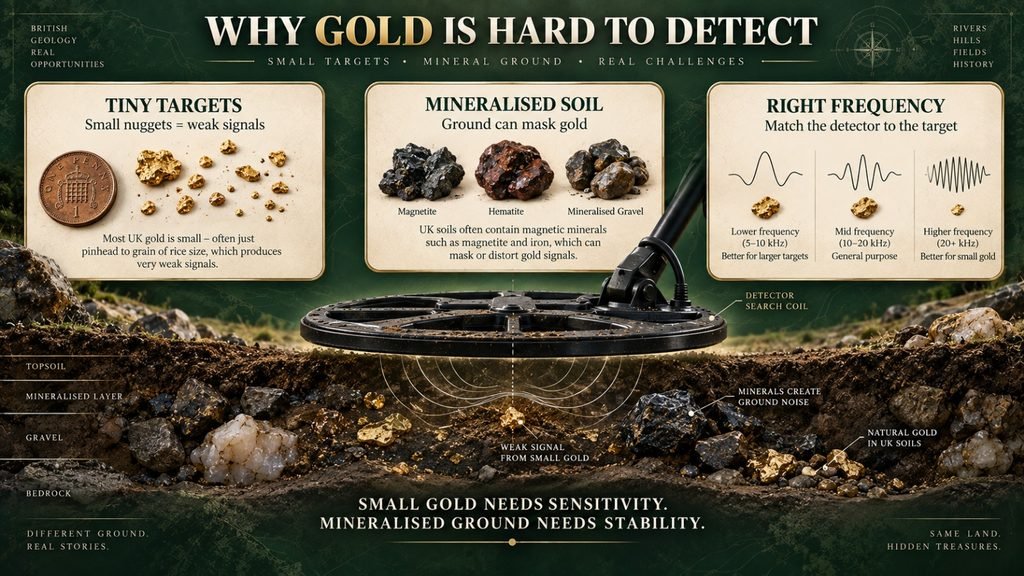
Standard metal detectors are generally designed around the targets UK detectorists encounter most often, including coins, relics and larger conductive objects. Many conventional machines operate in the lower to mid-frequency VLF range, which can be excellent for general detecting but is not automatically optimised for very small natural gold. A tiny gold nugget can therefore be a much harder target than a coin of similar size.
Gold’s conductivity, target size and shape all influence how a detector responds. Fine flakes and small nuggets produce weak signals, particularly when they are surrounded by mineralised material. A detector that gives a clear response to a copper or silver coin can therefore fail to produce a useful response from a very small natural gold target.
Gold-bearing ground presents another challenge because the surrounding geology can contain magnetic and iron-rich minerals that create strong ground responses. River gravels and other mineralised environments can make a detector sound unstable, producing false signals that become difficult to separate from genuine targets.
Understanding this behaviour is essential before choosing equipment. The metal detector ground balance guide explains why ground balance matters and how mineralised soil affects detector performance, while geological information from the British Geological Survey provides useful context for understanding the UK’s gold-bearing environments.
A detector designed specifically for gold needs to deal with both sides of the problem. It must be sensitive enough to respond to small targets while also maintaining useful performance in difficult ground.
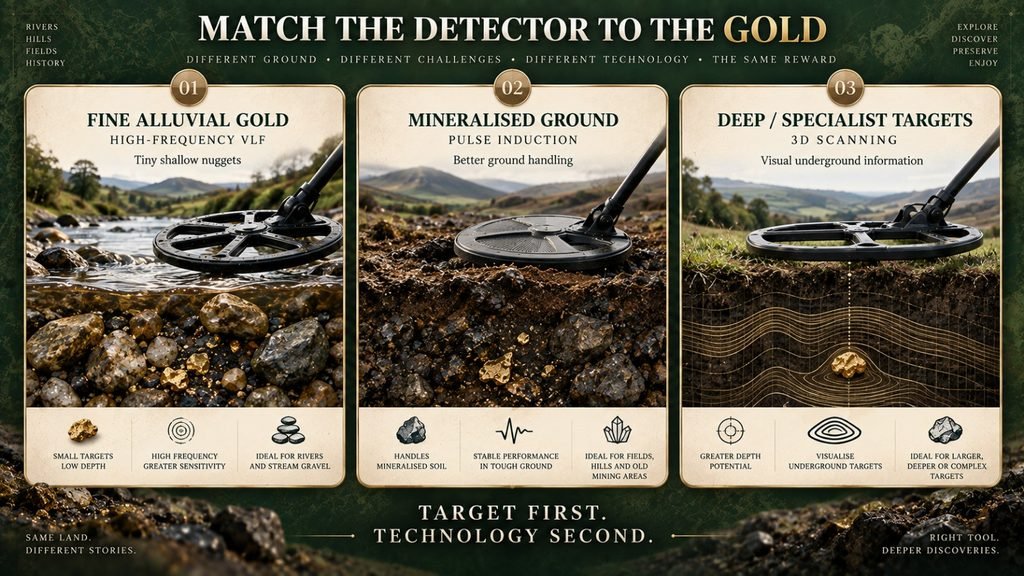
For very small natural gold in shallow ground, high-frequency VLF detectors can offer the sensitivity needed for tiny targets. The site also confirms that VLF detectors are ideal for tiny gold nuggets in shallow ground, while Pulse Induction detectors excel in highly mineralised soils.
PI technology becomes particularly useful where mineralisation is the limiting factor. Instead of treating every gold search as a conventional coin-hunting exercise, serious prospectors need to match the detector technology to the target, soil and expected depth.
Deep buried gold is a different proposition again. Where the objective involves researching possible caches, deposits, or other substantial buried targets, multi-system and 3D ground scanning technology can provide information that a conventional audio detector cannot.
There is no single “best metal detector for gold UK” answer because UK gold hunting covers several very different types of targets. Searching river gravel for a tiny nugget is not the same task as locating a buried gold artefact on farmland. Understanding that distinction makes choosing equipment considerably easier.
Alluvial gold is gold that has been transported and concentrated by natural processes, usually through streams and rivers. For a detectorist, this can mean searching gravel, shallow ground and areas where heavier material is naturally deposited. The targets may be extremely small, so sensitivity to fine gold and stability in mineralised ground are both important.
High-frequency VLF detectors are well suited to tiny gold nuggets in shallow ground, while PI machines can offer an advantage when mineralisation becomes a major problem. The OKM Pulse Nova, priced at £2,390, uses Pulse Induction technology and is positioned for gold prospecting and mineralised soil performance.
That makes PI technology particularly relevant to UK river prospecting, but it does not remove the need to understand the site itself. Kildonan Burn, the Wanlockhead and Leadhills area, and parts of the River Mawddach catchment all have very different geological and access considerations.
Gold artefact hunting is a different form of detecting altogether. A Celtic gold object, Roman coin, Anglo-Saxon item or medieval piece is a larger archaeological target than a tiny natural nugget, and the objective is usually to locate an artefact within historically productive ground.
Here, depth, target separation and performance around iron can become more important than extreme sensitivity to tiny natural gold. Machines designed for relic hunting can therefore have a role, particularly when searching historically productive farmland where gold artefacts may occur alongside iron contamination.
Professional multi-system detectors can take this further by combining different search approaches. The important point is that a detector chosen for gold artefacts should not automatically be judged by the same criteria as one selected for fine alluvial gold.
Deep cache detection involves another change in technology. If research points towards a possible buried hoard, cache or substantial deposit, 3D ground scanning systems can provide visual information about underground targets rather than relying only on a conventional audio response.
The Geoground Gold Vision, priced at £4,950, provides real-time 3D ground scanning and a visual underground map. The UIG Ground Scanner adds 3D imaging, live wall scanning and cavity detection, with a stated depth of up to 30 metres.
These systems are aimed at a much more specialised type of prospecting. They make most sense when there is a reason to investigate a particular site rather than simply walking across large areas hoping to encounter an unspecified target.
UK Metal Detectors is an official UK dealer for OKM, GER, UIG and Geoground. The range covers dedicated gold detection from £1,300 through to professional 3D scanning systems, so the right choice depends more on the intended type of search than on simply choosing the most expensive machine.
The GR-3 provides a multi-system approach for gold detecting. For someone moving from a standard general-purpose detector into dedicated gold equipment, it represents the entry point of this professional range.
The Golden Way adds a higher entry point into professional multi-system gold detection. Both machines are intended for buyers who want dedicated capability rather than simply adapting a conventional farmland detector for occasional gold searches.
Price should not be the only deciding factor at this level. The better question is whether the machine’s search systems match the type of gold being targeted, because river prospecting, farmland artefacts and deep targets place different demands on the equipment.
At around £2,400 to £2,500, three machines provide different approaches to serious gold detecting. The OKM Pulse Nova costs £2,390 and uses Pulse Induction technology, making it particularly relevant to gold prospecting where mineralised soil is a major concern.
The UIG Watch costs £2,450 and combines three scanning systems, including 3D imaging. It weighs just 85 grams and provides a stated depth of up to 20 metres, making its compact format relevant to prospectors covering substantial terrain on foot.
The UIG Gold Digger costs £2,499 and provides seven search systems, including a small-target system designed for nuggets. It also provides automatic soil calibration and a stated depth of up to 4 metres, making it a more versatile option for prospectors who want several detection approaches within one machine.
The Geoground Gold Vision moves into a more specialised category at £4,950. Its real-time 3D ground scanning creates a visual underground map and is designed to remain stable on mineral-heavy soil.
The UIG Ground Scanner is priced at £3,750 and combines three systems with 3D imaging, live wall scanning and cavity detection, with a stated depth of up to 30 metres. These machines are better suited to research-led prospecting where the ability to analyse underground targets is central to the search strategy.
For readers comparing 3D and longer-range approaches, the long-range metal detectors guide provides useful context on where that technology fits within a wider detecting setup.

| Machine | Price | Best For | Key Technology | Depth |
| GR-3 | £1,300 | Entry gold detecting | Multi-system | Good |
| Golden Way | £1,950 | Entry gold detecting | Multi-system | Good |
| OKM Pulse Nova | £2,390 | River prospecting, mineralised ground | Pulse Induction | Medium |
| UIG Watch | £2,450 | Mobile field prospecting | 3D imaging, 3 systems | 20m |
| UIG Gold Digger | £2,499 | Nugget hunting, deep gold | 7 systems, automatic calibration | 4m |
| UIG Ground Scanner | £3,750 | Deep scanning, 3D analysis | 3D imaging, 3 systems | 30m |
| Geoground Gold Vision | £4,950 | Research-based prospecting | Real-time 3D ground scan | Deep |
Choosing between these machines is ultimately about the search objective rather than simply moving up a price ladder.
The right detector depends on what you plan to find, where you plan to search, and how mineralised the ground is. UK Metal Detectors can help you compare PI, multi-system, and 3D options based on your specific prospecting plans.
Contact the team with your target, location, and type of ground, and get advice on the right machine before you buy.
The legal side of gold prospecting needs to be considered before the detector is switched on. Permission is fundamental when searching private land or river areas, and the rights associated with riverbeds, banks and naturally occurring gold can involve more than one party. Scotland also has a separate Treasure Trove system that makes find reporting particularly important.
Landowner permission should be obtained before prospecting on private land or river areas. River ownership and access rights can be more complicated than simply assuming that a public footpath or open access route gives permission to detect or remove material from the riverbed.
The same principle applies to riverbanks and other land adjoining waterways. Beach and river access can involve separate rights depending on the location, so serious prospectors should establish who controls the land and what activities are permitted before beginning a search.
The Crown Estate also has rights associated with naturally occurring alluvial gold in parts of the UK. The practical and legal position can vary, particularly for more serious or commercial prospecting, so those rights are worth clarifying rather than making assumptions about what a landowner’s permission covers.
Scotland has its own system for archaeological and historically significant finds. Significant portable antiquities can fall under the Treasure Trove system regardless of whether they are made from gold, silver or another material, making reporting requirements particularly important for anyone searching historically productive ground.
Treasure Trove Scotland explains the reporting process for finders and provides the relevant guidance for Scottish discoveries. A potentially important gold artefact should therefore never be treated simply as a valuable object to take home.
England and Wales have different rules. Under the Treasure Act 1996, qualifying gold and silver objects over 300 years old can be classed as treasure and must be reported to the local coroner within the required period. Anyone specifically targeting archaeological gold should understand those obligations before searching.

Gold detecting in the UK can produce genuine finds, but expectations need to be grounded in the reality of British geology. The UK’s natural alluvial gold is often fine, with small flakes and occasional small nuggets being far more realistic than the large nuggets commonly associated with Australian prospecting. A productive session may result in gold that is small enough to require careful inspection.
Exceptional discoveries do happen. The Douglas Nugget, valued at £50,000, is a remarkable example, while the £4,000 Westward Ho! discovery shows that substantial natural gold can also appear in English ground. Neither find should be treated as a normal outcome for a day’s prospecting.
Experienced prospectors understand that the attraction is partly in the process. Reading the geology, identifying likely deposition areas, learning how mineralised ground behaves and recovering a genuine piece of natural gold can all be worthwhile even when the material has little financial value.
Gold artefact hunting has the same statistical reality. Celtic, Roman and medieval gold objects exist in Britain, but they are rare discoveries rather than predictable outcomes. Good equipment cannot manufacture a target where none exists, but suitable technology can improve the chances of detecting a genuine target when the geology, history and permissions all point towards a worthwhile site.
The UK has real gold, from the historically important Dolgellau Gold Belt to Scottish rivers that have produced significant nuggets in recent years. Devon and Cornwall have also produced natural gold, proving that gold detecting in Britain is not simply a historical pursuit. What changes the outcome is understanding where the gold occurs, what form it takes and what the surrounding ground does to a detector’s signal.
A standard farmland detector may be excellent for coins and relics but poorly suited to tiny natural gold in mineralised river gravel. A dedicated VLF, Pulse Induction, multi-system or 3D machine can offer a much better match, depending on the target and search environment.
Choosing the wrong detector can mean spending £1,300 or more on equipment that does not suit your type of gold hunting.
Contact UK Metal Detectors before buying. Tell the team what you plan to search for and where, and get advice on the machine that best fits the job.
Yes, gold can be found with a metal detector in the UK, particularly in known gold-bearing regions of Scotland, Wales, Devon and Cornwall. Scotland has produced significant natural finds, including the Douglas Nugget discovered in 2018, while Devon has also produced a £4,000 nugget found by a detectorist. Small flakes and occasional nuggets are realistic targets in suitable ground when the correct equipment is used.
The best metal detector for gold in the UK depends on whether the target is fine alluvial gold, a buried gold artefact, or a deeper cache or deposit. High-frequency VLF machines can be suitable for tiny shallow nuggets, while Pulse Induction technology is particularly useful in highly mineralised ground. Multi-system and 3D scanning machines are better suited to specialised deep or research-based detection.
Scotland is generally regarded as the strongest region for recreational gold prospecting, with areas including Kildonan Burn in Sutherland and Wanlockhead and Leadhills in South Lanarkshire having documented gold histories. Wales’s Dolgellau Gold Belt and the River Mawddach catchment are also historically significant, while Cornwall and Devon have produced natural gold finds. The presence of gold does not remove the need for landowner permission and location-specific access checks.
Yes, especially when targeting small natural gold in mineralised ground. Conventional detectors designed primarily for general coin and relic detecting may struggle with very small, low-conductivity gold targets and unstable mineralised soil. High-frequency VLF detectors and Pulse Induction machines are more appropriate for natural gold, while multi-system and 3D scanning equipment can suit deeper or more specialised targets.
Gold prospecting can be legal when the required permissions and reporting obligations are followed. Permission should be obtained before detecting or prospecting on private land or river areas, while the rights surrounding riverbeds and naturally occurring alluvial gold can require further clarification. Scotland has a separate Treasure Trove system for significant archaeological and historical finds, while qualifying treasure finds in England and Wales are governed by the Treasure Act 1996.