On this page
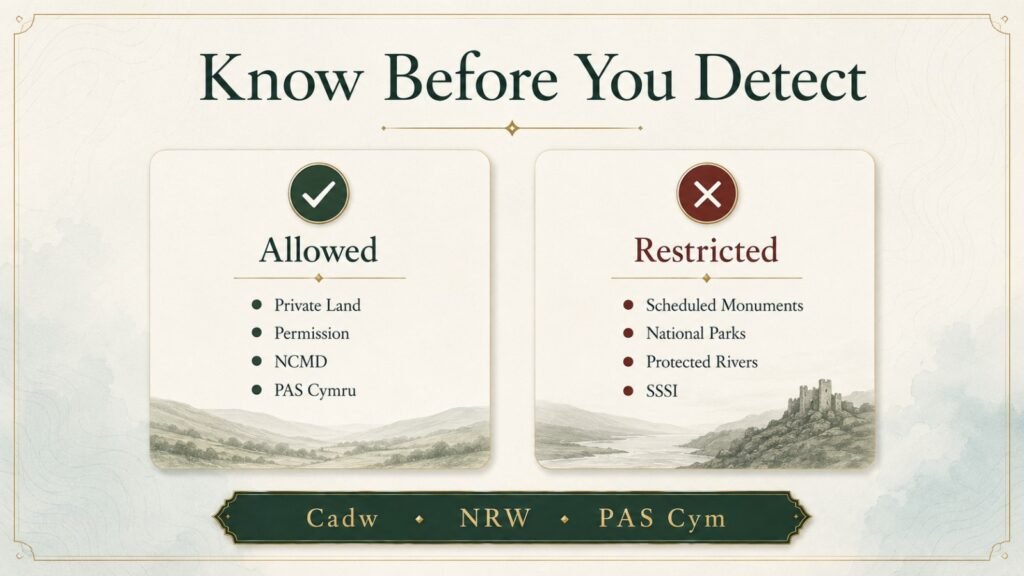
Wales plays by the same rules as England. You need landowner permission. You need NCMD membership. The Treasure Act applies. All of that is identical.
But Wales has one thing no other part of the UK can offer: the only significant gold-bearing geology in the British Isles, sitting in the hills of Gwynedd above the Mawddach Estuary. That alone makes it worth serious attention.
On top of the gold, Wales packs more than 4,000 Scheduled Monuments into a relatively small country: Roman forts, Iron Age hillforts, medieval castles, early Christian sites. The farmland around all of that history has produced some remarkable finds.
There is a catch, though. Welsh soil is heavily mineralised, and it will quietly humiliate a standard beginner detector. Wales rewards the detectorist who prepares. This guide covers exactly how to do that.
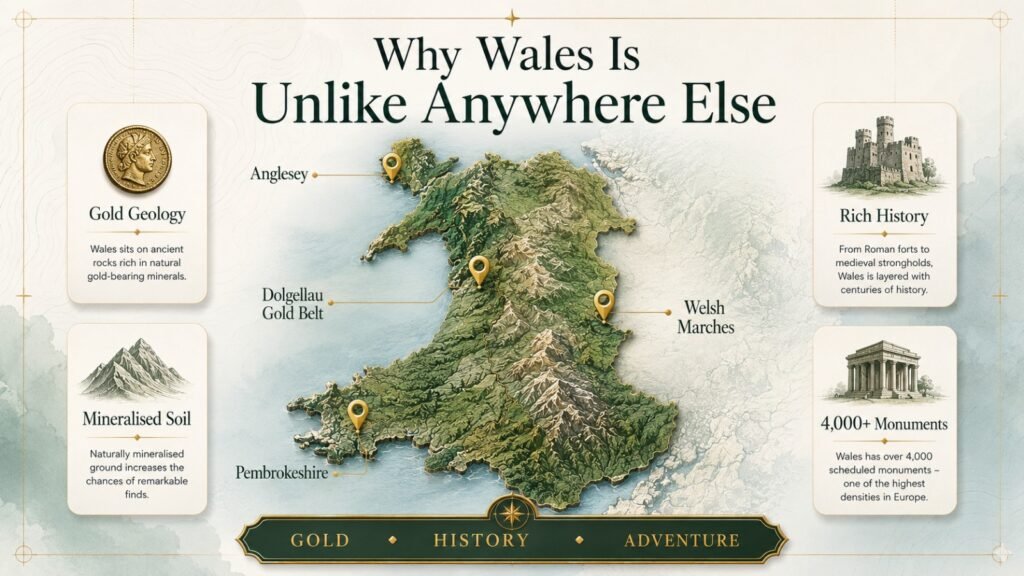
Wales is the only place in the British Isles with commercially significant gold geology. The Dolgellau Gold Belt in Gwynedd produced over 78,000 ounces from the Clogau St David’s mine between 1862 and 1911. The nearby Gwynfynydd mine added over 45,000 troy ounces on top of that.
Welsh gold carries real cultural weight too. Royal wedding rings have been made from it since Princess Marina’s in 1935. That tradition continues to this day.
The mine shafts are closed. But alluvial gold washed from the same geological formations has been carried into the rivers of the Mawddach catchment for centuries, and it is still there in the river gravels.
Cadw, the Welsh Government’s historic environment service, confirms Wales has over 4,000 Scheduled Monuments. Roman military camps, Iron Age hillforts, Celtic kingdoms, medieval castles all in a country you can drive across in a few hours.
The farmland surrounding those protected sites has produced significant finds. Iron Age chariot fittings on Anglesey. Roman cavalry equipment. Medieval Welsh coins. Wales records 20 to 30 Treasure finds annually through PAS Cymru, and the non-Treasure finds entering the database run considerably higher than that.
Most people have a vague image of what gold prospecting in Wales involves. The reality is more specific, and understanding it will save you a wasted trip.
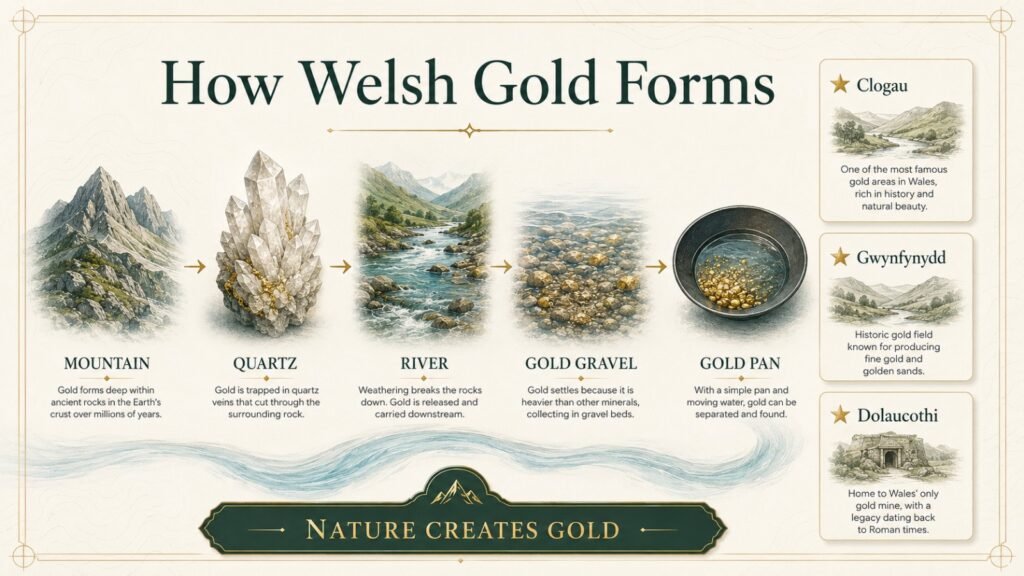
The gold sits in quartz veins within black shales, the specific geological formation that runs through the Dolgellau Gold Belt in Gwynedd.
The Mawddach Estuary and its river catchment drain that gold-bearing ground directly. Centuries of river erosion have broken gold away from the quartz veins and deposited it in the gravels downstream. That is the alluvial gold that prospectors have worked for hundreds of years.
The British Geological Survey documents this distribution in detail. Amgueddfa Cymru holds significant alluvial gold nuggets recovered from these rivers in its Mineralogy of Wales collection.
The famous Clogau and Gwynfynydd mines are closed and inaccessible. What you can do is work the alluvial gravels of the Mawddach catchment rivers with landowner permission using a gold pan or a high-frequency specialist detector.
The easily accessible placer deposits in the main channels have largely been worked historically. Serious prospectors who research less-visited sections of the catchment still find it worthwhile.
There is a second Welsh gold location much further south: Dolaucothi in Carmarthenshire, the only known Roman gold mine in Wales. The National Trust now owns it and runs guided prospecting experiences. This is not a walk-up site; you access it through the Trust’s own programme.
These are two completely different activities, and they need different equipment.
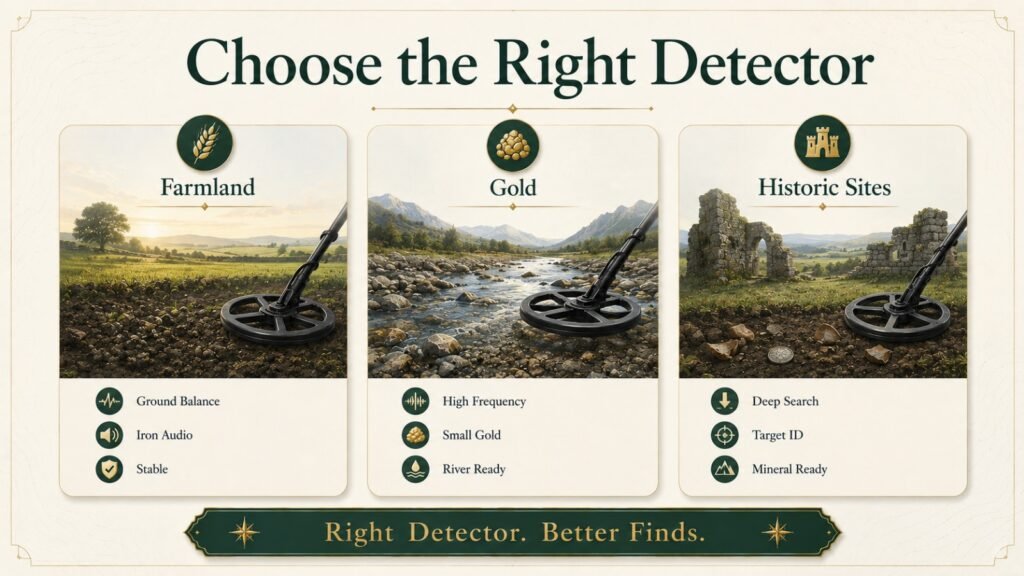
River prospecting uses gold panning and a high-frequency detector tuned to small, low-conductivity targets, such as fine flakes and small nuggets, in river gravel. Field detecting for gold artefacts is standard farmland technique on arable or pasture ground, looking for Celtic, Roman, or medieval gold objects lost or buried over the centuries.
Both are legitimate. Both need separate permissions from different people, and both need equipment matched to what you are actually trying to find.
Every river in Wales is privately owned to the centre line by the riparian landowner. The Crown Estate also holds rights over alluvial gold in many areas. You need permission before you detect or pan anywhere near a Welsh river.
The Mawddach catchment falls largely within the Eryri National Park boundary. National Park authorities in Wales do not grant permission for recreational detecting on their own land unless it forms part of a consented archaeological programme.
The gold gets the attention. But most UK detectorists visiting Wales will find their best opportunities on farmland, not rivers, and those opportunities are genuinely good.
Roman Wales was an occupied military province. Coins, personal items, and military equipment are distributed across its landscape in ways that still produce finds today.
Anglesey has been particularly productive. Detectorist Ian Porter found a group of chariot fittings and Roman cavalry equipment there in 2020. They were declared Treasure and reported through PAS Cymru at Gwynedd Archaeological Trust.
The Welsh Marches Flintshire, Wrexham, Powys, and Monmouthshire are historically rich territory for medieval finds, given the density of castle and market town activity from the Norman period onwards. The Vale of Glamorgan has produced Roman material around the civilian settlement at Venta Silurum, modern Caerwent.
This is where Wales is genuinely hard on detectorists.
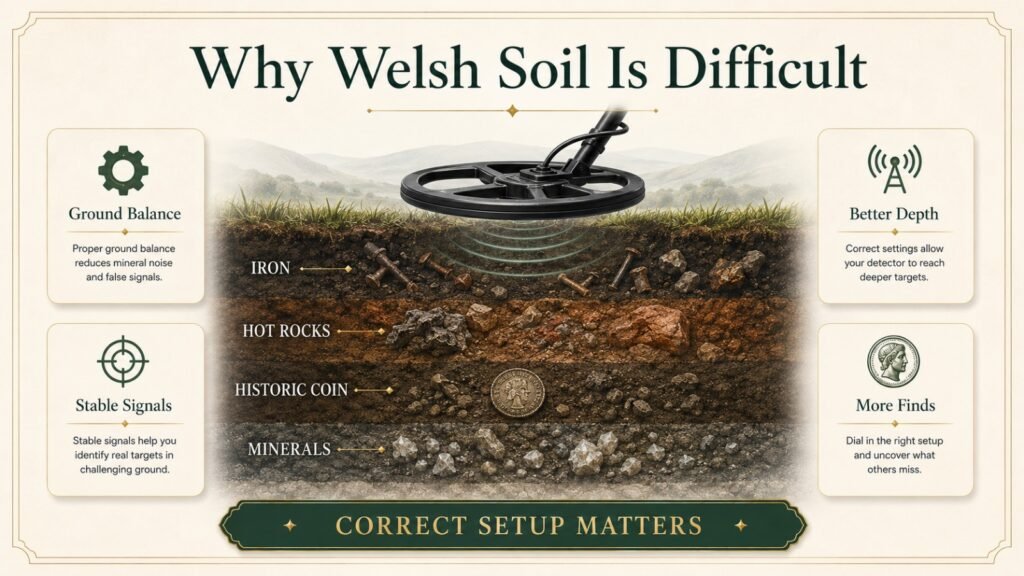
The iron-oxide-rich red soils of mid and north Wales, the acidic peaty ground of the uplands, and the heavily mineralised earth around Wales’s historic copper, lead, zinc, and silver workings all create far more ground noise than typical East Anglian arable.
A standard detector with preset ground balance will register that mineralisation as continuous false signals, drowning out the real targets beneath it. Getting the right machine and setting it up correctly before you arrive makes a dramatic difference. The metal detector ground balance guide explains exactly how to handle mineralised UK soil.
The affordable option

19 kHz, fast recovery, ground balances onto wet sand.
£249.99£399.95Save £149.96
Add to basketFull detailsIn stock
Most of the rules are the same. Treasure Act applies. NCMD membership covers you. Landowner permission is required. But the differences are real, and not knowing them can turn an expensive trip into a legal problem.
Historic England has no jurisdiction in Wales. The body responsible for Scheduled Monuments in Wales is Cadw, the Welsh Government’s historic environment service.
If you need to check whether a site is scheduled, understand a protected area’s legal boundaries, or seek consent to detect near a monument, Cadw is who you contact.
Under Section 60 of the Historic Environment (Wales) Act 2023, using a metal detector on a protected place without Cadw’s written consent is a criminal offence. Cadw’s guidance on metal detecting in Wales is clear that consent will not normally be granted for recreational detecting, only for consented archaeological programmes.
Wales has over 4,000 scheduled monuments. Checking the Cadw register before any new site is not optional.
Wales has three National Parks: Eryri (Snowdonia), Pembrokeshire Coast, and Bannau Brycheiniog (Brecon Beacons).
Bannau Brycheiniog National Park Authority is explicit: detecting on National Park Authority-owned land will not normally be permitted unless it is part of an accredited archaeological programme. Eryri takes the same position.
The working assumption near any National Park boundary is that NPA-owned land is unavailable for hobby detecting. Private farmland within a National Park still needs the usual landowner permission, plus awareness of any additional designations on that ground.
Where Natural England handles SSSIs in England, Natural Resources Wales handles them in Wales. Consent from NRW is required for activities on SSSIs that could damage the site’s special interest.
The gold-bearing rivers of the Mawddach catchment include sections designated as SSSIs and Special Areas of Conservation. This directly limits where prospecting activity is permissible along those river systems.
The Treasure Act 1996 applies identically in Wales. The 14-day reporting window is the same. The process is the same.
The difference is who you contact. Find Liaison Officers in Wales work through the regional Welsh Archaeological Trusts, coordinated through PAS Cymru at Amgueddfa Cymru. Detectorists in Wales can also take finds directly to Amgueddfa Cymru for examination and Treasure assessment, a route that English detectorists do not have in the same way.
Welsh ground isn’t forgiving. Mineralised soil can reduce depth, increase false signals, and make even good detectors struggle. We’ll help you choose a machine that performs well on Welsh ground and show you how to set it up before your first trip, so you spend more time finding targets and less time adjusting settings.
Contact our team for expert advice
PAS Cymru is the Welsh arm of the Portable Antiquities Scheme. It is managed through Amgueddfa Cymru, National Museum Wales, rather than the British Museum directly.
In practice, the FLO contacts are based through four regional Welsh Archaeological Trusts: Gwynedd Archaeological Trust for North Wales, Clwyd-Powys Archaeological Trust for Mid and Northeast Wales, Dyfed Archaeological Trust for Southwest Wales, and Glamorgan-Gwent Archaeological Trust for Southeast Wales.
Contact your nearest FLO details at PAS Cymru at Amgueddfa Cymru or finds.org.uk/ contacts and bring or photograph the find for recording.
In Wales, you also have the option of taking finds directly to Amgueddfa Cymru for examination and Treasure assessment. The museum has its own specialist curatorial team for Welsh finds, which gives it a depth of Welsh historical knowledge that is genuinely useful for uncertain or significant objects.
PAS Cymru records thousands of finds annually. The Anglesey chariot fittings and Roman cavalry equipment found in 2020 went through exactly this process: declared Treasure, assessed by Amgueddfa Cymru curators, and entered into the national record. The network works.
Equipment choice always matters. In Wales, it matters more than almost anywhere else in the UK.
The priority on mineralised Welsh farmland is stable ground balance and strong target separation in iron-heavy soil.
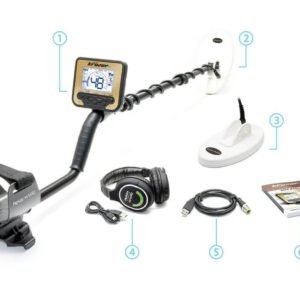
Machines like the Reflex G6 and G10 available from UK Metal Detectors handle mineralised UK soil well. Their 19kHz operating frequency and strong iron audio performance give you the ability to hear iron signals without digging every single one.
That matters in Wales, where iron-contaminated soils throw up dense ferrous signals alongside the occasional good find. The metal detector discrimination guide covers iron-heavy detecting conditions in detail, and everything in it applies directly to Welsh farmland.
Small alluvial gold is a low-conductivity, small-mass target. Standard farmland machines operating at 6 to 15kHz often fail to register fine gold reliably in mineralised river gravel.
Professional high-frequency gold detector machines from OKM, GER, and Geoground, all available from UK Metal Detectors, are purpose-built for exactly these conditions. This is not a case where a general-purpose machine gets you close enough. Alluvial gold prospecting in Welsh river gravel requires a purpose-built machine.
Wales’s density of known historical sites, and the depth at which significant objects can sit in undisturbed ground, makes long-range capability relevant for serious prospectors working specific areas.
The long-range detector systems covered in the long-range metal detectors guide offer depth and coverage that standard VLF machines cannot match on this type of work.
The sensible middle
The permission process follows the same structure as England. Private land needs written agreement from the landowner and tenant. NCMD membership provides the insurance most landowners require. A written Search Agreement using the NCMD template is strongly recommended.
A couple of Wales-specific points are worth knowing before you approach anyone.
Many rural landowners in north and mid Wales are Welsh-speaking. A cold-call approach in English, with no awareness of the local community, can land poorly not because of the detecting, but because of how the approach feels.
Taking time to understand the local context before you knock on a door makes a real difference. It signals respect, and respect is what opens gates.
Wales runs its own agri-environment scheme, Glastir, with different conditions from the English Countryside Stewardship scheme. If the land you want to detect on is enrolled in Glastir, specific conditions may apply, including mandatory PAS recording of finds.
Always ask the landowner whether their land carries an agri-environment agreement before you start. For a full guide to the permission process, the metal detecting permission guide covers every step.
| Topic | Wales-Specific Detail |
| Scheduled Monuments authority | Cadw (not Historic England) |
| Scheduled Monument consent | Section 60, Historic Environment (Wales) Act 2023 |
| Number of scheduled monuments | Over 4,000 |
| PAS Wales | PAS Cymru via Amgueddfa Cymru and Welsh Archaeological Trusts |
| Treasure reporting (Wales) | Local coroner, via FLO or direct to Amgueddfa Cymru |
| SSSIs and SACs | Consent from Natural Resources Wales required |
| National Parks | Eryri, Pembrokeshire Coast, Bannau Brycheiniog permission unlikely on NPA land |
| Gold geology | Dolgellau Gold Belt, Gwynedd; Dolaucothi, Carmarthenshire |
| Key gold rivers | Afon Mawddach and tributaries (riparian and Crown Estate permission required) |
| Agri-environment scheme | Glastir check conditions before detecting on enrolled land |
| NCMD membership | Required for insurance, same as England |
The serious choice

Professional gold and coin detector, strong on difficult ground.
£599.99£699.99Save £100
Add to basketFull detailsIn stock
Wales is one of the most interesting detecting destinations in the UK. It is also one where arriving unprepared is genuinely costly in wasted time, in missed finds, and potentially in legal problems.
The legal framework is distinct from England. The soil will challenge a standard machine. The gold is real but requires the right equipment and the right permissions from the right people.
Detectorists who arrive with all of that sorted will have sessions that simply are not replicable anywhere else in the country.
Welsh ground can quickly expose the limitations of the wrong detector. Mineralised soil, challenging terrain, and gold-bearing areas demand the right machine and the right settings if you want the best results.
Whether you’re searching farmland for historic finds or heading to the Dolgellau Gold Belt to prospect for gold, our experts will help you choose the right detector, recommend the best settings, and make sure you’re fully prepared before your trip.
Contact our team today for expert advice on the best detector for your Welsh detecting adventure.
Yes, metal detecting is legal in Wales on private land with the landowner’s written permission. NCMD membership and insurance requirements are the same as in England. The main difference is that Scheduled Monuments are protected under the Historic Environment (Wales) Act 2023 and managed by Cadw. Detecting on a scheduled monument without Cadw’s written consent is a criminal offence, so always check the Cadw register before visiting a new site.
Yes. Wales is home to the only significant gold-bearing geology in the British Isles, mainly around the Dolgellau Gold Belt in Gwynedd. You can also search for alluvial gold in the Mawddach catchment with the correct landowner permission and an appropriate high-frequency gold detector. Gold artefacts from Celtic, Roman, and medieval periods have also been discovered on Welsh farmland.
Cadw is the Welsh Government’s historic environment service and is responsible for protecting Scheduled Monuments in Wales. If you’re planning to detect near a historic site, Cadw is the authority you need to check. Detecting on a Scheduled Monument without written consent is a criminal offence, and permission is rarely granted for recreational detecting.
The best places to metal detect in Wales are private farmland with the landowner’s written permission. Popular areas include Anglesey, Pembrokeshire, the Vale of Glamorgan, and the Welsh Marches. River prospecting in the Mawddach catchment requires separate permission from the riparian landowner, while National Park authority-owned land and Scheduled Monuments are generally off limits to hobby detectorists.
The best metal detector for Wales is one with manual ground balance and strong performance in mineralised soil. Welsh ground contains high levels of iron minerals, which can create false signals on basic detectors. If you’re planning to prospect for gold around the Mawddach catchment, you’ll also need a specialist high-frequency gold detector.
Not sure which of these suits the ground you search? Tell us where you detect and we will point you at the right one, including the cheaper one when that is the honest answer. We use these machines ourselves.