
On this page
There’s a moment most UK detectorists will recognise. You’re on a permission you’ve been looking forward to, the ground looks promising, and your detector is chattering constantly, firing signals that lead nowhere, then going suspiciously quiet exactly where you’d expect a target. Meanwhile, the person twenty metres away in the same field is pulling coins cleanly and consistently. Same ground, different results. Nine times out of ten, the difference comes down to one setting: ground balance.
It’s the single most impactful calibration on a metal detector that beginners overlook and experienced detectorists still sometimes get wrong. It’s not complicated once you understand what it’s actually doing, and once you do, everything else about your machine starts to make more sense, too. This guide explains what metal detector ground balance is, why UK soil makes it more critical here than almost anywhere else, how the different types work in practice, and how to set it correctly step by step. No jargon, no assumed knowledge, just a clear explanation of one of the most useful things you can learn about the machine in your hands.
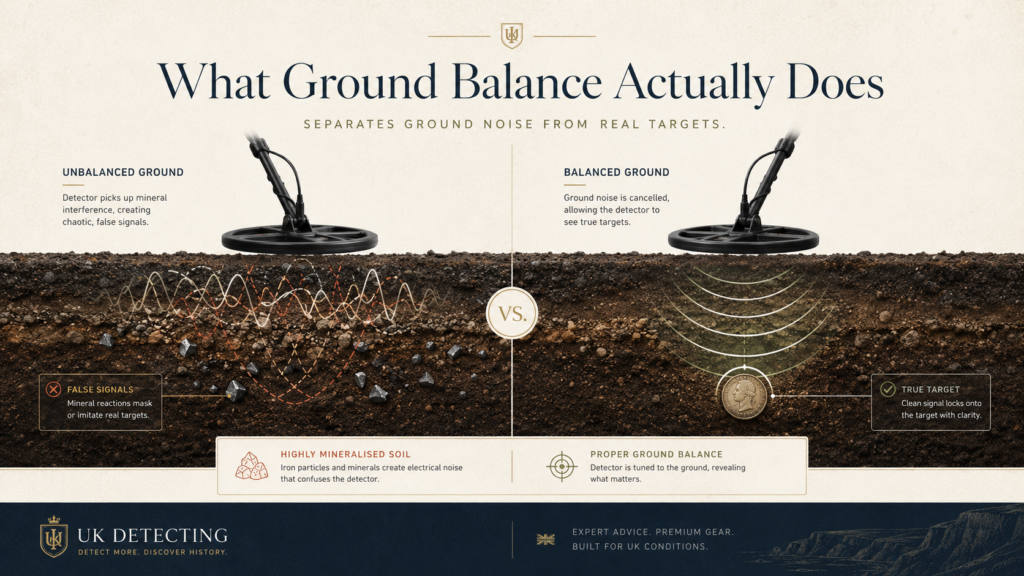
UK soil is not neutral. It contains naturally occurring minerals, iron oxides, magnetite, salt particles, and limestone compounds that have been present in the ground for millennia. The problem is that these minerals respond to a detector’s electromagnetic field in almost exactly the same way a buried metal target does. Without any correction for this, your detector treats the entire ground as one enormous, constant signal. Every swing produces noise, false alerts fire continuously, and real targets disappear into a wash of mineral interference.
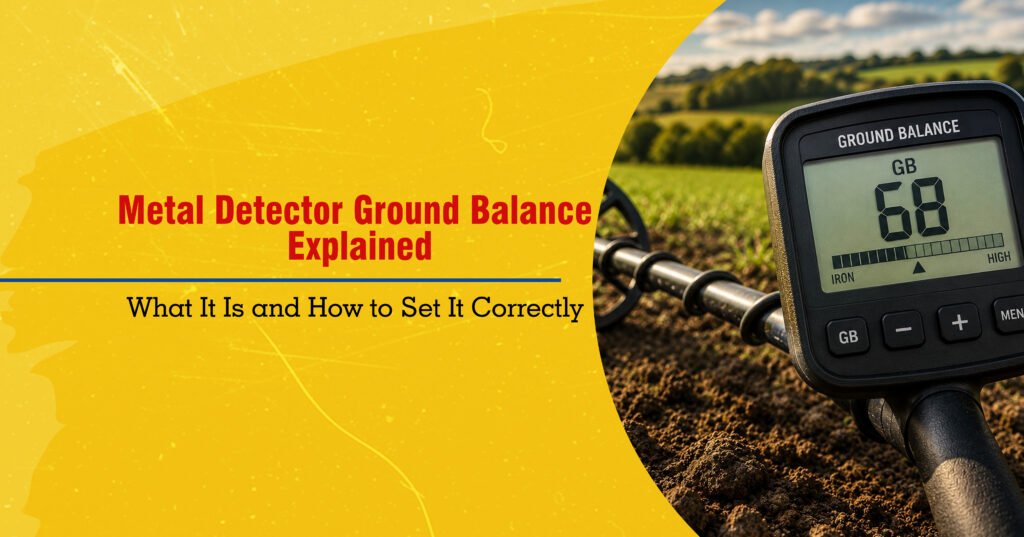
Metal detector ground balance is the process of calibrating your detector to recognise the specific mineral signature of the ground you’re searching and then instructing it to ignore that signature, so only genuine metal targets trigger an alert. Think of it as teaching the detector the difference between “this is what the soil sounds like here” and “this is what a coin sounds like here.” Once that distinction is made, the detector runs quietly between targets, responds cleanly over real finds, gives accurate target ID readings, and reaches its maximum possible depth for the conditions.
“Metal detector ground balance is a calibration setting that tells your detector what the soil’s natural mineral signals sound like, so it can ignore them and focus only on genuine buried metal targets.”
The depth impact alone is worth taking seriously. In heavily mineralised soil, a poorly balanced detector might achieve an effective detection depth of 8–10cm on a coin-sized target. The same detector, properly balanced, can reliably reach 20–25cm or more on the same target in the same ground. That’s not a marginal improvement; it’s the difference between finding the coin and walking straight over it.
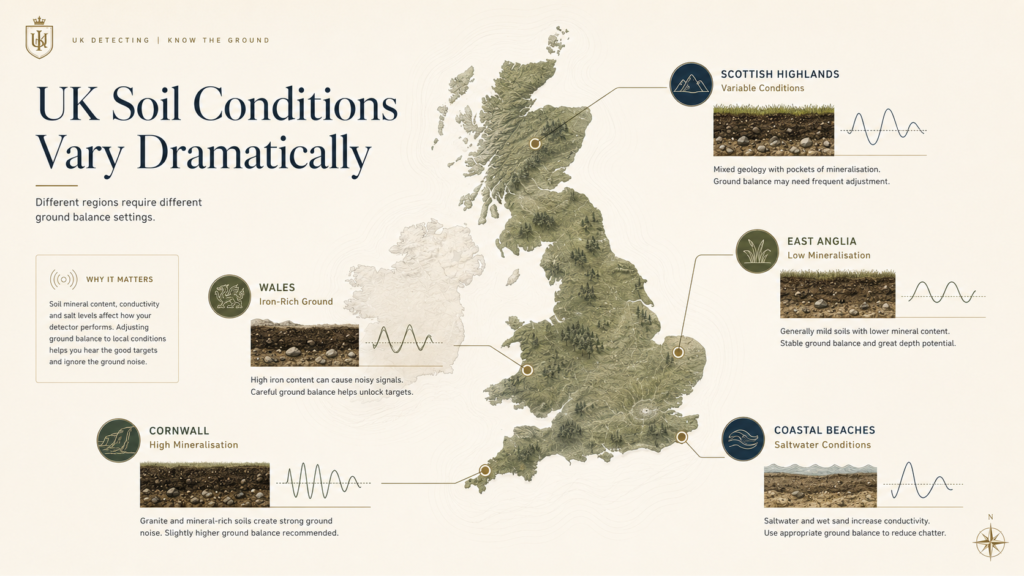
The United Kingdom sits on some of the most geologically varied land in Europe, and the British Geological Survey maps this variation in detail. Within a relatively small country, you have the heavily mineralised granite-based soils of Cornwall and Devon where centuries of tin and copper mining have left iron and sulphide compounds throughout the topsoil the red iron-oxide-rich soils of the Welsh and Scottish uplands, the salt-saturated wet sand of coastal beaches across all four nations, the relatively forgiving loamy arable soils of East Anglia, the moisture-retaining clay of the Midlands, and the alkaline chalk and limestone downland of Wiltshire and the Yorkshire Wolds. Cranfield University’s national soil classification, maintained through the LandIS database, documents exactly how dramatically these soil types differ, and each presents a genuinely different challenge for a detector’s ground compensation system.
Cornwall and Devon sit at the difficult end of the spectrum. The county’s granite geology and historic mining activity have left iron-rich mineral compounds in the topsoil across large areas, producing ground noise that pushes VLF detectors hard regardless of how carefully they’re balanced. Wales presents a related challenge: the red iron-oxide soils of mid and north Wales, particularly around the gold-bearing Dolgellau region, require deliberate management. The Scottish and northern English uplands bring variable iron content in peaty, acidic soils that can shift significantly within a single session as you move from drier, elevated ground to wetter, lower terrain. East Anglia, by contrast, is the UK’s most detector-friendly region, with low mineralisation in the light arable soils of Norfolk and Suffolk is part of why these counties consistently produce the highest numbers of PAS-recorded finds. UK beaches present their own specific problem: salt mineralisation from wet sand creates a type of interference that standard inland ground balance settings simply don’t address, which is exactly why dedicated beach modes exist as a separate calibration entirely.
The practical takeaway is this: the UK is one of the richest metal detecting destinations in the world archaeologically, and one of the most challenging geologically. Getting ground balance right is the difference between making the most of that richness and spending your day fighting your own machine.
Preset ground balance ships from the factory with a fixed value already set, calibrated for what the manufacturer defines as average soil conditions. The user adjusts nothing. For genuinely low-mineralisation UK ground, East Anglian farmland, well-drained parkland, and typical inland grassland, it works reasonably well, particularly for beginners not yet ready to navigate additional settings. The limitation becomes clear fast anywhere else. Cornwall’s highly mineralised granite soils sit far outside the factory’s “average,” and wet saltwater beach sand is in a different category entirely. On these ground types, a preset detector will false continuously, lose significant depth, and give unreliable target IDs, not because it’s a poor machine, but because preset balance has no means of adapting to actual conditions. It’s typically found on entry-level detectors: fine for getting started, genuinely limiting once you move to more challenging terrain.
Automatic ground balance uses a microprocessor to read the mineral content of the soil and set the balance value accordingly. Most mid-range and above detectors offer it. The process takes a few seconds: hold the coil over a clean patch of ground with no metal beneath it, press the ground balance button, keep the coil still while the detector samples the soil, and the machine calculates and applies the correct balance point automatically. For most UK detectorists in most conditions, this is the practical sweet spot: fast, accurate, and significantly more appropriate for the UK’s varied soil than a fixed factory value. The important nuance is that it sets a value at the moment of calibration. If soil mineralisation changes significantly as you move across a large farm, a common problem on UK farmland that crosses multiple soil types, the value set at the gate may be meaningfully wrong by the time you reach the far end of the field. That’s a reason to recalibrate periodically, not a reason to avoid automatic balance altogether.
Manual ground balance gives the detectorist direct control over the balance point, a numerical value displayed on screen that the user adjusts to match the specific soil conditions at their feet. Done correctly, it produces the most precisely calibrated result of any balance type, tuned exactly to the actual ground rather than to a microprocessor’s interpretation of it. The technique involves the pumping method: raise the coil 6–8 inches above the ground, lower it to within a few centimetres of the surface, and repeat in a steady rhythm while listening to the threshold tone. The correct setting is the one at which the threshold hum stays completely flat through the pumping motion, neither rising as the coil approaches the ground nor falling as it’s raised. A rising tone signals the balance is set too high; a falling tone means it’s too low. Manual balance takes practice but adapts precisely to conditions at any point in a session. For beginners, automatic is perfectly adequate. Manual earns its place on challenging terrain in the hands of someone who’s taken the time to get comfortable with it.
Tracking ground balance continuously adjusts the balance value in real time as the coil moves across changing soil. It’s the most adaptive system available, excellent for large areas with variable mineralisation and particularly effective for beach detecting, where the transition between wet and dry sand creates rapidly shifting conditions within a short walk. The trade-off is that tracking systems can sometimes interpret a stationary buried target as a soil signal and attempt to balance it out. Most detectors with tracking mode allow it to be switched to manual or automatic when investigating a specific signal in detail, a good habit when you need accurate target characterisation before committing to a dig.

The affordable option
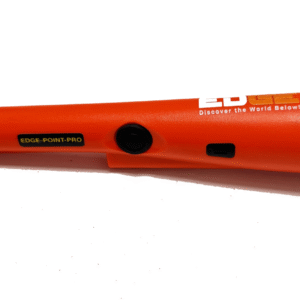
Pinpointer. Finds the target in the hole instead of the spoil.
£49.95£69.99Save £20.04
Add to basketFull detailsIn stock
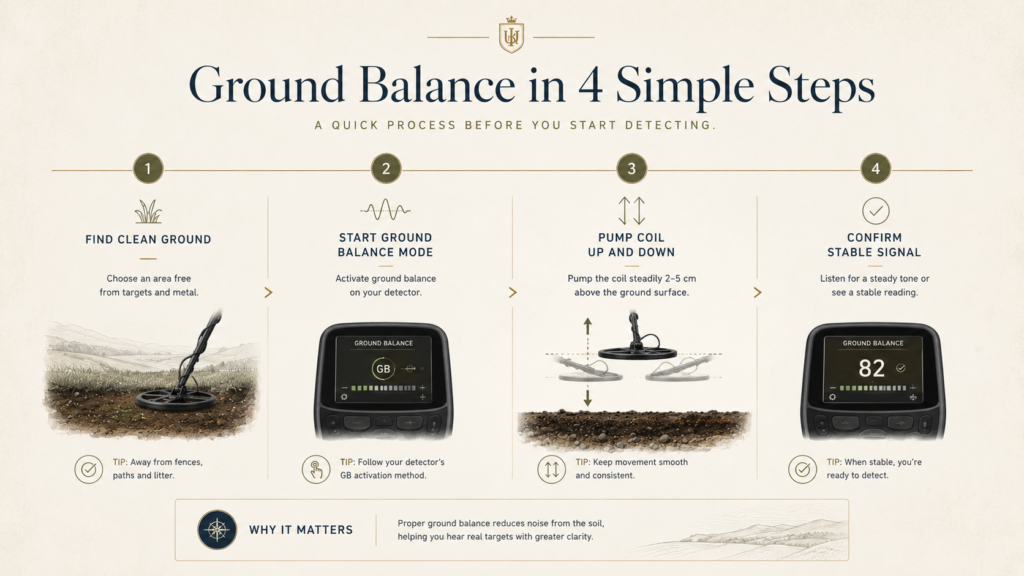
The process takes under a minute and should happen at the start of every session without exception. First, find a patch of ground with no metal beneath it, move a metre or two away from gates, fences, vehicles, or any known iron contamination, all of which will skew the reading. Hold the coil level, approximately 2–3cm above the surface. Press and hold the ground balance button location varies by model, so check your manual the first time, and keep the coil still while the detector samples. Most machines indicate completion with a tone or a settling value on screen. Re-balance at the start of every new session, whenever you move to a noticeably different soil type, whenever you switch frequency or mode, and any time excessive false signals appear after a period of stable running.
Enable the threshold tone first; you need to hear the background hum clearly to set manual balance accurately. Find a metal-free patch of ground, then begin pumping the coil: raise it 6–8 inches, lower it to 2–3cm, and repeat in a steady rhythm. Listen carefully to the threshold tone throughout. If it rises as the coil approaches the ground, reduce the balance value. If it drops, increase it. Adjust incrementally and repeat until the tone stays completely flat through the full pumping motion. That’s the correct balance point.
Calibrating over ground that already has metal in it. A buried nail, a bottle cap, or a length of wire beneath the calibration spot will distort the reading sometimes significantly enough to make the resulting balance point actively counterproductive. If the detector seems unstable immediately after calibration in conditions where you’d expect it to run cleanly, move two metres, find a fresh patch of ground, and recalibrate. It takes thirty seconds and solves the problem far more reliably than adjusting sensitivity in response to what is fundamentally a calibration issue.
Not Sure if Your Detector Has the Right Ground Balance System for UK Conditions?
Choosing a machine with the correct ground balance capability for the soil you’ll be searching is one of the most important and most commonly overlooked decisions in the buying process. Whether you’re researching your first detector or thinking about upgrading, our team can advise on exactly which machines handle UK ground conditions most effectively.
Get in touch with our team for honest, expert advice and guidance tailored to your needs with no pressure and no obligation.
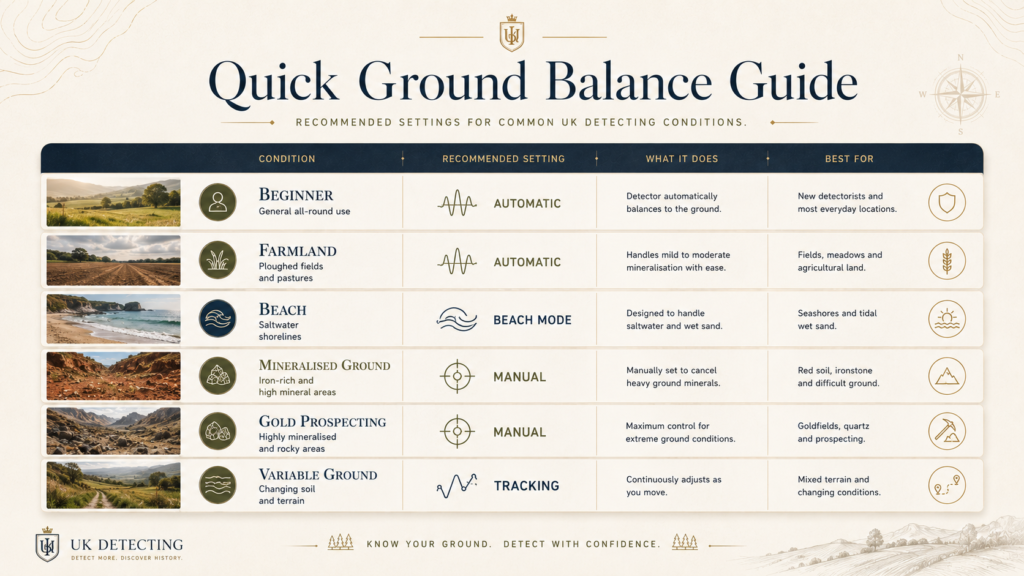
For most UK detectorists in most conditions, automatic is the right choice. It’s fast, accurate enough for the majority of detecting scenarios, and requires no prior experience. Setting it takes fifteen seconds and produces results that are genuinely close to optimal across most of England’s farmland. If you’re getting started or if your regular detecting is on typical arable or grassland permissions, automatic balance will serve you well without any additional effort.
Manual balance earns its place in specific conditions. On highly mineralised ground, Cornwall, the Welsh uplands, the Scottish Southern Uplands, it gives experienced detectorists the ability to fine-tune beyond what the microprocessor will choose, producing a quieter threshold and better depth on targets that the automatic-balanced detector was starting to mask. On beaches, manual balance combined with a dedicated beach mode allows deliberate adjustment for the specific mix of wet salt and dry sand mineralisation that switching between tidal zones creates — a calibration set on dry sand drifts out of tune quickly once you start working the wet foreshore. For gold prospecting, whether in Welsh rivers or the gold-bearing streams of the Scottish uplands, manual balance is almost always preferred, because automatic systems can sometimes treat the tiny signals fine gold produces as mineralisation rather than target response.
| Situation | Recommended Type |
| Beginner, any UK terrain | Automatic |
| East Anglian farmland, low mineralisation | Automatic or preset |
| Beach detecting | Automatic + dedicated beach mode |
| Cornwall / Welsh uplands / Scottish highlands | Manual (experienced users) |
| Gold prospecting | Manual |
| Large farm with variable soil | Tracking, or recalibrating automatically regularly |
The sensible middle

Golden Mask 32×28cm DD coil. Light for its size, with good ground coverage.
£129
Add to basketFull detailsIn stock
The decision guide above gives you the framework. What follows applies it to the specific situations that UK detectorists actually encounter, the scenarios where getting ground balance right, or wrong, makes the most tangible difference to what you come home with.
Wet salt sand is electrically conductive; it behaves less like a magnetic iron particle and more like a large flat sheet of conductive material beneath the coil. VLF detectors struggle with this because conductive wet sand can register as a non-ferrous target rather than ground noise, producing false signals that look, on the target ID display, exactly like good finds. The correct approach is a machine with a dedicated beach or saltwater mode that handles salt compensation differently from inland mineral compensation. Pulse Induction detectors largely bypass the salt problem entirely, which is one of the core reasons PI machines are taken seriously for regular UK beach use. The pulse induction metal detectors guide covers in detail how this technology handles difficult ground conditions.
Large UK farm permissions often cross multiple soil types within a single field. Ridge-and-furrow medieval field systems create micro-variations in topsoil depth and composition that can shift the optimal ground balance point meaningfully. Calibrating once at the gate and detecting for three hours without rebalancing is one of the most common reasons detectorists start missing targets in the second half of a session. Re-calibrate every time the threshold starts destabilising, every time you move to a clearly different area of ground, and automatically after switching mode or frequency. For guidance on UK locations and what ground conditions to expect by region, the best places for metal detecting in the UK guide covers this, alongside permission advice.
In Cornwall, large parts of Wales, and the Scottish uplands, mineralisation is severe enough that it genuinely exceeds what some VLF detectors can manage, regardless of how carefully they’re balanced. Switching to a multi-frequency machine or a pulse induction detector in these conditions isn’t a last resort; it’s the appropriate tool for the job. Detectorists who regularly work this ground typically own a machine specifically chosen for high-mineralisation performance, or run with reduced sensitivity and slower sweep speeds to manage the increased ground noise.
Soil moisture significantly affects mineralisation response. Wet soil is more electrically conductive than dry soil. The same field reads differently in January after a month of rain than it does in August after two dry weeks. If your detector seems noisier than usual after wet weather in an area where it normally runs stably, the answer is to recalibrate, not to adjust sensitivity or discrimination. The ground balance point has shifted because the soil has. This is the detector responding correctly to a genuine change in conditions.
The most obvious sign is a detector running noisily between targets, constant chattering, random signal bursts, and audio that fluctuates even when the coil is held still. Move to a clean patch of ground and recalibrate from scratch rather than reaching for the sensitivity control first. Reducing sensitivity in response to mineralisation-driven noise treats the symptom rather than the cause and costs you depth in the process.
If your detector consistently gives target ID readings that don’t match what you’re digging iron appearing as non-ferrous, or silver-range targets reading too low, incorrect ground balance is a common and overlooked cause. Mineralisation interference distorts the phase response that the detector uses to generate IDs. Recalibrate first. If the problem persists in a specific area, the ground mineralisation at that location may be high enough to challenge the discrimination system, regardless of the balance point a known limitation of VLF detection in severe mineralisation.
A detector finding targets significantly shallower than it should for its sensitivity setting is often experiencing ground balance drift rather than a mechanical issue. Over a long session in variable soil, a calibration set two hours earlier may be meaningfully wrong for where you currently are in the field. Recalibrate and test on a known target if you have one.
The serious choice
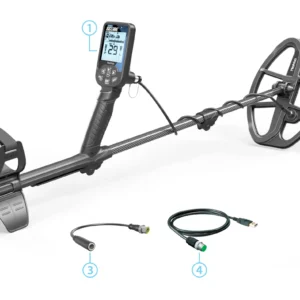
The practical value of everything in this guide depends partly on the detector in your hands, specifically, what ground balance options it actually offers. Understanding the difference between balance types is useful; being able to use the right type for the ground you’re searching requires that your machine actually has it.
Entry-level detectors typically offer preset balance only, fine for low-mineralisation UK ground, genuinely limiting for beach work or any of the more challenging soil environments across the UK. If you know from the outset that you’ll be detecting on beaches, in Cornwall, or in Wales, budgeting to a level that includes automatic ground balance makes an immediate and tangible difference. Mid-range detectors almost universally include automatic balance, and many include manual as well. This covers the majority of UK detecting scenarios effectively and is where the capability-to-cost balance sits most comfortably for most people. Professional and advanced machines include all types alongside tracking balance, dedicated beach or saltwater modes, and multi-frequency operation that significantly reduces the impact of mineralisation compared to single-frequency VLF. For regular detecting in the UK’s higher-mineralisation regions, a machine at this level changes the experience noticeably.
Ground balance capability, which type of detector offers, how it handles specific UK mineralisation, and whether it includes a beach mode, is one of the most worth-asking questions most worth asking before purchasing and one of the most commonly overlooked. Our team at UK Metal Detectors are happy to talk through which machines suit which conditions and detecting styles, without pressure toward any particular option.
| Ground Balance Type | Best For | Skill Level | Limitation |
| Preset / Fixed | Low mineralisation UK ground, beginners | Beginner | No adaptability is poor on beaches and mineralised ground |
| Automatic | Most UK farmland, arable fields, and parks | Beginner–Intermediate | The single calibration point needs resetting as conditions change |
| Manual | Highly mineralised ground, gold detecting | Intermediate–Advanced | Requires practice to set accurately |
| Tracking | Beach detecting, large variable sites | Intermediate–Advanced | Can balance out stationary targets if overactive |
Ground balance isn’t complicated once you understand what it’s doing, and once you do, it changes how you approach every session. The chattery, unstable detector that spends the morning misfiring isn’t broken. It’s miscalibrated. The fix takes thirty seconds at the start of the session and produces a machine that runs the way it was designed to: quietly between targets, cleanly on genuine finds, and deeply enough to reach things you’d otherwise walk straight over. If you’re unsure whether your current detector’s ground balance system suits the UK ground you actually detect on, or you’re choosing your first machine and want honest advice on which systems handle British soil conditions most effectively, our team at UK Metal Detectors is happy to help.
Get the Right Detector for UK Ground Conditions.
Ground balance capability varies significantly between machines, and choosing the wrong system for the soil you’re searching costs you depth, accuracy, and finds. Our team understands UK soil conditions and can match you with the right detector for your specific terrain, targets, and experience level.
Talk to our team today for honest, expert advice and personalised recommendations no pressure, just helpful guidance.
1. What is ground balance on a metal detector?
Ground balance is a calibration setting that tells your metal detector what the natural mineral signals in the soil sound like, so it can filter them out and only alert you to genuine buried metal targets. Without it, soil minerals trigger constant false signals, reduce detection depth, and cause inaccurate target identification.
2. How do I ground balance a metal detector?
For automatic: hold the coil over clean, metal-free ground and press the ground balance button for a few seconds while keeping the coil still. For manual: pump the coil up and down 6–8 inches above clean ground while adjusting the balance value until the threshold tone stays completely flat through the motion.
3. What is the difference between manual and automatic ground balance?
Automatic uses a microprocessor to set the balance value at the press of a button, fast, easy, and accurate enough for most UK conditions. Manual lets you set the value precisely yourself through the pumping technique, giving more control in challenging or highly mineralised soil. Most experienced detectorists use automatic for everyday farmland and manual for beaches, mineralised ground, and gold detecting.
4. How often should I re-ground balance my metal detector?
Re-balance at the start of every session on new ground, whenever you move to a noticeably different soil type, after switching mode or frequency, and any time the detector starts running noisily after a period of stability.
5. Does ground balance matter on UK beaches?
Significantly. Wet saltwater sand is highly mineralised with salt compounds that affect VLF detectors differently from iron-based inland mineralisation. Most beach detectors include a dedicated beach or saltwater mode for this reason. Pulse induction detectors handle salt mineralisation particularly well and are a strong option for regular UK beach detecting.
Not sure which of these suits the ground you search? Tell us where you detect and we will point you at the right one, including the cheaper one when that is the honest answer. We use these machines ourselves.