


On this page
Most detectorists put their machine away in November. They assume the hobby stops when the weather turns, the days shorten, and the fields look grey and uninviting. What they do not know is that the detectorists who keep going through those months are often having the most productive sessions of their entire year.
Metal detecting in winter UK is not a compromise. For anyone who understands why it works, it is the season to prioritise. This guide explains exactly why, what adjustments to make, what to wear, and which equipment choices separate a comfortable, productive winter session from a cold, frustrating one.
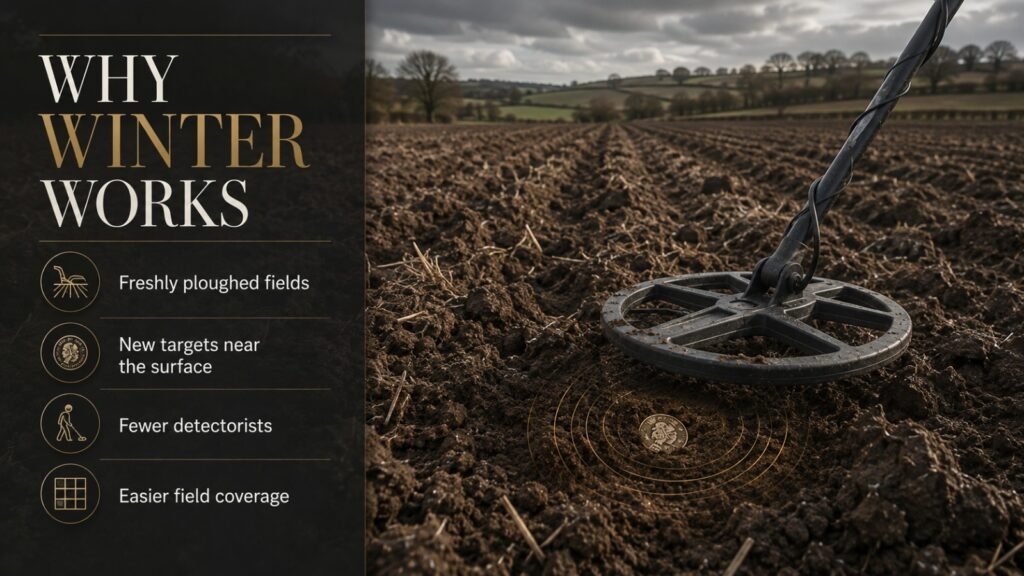
Here is the counter-intuitive truth about metal detecting in November and December in the UK. While the majority of hobbyists are storing their machines and waiting for spring, experienced detectorists are working freshly ploughed bare fields with nobody else on the ground, systematically covering the most accessible detecting terrain of the entire calendar year.
The reason comes down to what farmers are doing between September and December. Ploughing season across most of UK arable farmland runs through this exact window. A plough turns over 20 to 30 centimetres of topsoil, lifting material that has sat below detection range for potentially decades back within reach of a standard machine. Coins that were simply too deep to register in August can sit at 10 centimetres in November after a single pass of the plough. This cycle repeats every year, which is exactly why experienced detectorists on established farmland permissions return to the same fields every autumn knowing the ground has refreshed since their last visit.
The competition argument is equally compelling. Fair-weather detectorists outnumber committed winter ones by a significant margin. Sites that see multiple people across a summer weekend are often completely empty on a cold November Tuesday. Permission sites that feel heavily searched by October become productive again when the plough goes through, and the fair-weather crowd stays home. Less competition on already-permitted ground is one of the most underrated advantages in UK detecting, and winter is when that advantage is at its most significant.
Bare crop-free fields also allow proper systematic coverage in a way that summer grassland and growing crops simply do not permit. In winter, a detectorist can walk clean parallel lines across an entire arable field, ensuring genuine full coverage rather than the broken, crop-constrained search that summer forces. Systematic coverage is how productive fields get properly worked rather than casually searched.
One more thing worth saying upfront: UK winters are mostly wet rather than frozen. Genuinely frozen solid ground that prevents digging occurs only in the coldest spells, typically during January and February, and usually for days rather than weeks. The rest of the November to March window involves cold, wet, entirely workable ground. The real challenge of winter detecting in the UK is mud rather than frost.
This guide would lose credibility without acknowledging the genuine limitations of winter detecting. There are conditions where going out is not worth it.
If the topsoil is frozen solid, detecting still works but digging does not. There is no practical benefit in getting a clean signal over ground that physically cannot be excavated. Wait for two or three consecutive mild days after a cold spell, when the surface has softened enough to work cleanly.
Immediately after heavy, sustained rain is another scenario worth avoiding. Waterlogged ground creates erratic mineralisation readings that destabilise target identification and produce constant false signals even on well-calibrated machines. Waiting 24 hours after heavy rain for drainage makes an enormous difference. The ideal winter detecting ground is damp rather than saturated. Damp soil with good drainage actually improves signal response compared to bone-dry summer conditions because moisture increases soil conductivity. The sweet spot is damp, well-drained farmland rather than either dry summer soil or waterlogged clay.
Daylight hours are a genuine practical constraint from November through January. Planning sessions to start between 9 am and 10 am when any surface frost has had time to soften gives maximum useful detecting time before daylight runs out. Finishing before dusk is a basic practical and safety requirement rather than a preference.
Post-ploughing arable is the reason experienced detectorists value winter so highly. Freshly turned soil, bare ground for clean systematic coverage, and a full growing season’s worth of material refreshed at detectable depth make arable farmland the most productive winter location by a considerable margin. This is where metal detecting in winter UK genuinely outperforms summer detecting in terms of consistent finds. For a full guide to which UK regions produce which types of finds and why arable farmland is where the most significant UK coin discoveries consistently come from, the best places for metal detecting in the UK covers every major area in detail.
Crown Estate foreshore beaches take on a different character in winter. Storm activity between October and March erodes the beach profile, shifts sand layers, and exposes material that has been buried for months or years under stable summer sand. The beaches are completely empty of holiday visitors, and the items dropped by summer crowds have had a full season to settle to detectable depth. Winter beach detecting requires a waterproof coil without exception; wet sand, sea spray, and occasional shallow water work are constant features of any serious beach session in winter.
Permanent grassland is not ploughed, but winter rain softens the turf and makes target recovery noticeably cleaner than the hard, root-bound summer ground. Well-preserved items in unploughed pasture tend to survive in better condition than their ploughed counterparts, and the wet winter ground makes digging them out considerably easier than wrestling with compacted summer turf.

The affordable option

All rounder with full discrimination control. Inland, beach and parks.
£149.95£199.95Save £50
Add to basketFull detailsIn stock
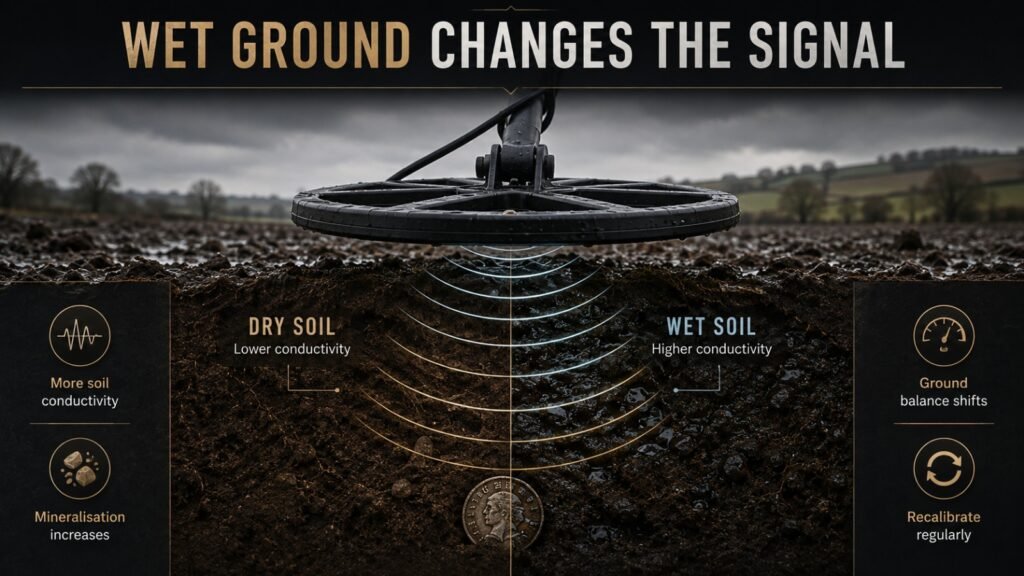
Wet soil is more electrically conductive than dry soil. The same field reads genuinely differently in January after a month of rain than it does in August after two dry weeks. This is not a problem with the detector, and it is not a malfunction. It is the machine responding correctly to a real change in what is beneath the coil.
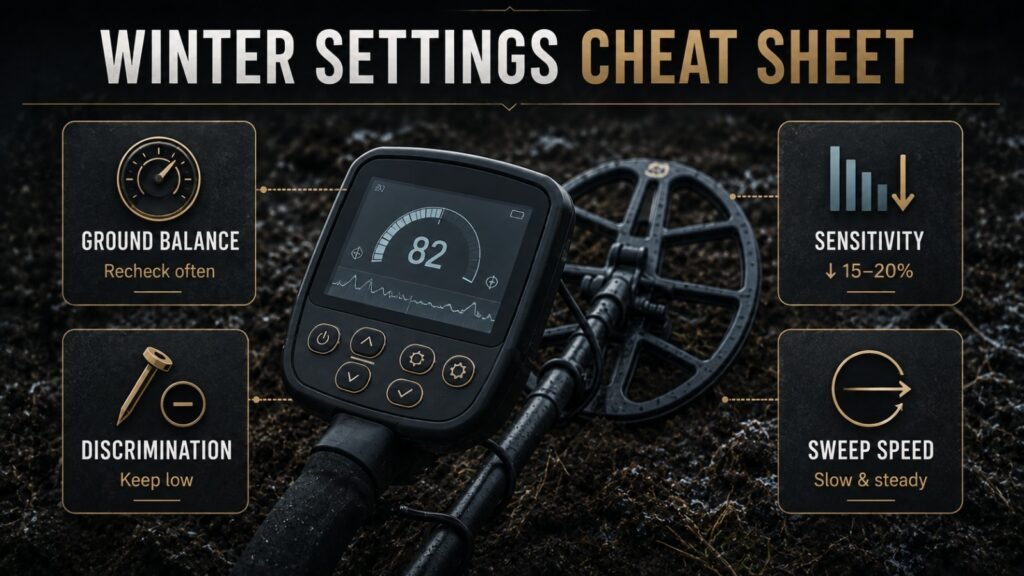
The practical implication is that the ground balance setting that worked in October will be wrong by December after sustained rain. Recalibrating at the start of every winter session is essential, and recalibrating mid-session again when the detector starts running noisier than it was an hour earlier is equally important. That increase in instability is a reliable sign that the ground balance point has shifted as soil moisture has changed across the field.
The iron-rich mineralisation present in most UK farmland also becomes more pronounced when the soil is wet. Standard preset ground balance on entry-level machines struggles more in wet winter conditions than it does on the same field in summer. This is one of the genuine practical reasons why winter detecting rewards a machine with proper automatic or manual ground balance control rather than a fixed factory setting.
Metal detector electronics themselves are not significantly affected by cold temperatures. The detection capability, signal processing, and discrimination functions work the same in January as they do in July. What changes is battery performance and the physical challenge of occasional frost-hardened topsoil. Everything else functions normally.
Recalibrate at the start of every session. In winter conditions, recalibrate again whenever the machine starts running noticeably noisier than earlier in the same session. On a large farm permission that crosses multiple soil types, recalibrating two or three times across a full winter day is entirely normal and worthwhile. The metal detector ground balance guide covers the full process of calibrating correctly for wet UK ground conditions, including when automatic balance is sufficient and when the manual pumping technique produces better results.
Maximum sensitivity in wet winter farmland amplifies mineral noise alongside target response, producing a machine that chatters and falses more than it should. Reducing sensitivity by roughly 15 to 20 percent from summer settings produces a cleaner, more stable signal environment without meaningfully reducing detection depth on real targets. Real targets still register. Mineral chatter reduces. The session becomes more interpretable.
The case for running low discrimination on UK farmland applies even more strongly in winter. Post-ploughing bare fields are exactly the conditions where historically interesting finds appear at freshly accessible depths. Running aggressive discrimination to minimise digging on winter ground means missing the coins the plough has just brought within range. Iron-only rejection and dig everything else remains the right approach on productive winter farmland. The metal detector discrimination guide covers how to build a site-specific approach over multiple sessions without closing off the conductivity ranges where good UK finds consistently sit.
Wet ground absorbs the electromagnetic field slightly differently than dry ground, which means target response can be marginally softer in winter conditions. A slower sweep gives the machine more processing time over each signal. The summer advice to slow down and overlap each pass applies even more strongly through the winter months.
The sensible middle

Improved screen and more stability on mixed ground.
£275£449.99Save £174.99
Add to basketFull detailsIn stock
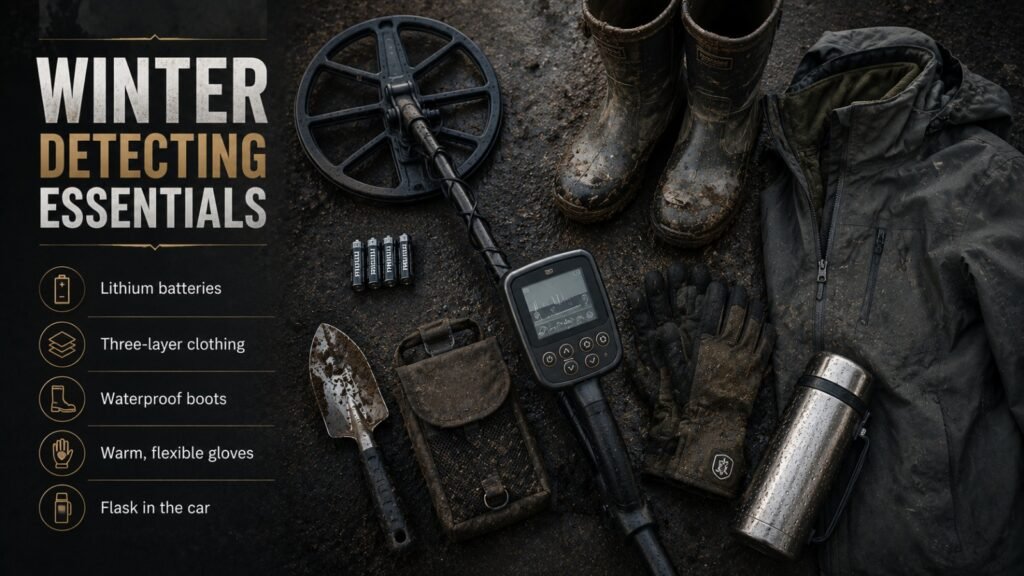
Cold weather is where the difference between lithium and alkaline batteries becomes practically significant. Alkaline batteries use a water-based electrolyte whose chemical reaction slows measurably in cold temperatures. A fresh alkaline AA battery that performs normally at room temperature delivers significantly less power at sub-zero temperatures and fades progressively through a cold outdoor session. Lithium batteries maintain stable performance in cold conditions, hold nearly full capacity through a winter session, and are substantially lighter than alkaline equivalents. For winter detecting sessions, switching to lithium AA batteries is the simplest and most immediate practical upgrade available. The higher upfront cost is easily justified by consistent full-session performance.
A moisture-wicking base layer moves sweat away from the skin during active detecting. A mid-layer fleece or insulated jacket retains warmth between signals and while recovering targets. A waterproof and windproof outer layer handles the persistent light rain and wind that characterise most UK winter detecting days. Hands are the critical point. Thin liner gloves under a windproof outer allow enough tactile sensitivity to handle the control box and evaluate small finds while keeping hands warm enough to continue through the session. Fully insulated gloves make operating the detector and examining finds properly difficult.
UK farmland in November and December is muddy. Waterproof boots with a sole that handles wet clay without slipping are worth getting right before the first winter session rather than discovering mid-field that trail shoes are not adequate. Ankle-height waterproof boots work well across most farmland conditions. Wellington boots handle the wettest ground but make walking long distances across fields uncomfortable over a full session.
This sounds trivial. It is not. A hot drink waiting in the car gives the session a genuine endpoint and a small reward for completing it. Experienced winter detectorists consistently mention the small practical comforts as what makes the difference between actually getting out and turning back at the field gate. For everything that goes alongside the detector in a winter kit setup, the metal detecting accessories guide covers pinpointers, digging tools, and finds pouches with honest assessments of what matters most in practical field conditions.
Is Your Current Detector Ready for Winter Ground?
Wet, mineralised winter farmland can expose the limits of a detector. If your machine struggles with ground balance, stability, or wet conditions, the UK Metal Detectors team can help you choose a detector that is better suited to winter UK detecting.
Get Advice on Choosing a Detector
Three specific characteristics separate machines that perform well in winter UK conditions from those that do not. A waterproof or water-resistant coil that handles wet sand and muddy farmland without degraded performance. A proper automatic or manual ground balance system that recalibrates accurately as soil moisture shifts across a session. And a sensitivity control that can be adjusted downward from maximum without losing meaningful target response in wet mineralised conditions.
The Reflex G6 and Reflex G10 are both consistently described by UK customers as stable performers in wet and mineralised farmland conditions. The G6’s 19kHz operating frequency and fast recovery speed suit the iron-heavy post-ploughing winter farmland environment particularly well. The G10’s improved stability in high-mineralisation conditions makes it the stronger choice for the wetter, clay-heavy farmland found across the Midlands and parts of northern England. Both machines have waterproof search coils that handle the persistent wet conditions of UK winter, detecting without concern.
The Golden Mask 7‘s four selectable frequencies become particularly practical in winter. The ability to drop to 4kHz for deeper Roman bronze on freshly ploughed historically productive sites, then switch to 14 or 24kHz for general coin hunting on typical farmland, covers the two most common winter farmland scenarios within a single machine. Its FX ground balance mode is built specifically for high-mineralisation and wet soils, which matters as moisture levels shift across a winter session, and the waterproof search coil together with the rain-resistant control block handle the persistent wet conditions of UK winter without requiring additional protection.
The serious choice
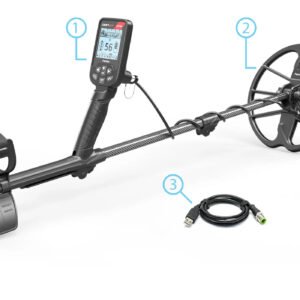
15 kHz, fully waterproof, light, with six search modes.
£299.95£349.95Save £50
Add to basketFull detailsIn stock
Post-ploughing winter farmland produces the same range of finds as any productive permission at any time of year: Roman coins, medieval hammered silver, Georgian copper, Victorian bronze. The advantage in winter is access. Material that was below detection range in August is now within reach after the plough has turned the soil. Experienced UK detectorists consistently make some of their best finds of the year in October and November specifically because of this.
Finds recovered from wet winter soil come out wetter and muddier than summer finds. Leave them dirty. Do not rub them on clothing or the grass. Place each find in a separate zip-lock bag with a note of approximate location and depth, and clean them at home using distilled water rather than tap water. Recording significant finds with the Portable Antiquities Scheme, managed by the British Museum, applies exactly as it does in any other season. Any find over 300 years old made of gold or silver must be reported to the local coroner within 14 days under the Treasure Act 1996.
Filling every hole completely is non-negotiable in winter. The NCMD Code of Conduct is clear on this, and it applies more importantly in winter, where an incompletely filled hole in soft wet ground can be a genuine hazard for farm animals. Avoid any field with established winter crops without explicit landowner confirmation that the field is accessible.
| Topic | Winter-Specific Detail |
| Best detecting window | October to February, with November and December particularly valuable on freshly ploughed arable land |
| Best time of day | 10 am to 2 pm; frost has softened, maximum daylight remaining |
| Why winter works | Post-harvest ploughing brings new material to detectable depth; no competition |
| Ground balance | Recalibrate at start of every session; repeat when machine becomes unstable |
| Sensitivity | Reduce 15 to 20 percent from summer settings in wet mineralised conditions |
| Batteries | Lithium AA batteries perform better than alkaline batteries in cold weather |
| Frozen ground | Wait for a mild spell; do not detect if ground cannot be dug |
| After heavy rain | Wait 24 hours for drainage before heading out |
| Clothing | Moisture-wicking base layer, insulating mid layer, waterproof outer layer |
| Coil requirement | Waterproof coil essential for wet farmland and beach winter conditions |
The detectorists who stop in November and pick up again in March miss the most productive detecting window of the year. The ones who keep going, adjust their settings, look after their batteries, dress properly, and target freshly ploughed farmland in October and November come home with the kind of finds that fair-weather sessions rarely produce.
Metal detecting in winter UK is not a consolation prize for not being able to go out in summer. It is the season that rewards the detectorists who understand it.
Ready for Winter Detecting?
Wet, mineralised winter farmland rewards detectors with proper ground balance control, waterproof coils and adjustable sensitivity. If you’re planning to detect through autumn and winter, the UK Metal Detectors team can help you choose a machine suited to UK ground conditions and your detecting style.
Get Help Choosing Your Winter Detector
Yes. Winter can be one of the best times for metal detecting in the UK, especially on freshly ploughed farmland. Ploughing can bring deeper coins and artefacts closer to the surface, while fewer detectorists are out searching. Damp but workable ground can also make digging easier than during dry summer conditions.
October to December can be particularly productive because many arable fields have been harvested and freshly ploughed. November and December are often ideal for searching bare farmland before winter conditions become too difficult. The best month still depends on local weather, crop cycles and when a field has been ploughed.
Yes, changes in soil moisture can affect how a metal detector responds to the ground. Very wet or mineralised soil may cause more instability and false signals on some machines. Re-ground-balancing before a session and reducing sensitivity slightly can help produce a more stable response.
Yes, but only with the landowner’s permission and when the field is suitable for detecting. Freshly ploughed, bare fields can be particularly productive because the soil has been turned and can expose previously buried targets. Avoid fields with growing crops or waterlogged or frozen ground unless you have confirmed that detecting is appropriate.
Wear a moisture-wicking base layer, an insulating mid-layer and a waterproof, windproof outer layer. Waterproof boots are important on muddy UK farmland, while thin gloves or liner gloves can keep your hands warm without making it difficult to operate the detector. Carrying spare gloves and a hot drink can also make longer winter sessions much more comfortable
Not sure which of these suits the ground you search? Tell us where you detect and we will point you at the right one, including the cheaper one when that is the honest answer. We use these machines ourselves.