
On this page
There’s a moment most detectorists remember forever. Not the big find itself, the sound right before it. That clean, repeatable tone that cuts through a field full of scrap and suddenly makes the entire day feel different.
Most people assume the secret is the detector. It usually isn’t. The real difference is almost always the ground beneath your boots.
The UK gives you an unfair advantage compared to almost anywhere else in the world. Roman occupation. Viking settlement. Medieval trade routes. Civil War battle movement. Centuries of farming layered over older farming. You can walk onto an ordinary-looking field in Norfolk and realise three different civilisations probably crossed it before breakfast.
That’s why the phrase best places for metal detecting UK doesn’t really mean “the richest county.” It means understanding what type of ground produces what type of finds, which places are genuinely worth your time, and which locations look promising until you spend six hours digging shotgun caps.
More than 23,000 finds were recorded with the Portable Antiquities Scheme in 2025 alone. And those are only the finds that were officially logged. The truth is, there are productive locations scattered across nearly every part of Britain if you know how to research properly and approach landowners the right way.
Some detectorists love beaches because they want modern jewellery and easy access. Others chase deep Roman history on ploughed farmland. Some spend years quietly working the same pasture permission because they know one untouched corner can outperform ten rally sites.
The land decides the game long before the coil touches the soil.
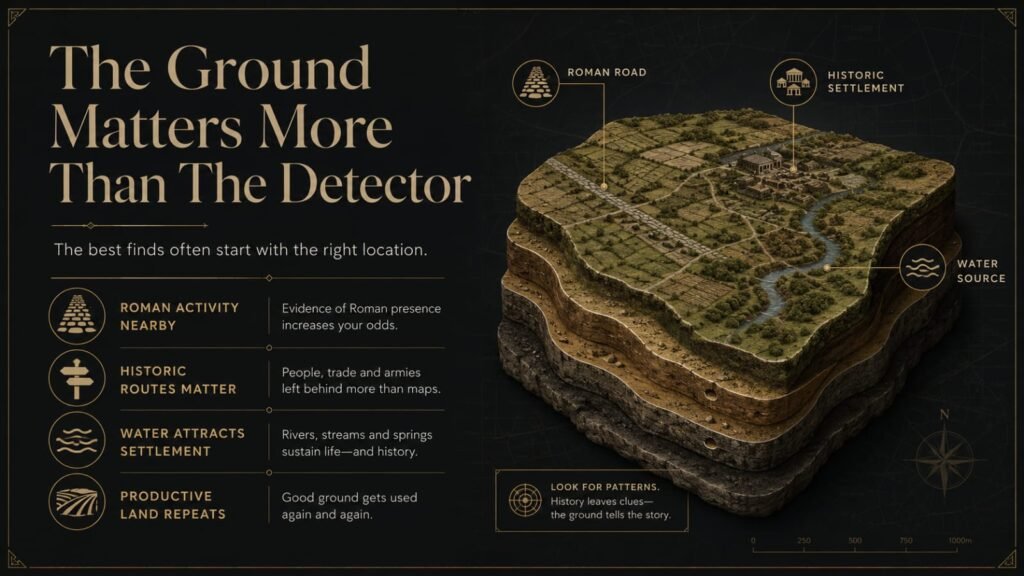
Every field belongs to somebody.
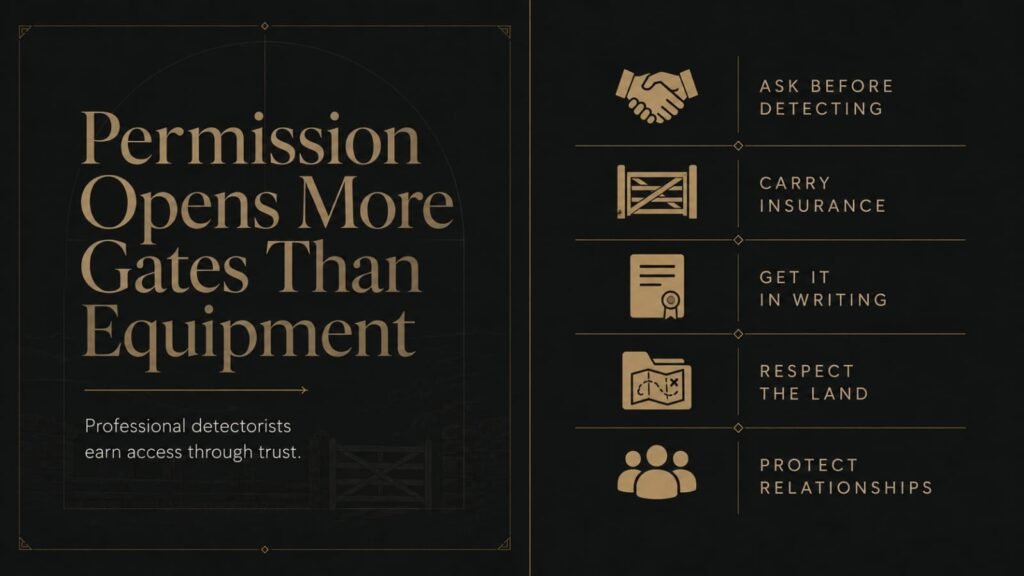
That sounds obvious until you realise how many beginners confuse public access with permission to detect. A public footpath lets you walk across land. It does not let you dig it. The same goes for woodland trails, common land, riverside paths, parkland, and half the beaches people assume are “public.”
Most experienced detectorists get this instinctively because they’ve seen what happens when someone ignores it. Farmers talk. Councils tighten rules. Entire permissions disappear because one person couldn’t be bothered to ask properly.
Here’s the practical version most people actually need:
| Location Type | Permission Needed From |
| Private farmland/fields | Landowner + tenant farmer |
| Crown Estate foreshore | Generally permitted under conditions |
| Council beaches & parks | Local council |
| Common land | Landowner or managing authority |
| Woodland | Private owner/forestry authority |
| Riverbanks | Riparian landowner |
| Your own garden | No permission needed |
| Organised rallies | Covered by the organiser |
The funny thing is, once you start approaching permissions professionally, landowners usually respond far better than beginners expect. Farmers deal with people trespassing constantly. Someone turning up politely, carrying insurance, offering a written agreement, and talking about local history immediately feels different.
That professionalism matters more than whatever detector you own.
A beach gives you something farmland never can: immediate access. No awkward permission conversation. No harvest timing. No wondering whether you’ve parked in the wrong gateway.
You just turn up and start learning.
That’s why so many people searching for places to metal detect near me end up beginning on the coast. In England, Wales, and Northern Ireland, much of the foreshore falls under The Crown Estate control, and detecting is generally allowed between mean high and low tide marks under their conditions.
But beaches fool beginners constantly because not all sand is equal.
A packed tourist beach in Cornwall behaves completely differently from a tidal estuary in Yorkshire. One produces modern jewellery. The other can occasionally expose material that sat buried for centuries until erosion shifted the bank.
Most beach detecting is modern-loss hunting. That’s not a criticism either. Plenty of detectorists quietly fund their hobby by recovering dropped rings and jewellery from busy summer beaches. The people who mock modern finds usually haven’t dug for gold lately.
The most productive beach sections tend to be:
Storms change everything. A beach that produced nothing for six months can suddenly expose an entirely different layer overnight after heavy surf strips sand away. Experienced beach detectorists watch weather forecasts almost as closely as tides.
The permission side matters too because beaches can switch ownership faster than people realise.
The Thames deserves special mention because people romanticise it without understanding the restrictions. Mudlarking and detecting are tightly controlled through the Port of London Authority permit system, and waiting lists can stretch painfully long.
Still, for learning tones, recovery speed, and confidence with your machine, beaches remain the easiest starting point in the UK.
And they teach something farmland eventually teaches too: the best finds usually come after everyone else has gone home.
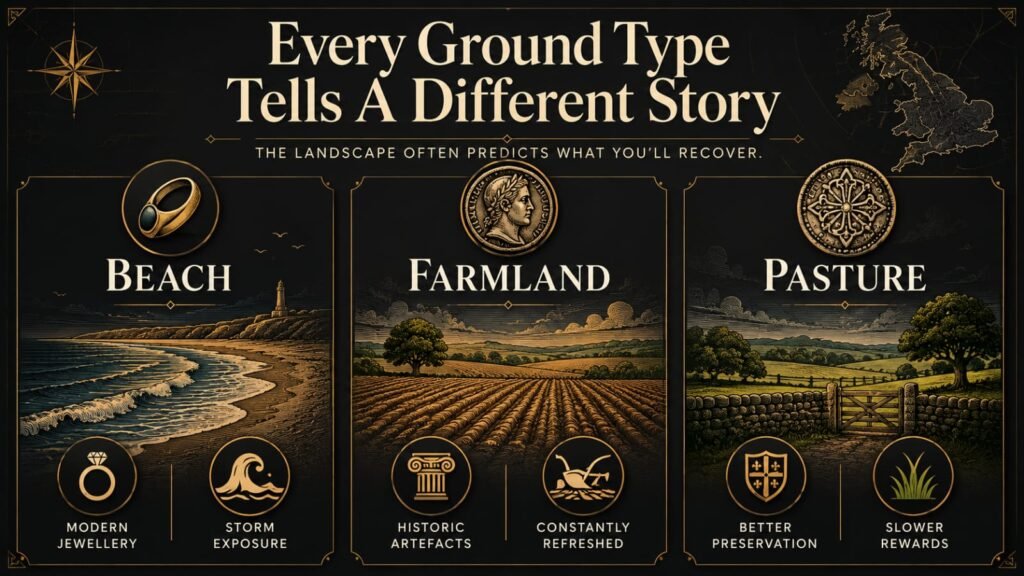
Ask experienced UK detectorists where their best discoveries came from and the answer is almost always the same: arable farmland.
Not because it’s glamorous. Most of the time it’s windy, muddy, exhausting work. But ploughing constantly moves older material upward into the plough zone, which means productive fields effectively refresh themselves over time.
That matters more than most beginners understand.
Pasture can preserve finds beautifully, but a ploughed Roman field gives you repeated chances. Every season changes the ground slightly. Every rain exposes something new. A field that seemed “done” three years ago suddenly starts producing hammered silver again after deeper cultivation.
The range of history on UK farmland is honestly absurd.
You can recover:
Sometimes from the same field.
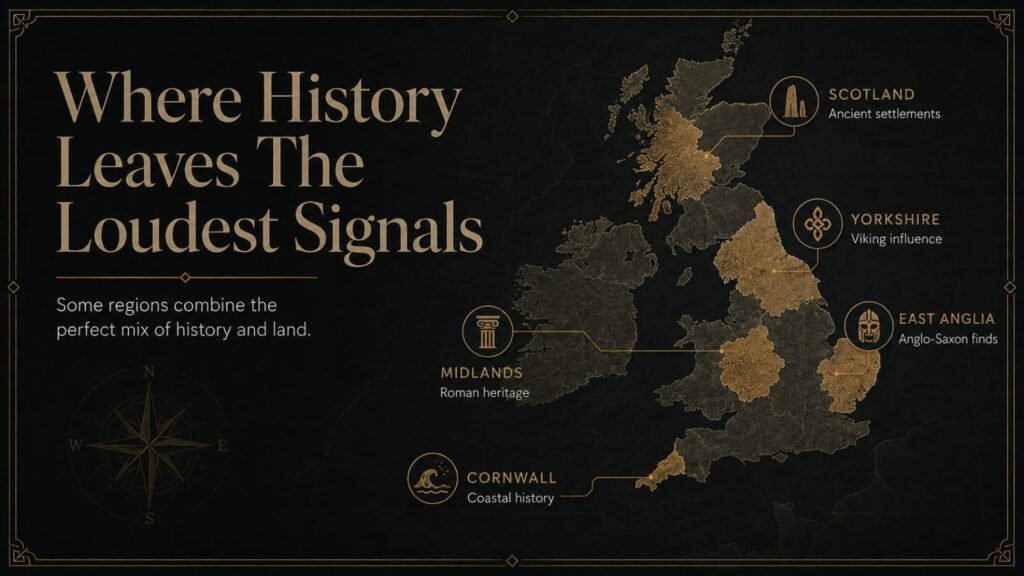
East Anglia dominates conversations around UK metal detecting for a reason. Norfolk, Suffolk, Cambridgeshire, and Lincolnshire combine centuries of intensive farming with extraordinary historical occupation. Roman roads cut through huge parts of the region. Viking settlements spread heavily across it. Anglo-Saxon activity never really stopped.
The soil helps too. Light East Anglian arable ground is forgiving on detectors and kind to preservation. You notice the difference immediately if you’ve spent time fighting mineralised ground elsewhere.
The best farmland permissions usually share a few clues:
One thing people rarely admit publicly: research impresses farmers more than enthusiasm does.
Turning up saying “I love history” sounds generic. Turning up with an 1880s tithe map showing an old trackway across their field creates a completely different conversation. Suddenly, you don’t sound like someone chasing treasure videos online. You sound like somebody genuinely interested in the land.
That difference opens gates.
The permission side is straightforward legally, but delicate socially. You need permission from:
And get it written down. Always.
A proper agreement protects both sides, especially around finds ownership and reporting obligations under the Treasure Act 1996.
Most long-term permissions survive because the detectorist behaved responsibly during the boring moments, not because they found something valuable. Closing gates. Avoiding crops. Filling holes perfectly. Turning up when promised.
That’s the stuff farmers actually remember.
Pasture feels slower than arable at first. Sometimes painfully slower.
You can spend hours covering ancient meadow and recover almost nothing modern detectorists would call exciting. Then, suddenly, a sharply preserved medieval coin appears that looks untouched by time.
That preservation is the real attraction.
Because the pasture hasn’t been churned repeatedly by ploughing, objects often remain where they were originally lost. Coins stay sharper. Artefacts survive with less damage. Buckles, fittings, and dress items can emerge in conditions that farmland rarely preserves.
The downside is depth.
Good pasture often hides finds just beyond where beginners expect them to be. People used to shallow modern losses on beaches can get frustrated quickly because pasture rewards slow, methodical coverage instead of rapid target recovery.
Ancient grazing land near:
…can be incredibly productive over time.
Livestock changes the permission conversation, too. Farmers care deeply about animal safety, and rightly so. An incomplete hole in pasture isn’t just sloppy; detecting it can injure livestock.
Experienced detectorists mention this proactively when asking permission because it shows you understand real-world consequences beyond the hobby itself.
That matters more than polished speeches ever do.
The affordable option

Simple controls and light enough for a first machine.
£79.95£99.95Save £20
Add to basketFull detailsIn stock
When people search for metal detecting sites near me, what they usually mean is: where do serious detectorists actually go?
Some regions consistently outperform others because history, soil conditions, and farming patterns all overlap in the right way.
Norfolk has almost become mythical among UK detectorists at this point, and honestly, some of the reputation is deserved.
Roman settlement was dense. Anglo-Saxon occupation spread heavily across the region. Viking influence remained strong. The farmland is extensive and productive. Finds recorded through the PAS consistently rank among the highest in the country.
The region also benefits from relatively forgiving ground conditions. Beginners don’t realise how difficult mineralisation can be until they leave East Anglia and try somewhere harsher.
You hear the same county names repeatedly for a reason:
These counties combine deep history with workable farmland at scale.
Yorkshire has a completely different detecting personality.
A stronger Norse and medieval flavour runs through many finds there. Viking settlement names scatter across the landscape, and certain areas consistently produce silver associated with Scandinavian occupation.
The atmosphere changes, too. East Anglia often feels open and agricultural. Yorkshire can feel harsher, older, and more rugged historically.
Detectorists chasing:
…often end up spending serious time there.
The Midlands quietly produced some of the most important finds in British detecting history.
Staffordshire Hoard discovery changed how many people viewed Anglo-Saxon Britain entirely. And while finds on that scale are extraordinarily rare, the region still produces remarkable material regularly.
Roman roads crossing the Midlands also create productive corridors that many detectorists deliberately target.
This is where beginners discover that ground conditions matter.
Cornwall and parts of Wales contain highly mineralised ground that can make cheaper detectors behave terribly. False signals increase. Depth drops. Iron contamination becomes exhausting.
But the history there is extraordinary:
You just need equipment capable of handling the ground properly, which in practice means a machine with proper ground balancing rather than the cheapest one on the shelf. The pulse induction detectors and the better motion detectors both stay far calmer in mineralisation.
Scotland deserves careful attention because its legal framework differs significantly from England and Wales.
Treasure Trove law applies rather than the Treasure Act, and archaeological reporting expectations are broader. That scares some beginners unnecessarily, but Scotland remains one of the most historically rich detecting regions anywhere in Britain.
Viking silver. Pictish material. Early Christian artefacts. Bronze Age gold.
The potential is staggering.
But Scotland also rewards detectorists who take the legal and historical side seriously.
People see the word “common” and assume it means public.
It doesn’t.
Common land usually remains privately owned, even when public access exists. Those access rights generally cover walking, grazing, or historical use rights — not digging holes with a detector.
That misunderstanding causes endless problems.
Some common land can absolutely be worth detecting, especially around historic village commons or long-settled agricultural areas. But permissions become more layered because ownership and management rights often overlap.
You may need approval from:
The key is specificity. Random emails asking “Can I metal detect on your common land?” usually disappear unanswered. Referencing exact locations, showing insurance membership, and explaining your reporting practices make conversations much smoother.
Land managers want reassurance that you won’t create headaches.
Most experienced detectorists eventually learn that permissions succeed when you reduce perceived risk for the owner.
Woodland detecting looks romantic online. Ancient paths. Forgotten clearings. Medieval pilgrims dropping coins under old trees.
The reality is usually roots, nails, and exhaustion.
But good woodland can still produce remarkable finds precisely because fewer detectorists bother with it.
Ancient trackways running through woodland edges are especially interesting. Before modern roads, many travel routes cut directly through wooded areas linking settlements and markets. People lost things there for centuries.
Woodland tends to produce:
The challenge is technical as much as historical.
Root systems limit digging. Iron contamination can become relentless. Acidic woodland soil destroys certain materials over time. Smaller coils help enormously because manoeuvring a large coil through dense woodland becomes frustrating quickly.
Permissions are straightforward legally:
But socially, woodland permissions often happen through existing farmland relationships. Once a farmer trusts you, conversations about adjoining woodland become easier naturally.
Trust expands permissions more effectively than persistence ever does.
The sensible middle

All rounder with full discrimination control. Inland, beach and parks.
£149.95£199.95Save £50
Add to basketFull detailsIn stock
The river moved ancient Britain.
Trade moved by river. Armies moved by river. Pilgrims crossed rivers. Livestock crossed rivers. Roman roads targeted crossings deliberately because water dictated movement long before modern transport existed.
That’s why riverbanks can be incredibly productive.
The best areas are rarely random stretches of water. They’re:
Objects accumulated there for generations.
The permissions get complicated fast, though, because river ownership layers differently from ordinary land. The adjacent landowner often owns to the river centre line. Tidal sections involve Crown Estate considerations. Navigable waterways introduce additional authorities.
Beginners often assume riverside footpaths mean accessible detecting ground.
They don’t.
And riverbanks punish sloppy recovery work harder than ordinary fields. Poorly filled holes erode quickly near water, which is one reason responsible detectorists tend to be extremely careful around them.
Good river permissions are usually built slowly through farmland access nearby.
The best training ground in the UK might be ten metres from your back door.
People rush toward “famous” detecting counties before they even understand how their detectors sound over different metals. Then they spend the entire period second-guessing every signal.
A garden fixes that quickly.
Bury:
…at different depths and learn what your machine is actually telling you.
That controlled practice matters massively because real detecting is mostly interpretation, not swinging.
Older gardens can surprise you, too. Victorian coins, Georgian buttons, lost jewellery, trade tokens, they appear more often than beginners expect, especially around older properties.
And once family or friends see you recovering interesting things responsibly, permissions spread naturally.
That’s how many detectorists quietly build their best local access.
Not through cold approaches. Through trust already sitting inside their own circles.
Getting permissions from scratch is intimidating at first. Most people hate knocking on farmhouse doors. That’s completely normal.
That’s why rallies and local clubs matter so much.
An organised rally handles:
You just buy a ticket and detect legally.
Events like Detectival became popular partly because they removed the hardest administrative barriers for ordinary detectorists.
Local clubs matter even more long-term, though.
A good club gives you:
And honestly, detecting alone constantly gets overrated online. Some of the best field knowledge spreads quietly between detectorists comparing finds beside muddy cars at the end of a day.
Most counties across Britain have active detecting communities now. The National Council for Metal Detecting maintains club resources across the UK.
The strongest permissions often stay inside trusted club networks for decades.
That tells you something important about this hobby.
Relationships matter as much as research.
The serious choice
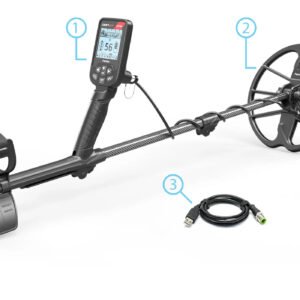
15 kHz, fully waterproof, light, with six search modes.
£299.95£349.95Save £50
Add to basketFull detailsIn stock
Some rules are flexible depending on ownership.
These are not.
The MAGIC Map system is one of the most useful tools any UK detectorist can learn because it shows protected land designations clearly.
Checking a site takes minutes.
Ignoring those checks can end your hobby permanently.
And the uncomfortable truth is this: responsible detectorists protect the hobby far more effectively than legislation ever will.
Most productive sites are found long before anyone arrives with a detector.
Research creates permissions. Research narrows land choices. Research explains why one field keeps producing, and the neighbouring field stays silent.
A few tools come up repeatedly among experienced UK detectorists.
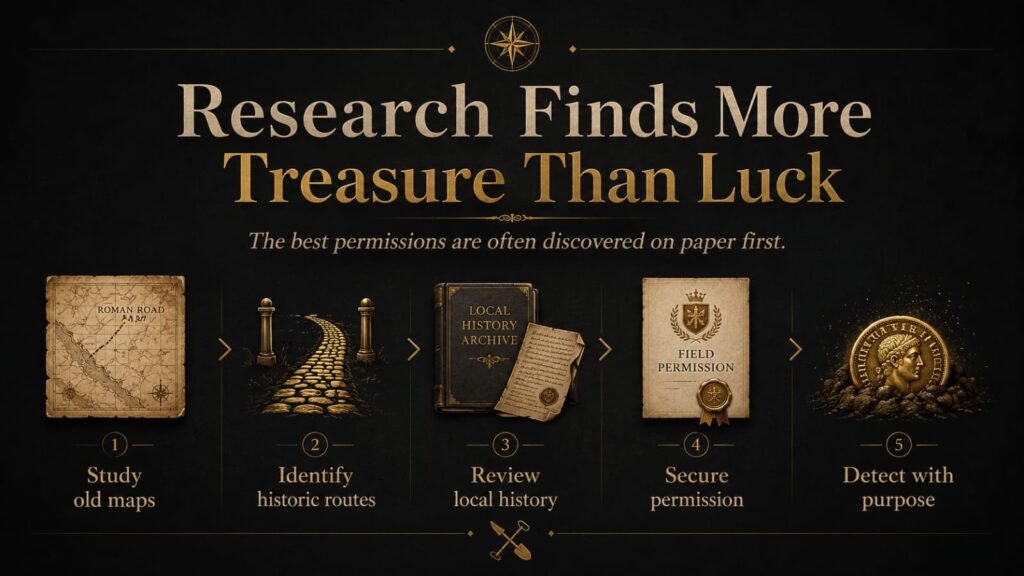
National Library of Scotland Maps is unbelievably useful for comparing modern landscapes with older field systems, vanished settlements, and forgotten trackways.
Old maps reveal patterns modern satellite imagery completely hides.
The Portable Antiquities Scheme Database lets you search recorded finds geographically.
If Roman coins repeatedly appear around a parish boundary, that tells you something.
LiDAR changed modern detection research massively.
Subtle earthworks invisible at ground level suddenly become obvious:
Once you learn to read LiDAR properly, ordinary fields stop looking ordinary.
ARCHI UK remains one of the strongest archaeological research platforms for British detecting research.
Many experienced detectorists quietly rely on it constantly.
HM Land Registry solves the most practical problem of all: figuring out who actually owns the land you want to approach.
That matters because permissions fail surprisingly often simply because people ask the wrong farmer.
A detector that performs brilliantly on East Anglian farmland can struggle horribly on wet salt beaches or mineralised Cornish ground.
People underestimate this constantly.
Wet beach sand punishes weak machines because saltwater mineralisation creates instability and false signals. Cornwall and parts of Wales create similar frustrations through iron-heavy mineralisation.
Woodland benefits from smaller coils. Deep arable farmland rewards multi-frequency depth capability. Riverbanks need a stable recovery speed and careful target separation.
This is why experienced detectorists eventually stop asking “What’s the best detector?” and start asking “Best detector for what ground?”
That’s the real question.
UK Metal Detectors carries machines built specifically for UK ground conditions, from beach-ready pulse induction setups to deep multi-frequency farmland detectors. Matching the machine to the location saves far more frustration than most beginners realise.
If you already know the ground you will be searching, it is worth starting there rather than with a brand. The beach detectors are the ones built to stay settled on wet salt sand. The pulse induction machines handle the iron-heavy mineralisation you get in Cornwall and parts of Wales. The deeper multi-frequency machines sit in the ground detectors range, which is where arable farmland is best served. And if this is your first machine, start with the new to detecting range, which will cope with most of the ground above well enough to learn on.
Woodland is the one worth planning for separately, because it is more a coil question than a machine question. A smaller coil gets in between roots and iron far better than a large one, and a replacement search coil costs a great deal less than a second detector.
The biggest mistake beginners make is chasing famous land before they understand ordinary land.
Some of the most productive permissions in Britain aren’t rally fields or headline counties. They’re small farms nobody talks about publicly. A pasture permission was held quietly for fifteen years. A river meadow, one farmer trusts a single detectorist to search after harvest. The sort of places that never appear on YouTube thumbnails but keep producing year after year because the relationship behind them was built properly.
That’s the strange thing about UK detecting. The best locations rarely announce themselves loudly.
They’re built slowly through research, patience, and showing up consistently enough that landowners stop seeing you as “the detectorist” and start seeing you as somebody who genuinely respects the ground they work every day. Most experienced detectorists eventually realise the hobby rewards trust just as much as technology.
So instead of waiting for the perfect permission, start with one field. One conversation. One stretch of beach you learn properly over time. The people who keep finding history are usually the ones willing to put in that quieter kind of work.
And if you’re unsure where to begin, whether that’s choosing the right detector, understanding your local ground, or figuring out which UK locations suit your goals best, you can always get in touch with the team at UK Metal Detectors for honest advice from people who actually spend time detecting themselves.
Not sure which of these suits the ground you search? Tell us where you detect and we will point you at the right one, including the cheaper one when that is the honest answer. We use these machines ourselves.