

On this page
Every new detectorist hits the same moment within about 48 hours of buying their first machine. The detector is assembled, the garden test went well, you found a coin in the flower bed, and now you are down a forum rabbit hole at midnight wondering what else you need. The internet says everything. The forums disagree. The kit lists are endless and contradictory.
This guide cuts through all of that. Some accessories make a genuine, measurable difference to how much you find and how enjoyable the session is. Others are useful additions once you are more established. And a small handful are largely unnecessary, especially at the start, no matter how confidently they are marketed. If you have not read our beginner’s guide to your first session yet, that is the place to start before worrying about accessories it covers setup, settings, and technique from scratch.
The accessories covered here are: pinpointers, headphones, digging tools, coil covers, finds pouches, sand scoops for beach detecting, carry bags, and a short section on what you can confidently leave on the shelf. Everyone comes with an honest assessment of whether it matters, why it matters, and what to look for.
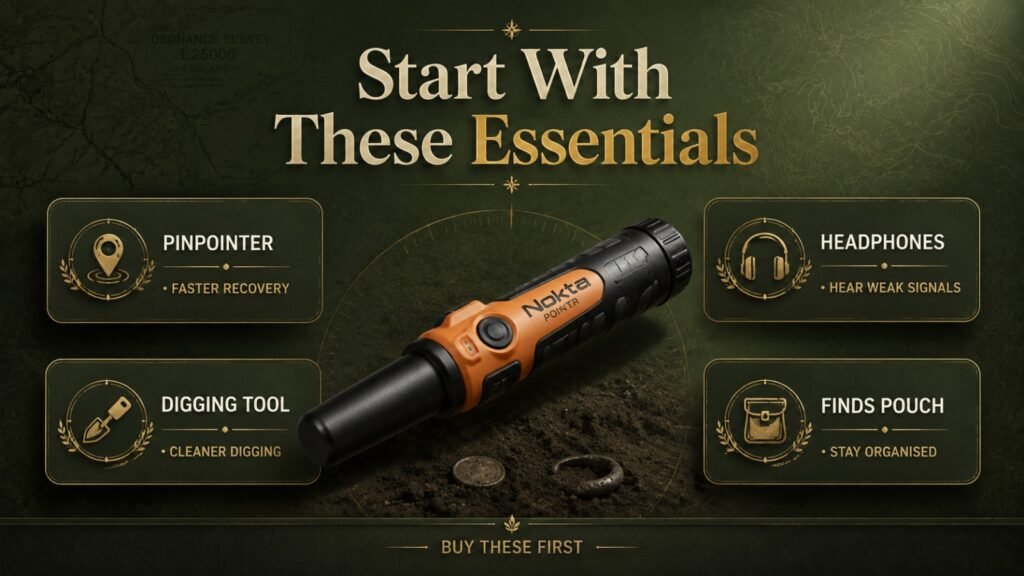
If you buy one accessory beyond the detector itself, make it a pinpointer. Not because it sounds impressive or because everyone on the forums has one, but because of what it actually does to your session in concrete, measurable terms. It reduces recovery time. It keeps your holes small and clean. It means the difference between finding a target in fifteen seconds and spending two frustrating minutes searching a plug of soil by hand.
A metal detector narrows a buried target down to a general area roughly the width of the search coil, which is typically 20 to 30 centimetres across. Once you start digging, the main detector becomes largely useless for locating exactly where within the hole the target actually sits. You end up either digging a wide, messy hole, hoping to spot something, or spending several minutes scanning handfuls of loose soil while the signal moves around unpredictably.
A pinpointer is a handheld probe that you insert directly into the hole or the removed soil plug. It detects metal within a few centimetres of its tip and signals with audio and vibration, getting faster and more intense the closer it gets to the target. With a pinpointer, a recovery that might take two minutes by hand takes fifteen seconds. Across a full day’s detecting, that adds up to significantly more ground covered, significantly fewer large ragged holes, and a much cleaner relationship with the landowner whose permission makes everything possible.
The EDGE-PRO-POINTER is available directly from UK Metal Detectors and is one of the most capable pinpointers at its price point. It offers 360-degree detection around the tip, adjustable sensitivity for different ground conditions, audio and vibration alerts, and a built-in LED for low-light use. The sensitivity adjustment matters more than it sounds on UK farmland, where highly mineralised soil, common in Cornwall, Wales, and parts of Northern England, can cause lower-quality pinpointers to false continuously, making them nearly useless in the very conditions you need them most.
The Fortuna XELA is the step up and is also available through UK Metal Detectors. Its 360-degree detection tip and rapidly escalating response as it approaches a target make it noticeably faster to use in practice. For detectorists who are already active and want to improve their recovery speed without changing their main machine, the Fortuna XELA is the more capable option of the two. Both pinpointers offer genuine waterproofing, which matters in the UK, where the soil is regularly wet, and sessions carry on regardless of whether it has been raining for three days straight.
The bottom line: this is the accessory that the majority of experienced UK detectorists say they wish they had bought on day one rather than after their first frustrated afternoon of searching soil by hand. Get one before your first session.
Headphones are not a luxury. On a typical UK detecting session, open farmland, coastal beach, or wind-swept parkland, the difference between hearing a faint deep signal clearly and missing it entirely often comes down to whether the audio is going through decent headphones or drifting from the detector’s built-in speaker into the open air. The signals most worth digging are often the quietest ones, because quiet usually means depth, and depth means older, more interesting targets.
Three things work against detecting with speaker audio only.
First, wind is very common on UK farmland and coastal sites partially or completely masks quiet signals.
Second, external noise from farm machinery, passing traffic, or other detectorists creates a background hum that makes subtle target responses hard to distinguish from ambient sound.
Third, speaker volume has to be turned up to be audible outdoors, and at higher volumes, the tonal differences between target types become harder to read accurately.
Headphones solve all three problems at once. Getting those signals right also pairs directly with how well your machine is set up, which is why reading our metal detector ground balance guide alongside this one makes sense: settings and accessories work together.
Most detectors include a 3.5mm headphone socket, and a decent pair of wired headphones works perfectly well for the majority of UK detecting. The advantage of wireless is freedom of movement without a cable catching on your clothes or digging tool every time you reach down to recover a target. Over a full session, that snagging and tugging is more annoying than it sounds. Several machines in the UK Metal Detectors range include headphones as part of the package: the Reflex G6 includes wired headphones, and the Lander XD50 includes headphones with volume control. If your detector came with headphones, use them before spending on a separate pair.
A detecting session without a proper digging tool is an exercise in frustration and, frankly, bad practice. Your hands are not a substitute for a well-designed implement when you are working into compacted UK farmland in November, cutting a clean plug out of grassland in August, or trying to recover a target neatly without leaving a mess the farmer will notice on his next walk around the field.
A stainless steel trowel with a serrated edge is the standard close-range recovery tool for the majority of UK detecting conditions. It lets you cut a precise plug in grassland, work carefully into a tighter dig on arable, and probe around a target without either losing it in the soil or dragging a metal blade across it. The serrated edge matters because grass roots and compacted earth require a sawing motion rather than a push, and a smooth blade bends under that kind of pressure on UK clay soil. Thin, stamped-metal trowels from garden centres are not appropriate for detecting; they flex and fail within a few sessions.
For deeper targets or harder ground, a longer-handled detecting spade gives you the leverage to cut a clean, deeper plug without kneeling fully into wet soil. These are specialist tools with a narrow blade, typically 10 to 15 centimetres wide, designed to cut a precise plug rather than shift large volumes of earth. A garden spade is not a substitute: the blade is too wide, the plug removal is too disruptive, and you end up with a hole that looks like a badger excavated it.
Why Recovery Quality Matters
The NCMD Code of Conduct is clear that every hole must be filled and the ground left as it was found. A proper digging tool makes this far easier to achieve consistently. A neat, hinged plug cut with a good trowel sits back almost invisibly, and the grass recovers quickly. A ragged, wide hole torn out with an inadequate tool is nearly impossible to fill convincingly, and it is the single most common reason farmers quietly stop renewing permissions. The quality of your digging tool is directly connected to the quality of your recovery, and the quality of your recovery is directly connected to how long you keep access to the land you are searching.

The affordable option
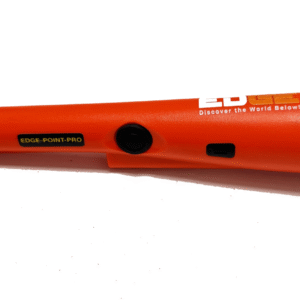
Pinpointer. Finds the target in the hole instead of the spoil.
£49.95£69.99Save £20.04
Add to basketFull detailsIn stock
A coil cover is a protective plastic shell that fits over the search coil and prevents the coil housing from being scratched, cracked, or abraded by contact with the ground, stones, and compacted soil during a session. It does one job and does it well: it takes the wear that would otherwise go directly onto a component that costs significantly more to replace than a cover costs to buy.
The case for a coil cover is simple. Replacing a damaged or cracked coil is significantly more expensive than buying a cover in the first place. Coils are waterproof in their own right on most modern detectors, so the cover is purely about physical protection from abrasion and impact rather than moisture. It also makes cleaning easier after a muddy session a cover can be rinsed under a tap without any concern about connector seals.
Not Sure Which Accessories Suit Your Detector?
Not every accessory suits every detector or every type of ground. Choosing the right pinpointer, headphones, coil cover, or digging tool depends on your machine and where you plan to detect.
Rather than spending money on accessories you may never use, get expert advice first. Tell us which detector you have and where you plan to detect, and we’ll recommend the accessories that will genuinely improve your sessions.
Get in touch with the UK Metal Detectors team today for honest, expert advice and the right kit recommendations for your detector.
A finds pouch is a belt-mounted bag with separate compartments for keeping finds organised during a session. It sounds like a minor convenience right up until the first time you empty your jacket pocket at the end of a day and find three coins, a buckle fragment, two nails, and something unidentifiable all jumbled together with no memory of where any of them came from on the site.
Keeping finds separate in small pill boxes or compartments within a finds pouch means you know where each item was recovered on the site, what depth it came from, and what the signal looked like. That information is only fully retrievable in the moment and immediately after a session. Once you are home with everything in a pile, most of the context is gone. If any find later turns out to be potentially significant, the location data is required for a Treasure Act report and for recording with the Portable Antiquities Scheme, the national database managed by the British Museum that records archaeological finds made by the public. Good finds organisation is not just helpful, it is part of responsible detecting practice. If you are heading to your first rally or group dig, an organised kit becomes even more important, and the metal detecting rallies UK guide covers exactly why that matters in a shared detecting environment.
A finds pouch with at least two separate sections, one for items worth examining further, and one for obvious rubbish that still needs to go in a bag rather than back in the hole, is the most practical format. Waterproof or water-resistant fabric is worth prioritising given UK weather, which rarely provides the dry, sunny conditions that detecting content on YouTube always seems to feature.
A sand scoop is a long-handled tool with a perforated or mesh base that lets wet sand fall through while retaining whatever target is in the material. On a UK beach, trying to recover a buried find by hand or with a trowel in wet, shifting sand near the waterline is an exercise in losing the target entirely, as it drops back through your fingers the moment you open your hand over the surf.
Only if beach detecting is part of your plans. On inland farmland, pasture, or parkland, a sand scoop has absolutely no practical application. On a beach, particularly on wet sand near the waterline where the best finds tend to concentrate, it is the correct recovery tool, and the trowel is the wrong one. A scoop lets you work quickly and cleanly through wet sand, shake out the material in the water or on the surface, and find the target without losing it to the tide. Without one, beach detecting on the wet foreshore is significantly slower and more frustrating than it needs to be.
The sensible middle

Golden Mask 32×28cm DD coil. Light for its size, with good ground coverage.
£129
Add to basketFull detailsIn stock
A carry bag designed for metal detecting holds the detector, the coil, and accessories in one organised unit for transport. The practical value is in getting your kit from the car to the site and back without the control box rattling around unsupported in the boot or the coil getting scratched against whatever else is in the car.
Not on day one. Most modern detectors with telescopic shafts fold down to a compact, manageable size that travels safely in a car boot without a dedicated bag. If you plan to travel to sites by public transport, cycle, or carry the kit any significant distance on foot, a bag moves up the priority list quickly.
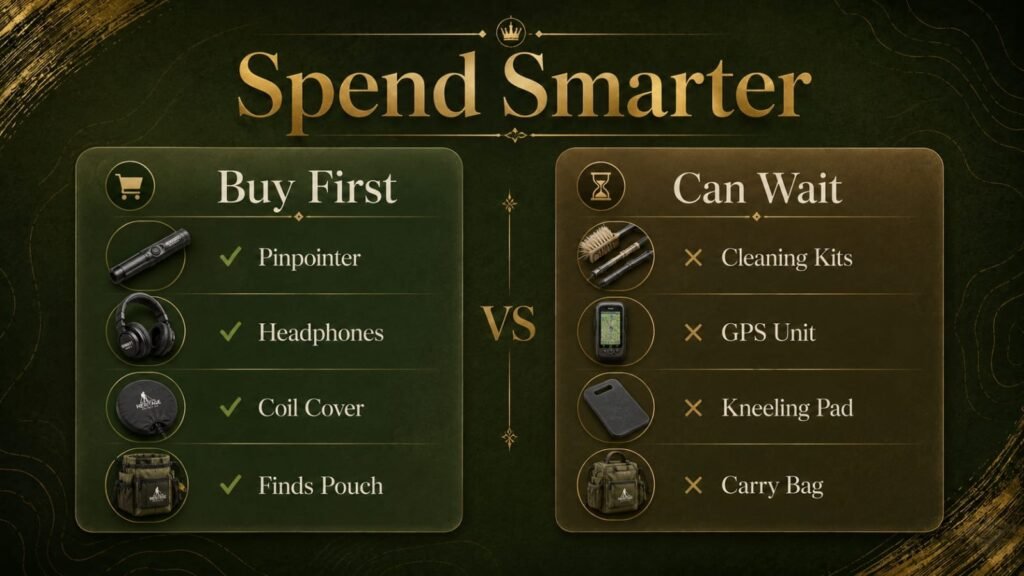
The detecting accessories market includes a number of products that sound useful in a description and turn out to be largely unnecessary in the field. These are the ones worth skipping, at least at the start.
The market has a range of branded cleaning kits aimed at detectorists. Most contain tools that are either inappropriate for the finds you will actually recover in the UK or that duplicate what you already have at home. A bottle of distilled water, some wooden toothpicks, a soft natural-bristle brush, and a small jar of Renaissance Wax cover almost everything a UK detectorist needs for finds care. Our guide to cleaning coins found by metal detecting covers the correct approach for every UK coin type: Roman bronze, medieval silver, Victorian copper, and everything in between. That guide is a better investment of five minutes than any branded cleaning kit.
These exist, and some detectorists use them, but they add bulk and weight to your kit for a benefit that a waterproof jacket folded and laid on the ground provides equally well. Leave them off the list until you have a specific physical reason to add them.
A smartphone with your maps app does everything a dedicated GPS unit does for the purposes of recording found locations. Dropping a pin on Google Maps at the moment of recovery is fast, accurate, and free. A dedicated GPS unit offers no practical advantage over this for hobby detecting, and the cost is difficult to justify against the genuine accessories that make a real difference to the session.
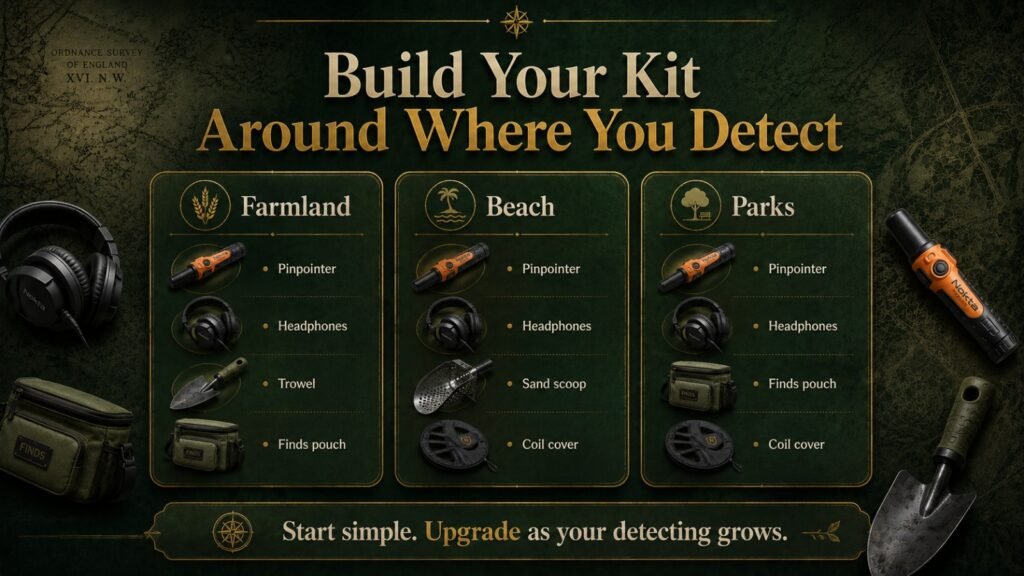
| Accessory | Farmland | Beach | Parks |
Essential? |
|
Pinpointer |
Yes | Yes | Yes | Buy first |
|
Headphones |
Yes | Yes | Yes | Yes, essential |
|
Digging trowel |
Yes | Partial | Yes | Yes |
|
Detecting spade |
Yes (hard ground) | No | Partial | Useful |
| Coil cover | Yes | Yes | Yes |
Yes, protect coil |
| Finds pouch | Yes | Yes | Yes |
Yes |
| Sand scoop | No | Yes | No |
Beach only |
| Carry bag | Useful | Useful | Useful |
Not urgent |
The serious choice
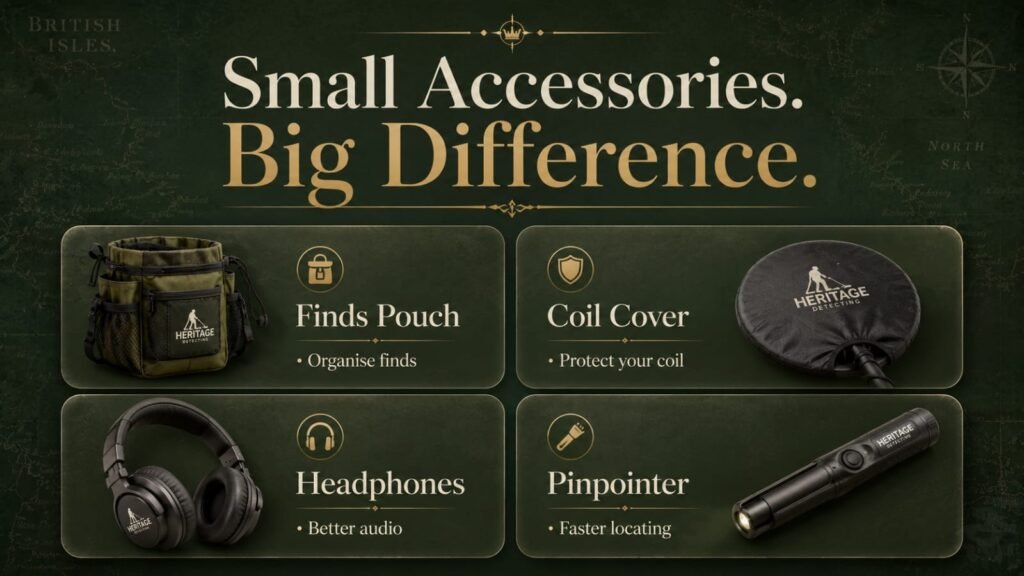
The right approach to accessories is not to buy everything at once. Start with what actually changes your session: pinpointer, headphones, digging tool, coil cover, finds pouch. Add everything else as your detection develops, and you understand what specific conditions or targets you are working towards. The accessories that make the most difference are the ones that remove friction from the session itself: faster target recovery, clearer audio, cleaner holes, and organised finds that actually make sense when you get home.
Getting a well-chosen detector package from the start often covers most of this list as standard, which is worth considering at the point of purchase rather than afterwards. Buying a basic machine and then spending the same amount again on separate accessories is a common and avoidable pattern, and our team can help you avoid it before you spend anything.
The best accessories are the ones you’ll actually use in the field. A well-matched kit helps you recover targets faster, protect your equipment, and enjoy every detecting session without wasting money on unnecessary extras.
Whether you’re buying your first detector or upgrading your existing setup, we’re here to help you choose the right accessories for your machine, your budget, and the type of detecting you enjoy.
Contact us for expert guidance and personalised recommendations, and let us help you build a kit that’s ready for your next adventure.
The essential metal detecting accessories in the UK are a pinpointer, headphones, a digging tool, a coil cover, and a finds pouch. These five items help you recover targets faster, hear faint signals more clearly, protect your detector, and keep your finds organised.
The best pinpointer depends on your budget, but the EDGE-PRO-POINTER and Fortuna XELA are two excellent choices for UK detectorists. Both offer 360-degree detection, waterproof construction, and reliable performance in the UK’s often wet and mineralised ground.
The EDGE-PRO-POINTER is an excellent value option with adjustable sensitivity, audio and vibration alerts, and an integrated LED light. If you want faster target recovery and more precise locating, the Fortuna XELA offers quicker target response and enhanced recovery performance for regular detectorists.
You only need a sand scoop if you plan to detect on beaches. It is an essential tool for recovering targets from wet sand, where using a trowel or your hands is slow and often causes targets to disappear back into the sand.
For inland detecting on farmland, pasture, or parks, a standard digging trowel is the better choice. If beach detecting will be a regular part of your hobby, investing in a quality sand scoop is well worth it.
A stainless steel serrated digging trowel is the best all-round digging tool for most UK metal detecting. It allows you to cut neat plugs, recover targets carefully, and minimise damage to grass and farmland.
If you regularly detect on compacted ground or search for deeper targets, a narrow-blade detecting spade provides better leverage while still leaving clean, tidy holes. Using the right digging tool also helps you follow the NCMD Code of Conduct by restoring the ground properly after every recovery.
Yes. Headphones are one of the most useful metal detecting accessories because they help you hear weak and deep signals more clearly. They also reduce interference from wind, traffic, and other background noise that can easily mask faint target responses.
Most modern detectors include a standard headphone connection, while many detector packages also include headphones. Whether you choose wired or wireless, using headphones improves target identification and makes long detecting sessions more comfortable and productive
Not sure which of these suits the ground you search? Tell us where you detect and we will point you at the right one, including the cheaper one when that is the honest answer. We use these machines ourselves.