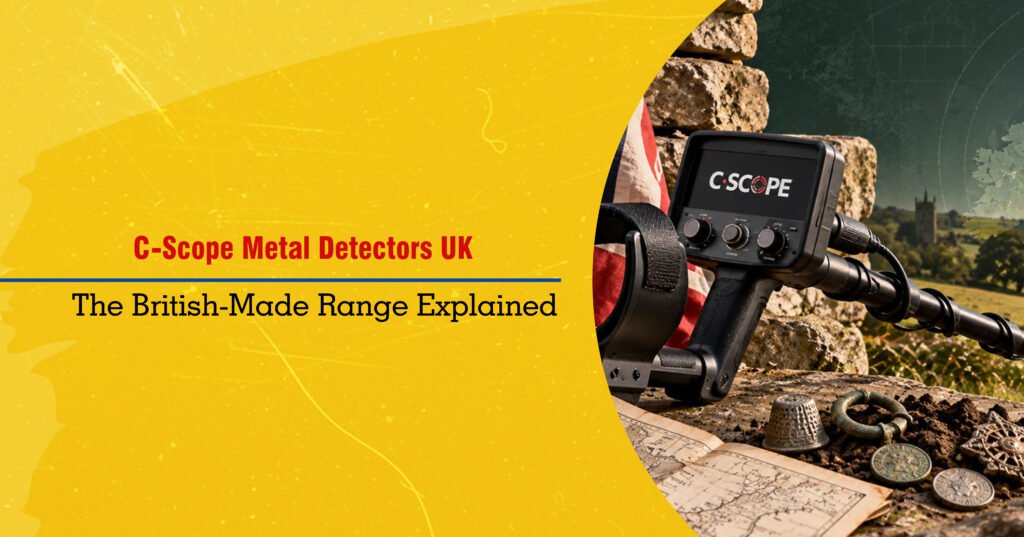
When you’re looking for a metal detector in the UK, it’s easy to get drawn towards the big European brands. They have plenty of models, impressive specifications and features that look good on paper. But there’s another name worth spending some time with: C-Scope.
C-Scope International has been making metal detectors in Colchester, Essex, since the 1970s. That’s a long history in an industry where technology and buying trends are constantly changing. More importantly, the company has maintained an approach that appeals to a particular kind of detectorist: someone who values straightforward controls, clear audio signals and a machine that does its job without making the hobby unnecessarily complicated.
The C-Scope metal detector UK range covers prices from £199.99 to £779.99, so there’s a reasonable choice whether you’re just getting started or have years of detecting behind you.
But here’s the interesting part: choosing a C-Scope isn’t just about your budget. The range includes both motion and non-motion detectors, and understanding the difference can tell you far more about which machine will suit you than the price tag alone.
Let’s look at the range properly.
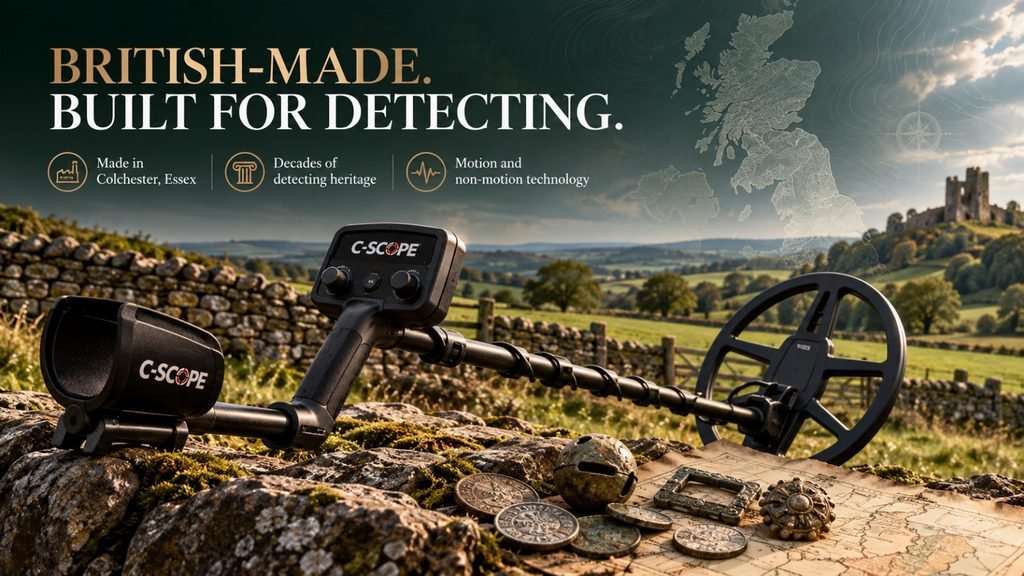
One of the first things worth knowing about C-Scope is its British manufacturing background. The company is based in Colchester, Essex, and has been producing detectors for decades. For anyone who prefers buying from a British manufacturer, that’s a meaningful distinction.
You can learn more about the company and its products on the official C-Scope International website.
However, British manufacturing isn’t the only reason to consider the brand. The more interesting difference is how its detectors approach target identification.
Most modern motion detectors need the search coil to move across the ground to register a target correctly. That works well when you’re sweeping a field methodically and trying to cover as much ground as possible.
C-Scope’s non-motion detectors take a different approach. You can hold the coil still over a suspected target and continue receiving a response.
Why does that matter?
Imagine you’re searching a field with plenty of iron contamination. You hear a signal, but you’re not entirely convinced it’s worth digging. With a non-motion machine, you can slow down, investigate the response, and take your time deciding what to do next.
It won’t magically tell you whether every signal is a coin or a rusty nail. No detector can promise that. But the ability to assess a signal without keeping the coil moving is a useful distinction for people who prefer deliberate, controlled detecting.
C-Scope also uses its Audio Tone Discrimination system across the range. In simple terms, desirable targets produce a higher tone, while iron and other ferrous debris produce a lower tone.
Rather than relying entirely on a screen full of target numbers, you’re encouraged to learn the sounds your machine makes.
That may sound basic, but there’s a practical benefit. Once you become familiar with your detector’s audio responses, you can spend less time looking down at a display and more time concentrating on the ground.
It’s a straightforward philosophy, and it runs through the C-Scope range.
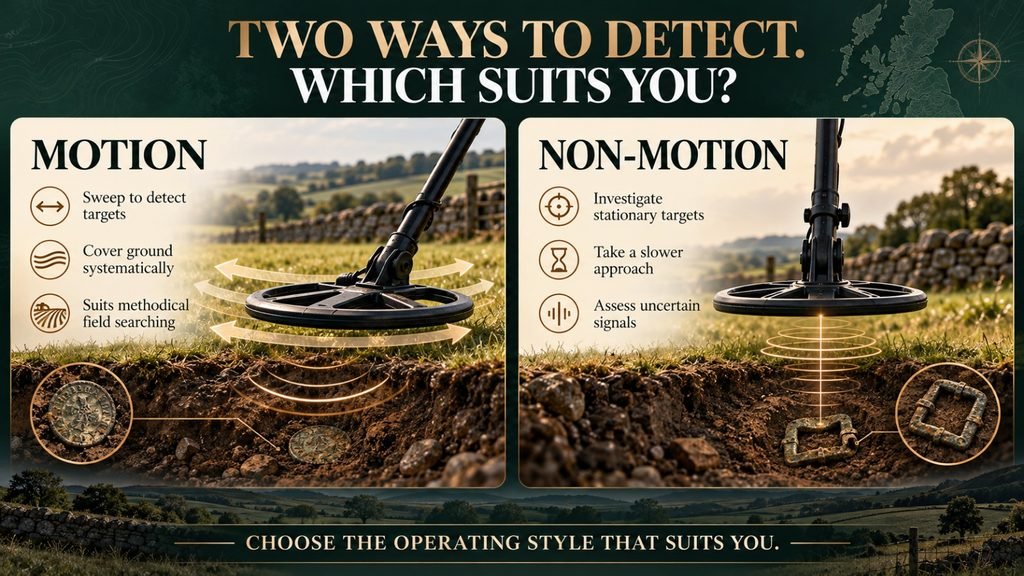
If you’re specifically interested in a C-Scope non-motion detector, this is where you should start.
These machines are designed for detectorists who prefer to investigate signals carefully rather than simply sweep quickly across a large area. There are differences between the models, though, so it’s worth looking at each one individually.
The CS770XD is the entry point into the non-motion range.
It combines non-motion detection with C-Scope’s audio discrimination system in a lightweight, counterbalanced design. The machine is positioned for inland and beach use, making it an option for detectorists who want flexibility rather than a detector for just one environment.
Its main appeal is the straightforward detecting experience. You don’t need to get lost in complicated menus before you can start learning how the machine responds to different targets.
For someone moving towards non-motion detecting for the first time, the CS770XD is a sensible starting point.
The CS990XD offers another way to approach non-motion detection.
Like the CS770XD, it uses audio discrimination, but it also includes a signal meter. That gives you an additional visual indication alongside the sound.
This can be useful if you prefer having more than one source of information when assessing a target. You can listen to the tone and consider the meter reading rather than relying on audio alone.
Interestingly, the CS990XD is priced slightly below the CS770XD in the listed range. If you’re comparing the two, don’t assume the more expensive model is automatically the better purchase. Think about whether the signal meter is something you’ll actually use.
The CS1220XD sits at the top of the non-motion family and is aimed at experienced detectorists who want a more developed approach to target analysis.
Its three-mode operating system is designed around different ways of working, including a Meter and Audio Discrimination mode that provides audible and visual target information.
For someone searching iron-heavy farmland, where a promising signal can be surrounded by unwanted metal, the ability to take a more measured approach may be particularly appealing.
This isn’t necessarily the machine every detectorist needs. If you’re a beginner still learning to recognise common signals, a less expensive model may be perfectly adequate.
But if you already know that you prefer slow, methodical detecting and want more information when assessing targets, the CS1220XD deserves a closer look.
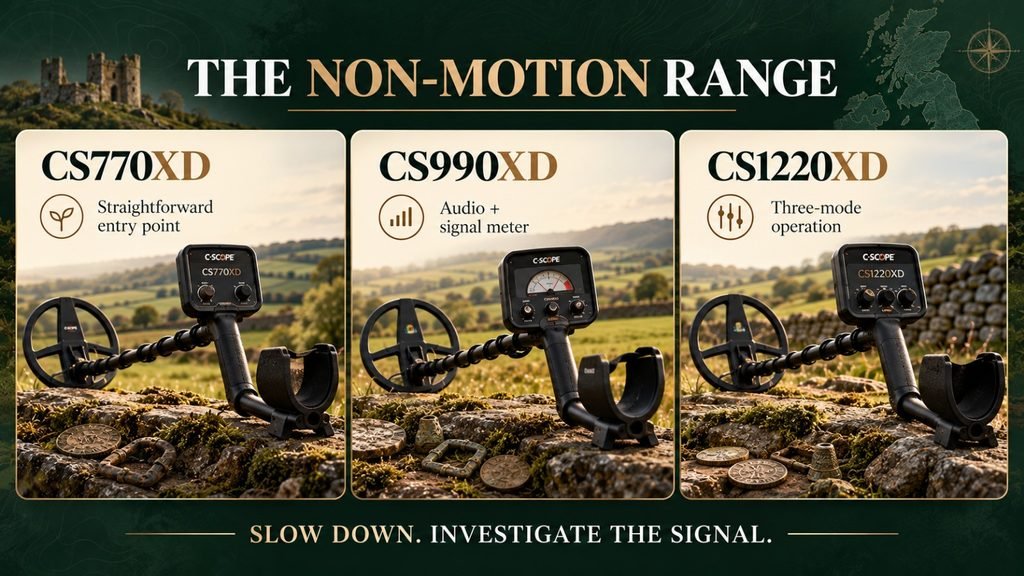
Not everyone wants to stop and investigate every signal. Sometimes you have a large perimeter, limited daylight, and plenty of ground to cover.
That’s where C-Scope’s motion detectors make more sense.
The range includes the CS2MX, CS3MXiPRO, CS4MXi and CS6MXi. All follow the brand’s emphasis on audio discrimination, but each offers a different combination of features.
The CS2MX is an interesting option for anyone who wants straightforward operation without giving up useful detecting features.
It’s designed as a switch-on-and-go machine, with automatic tuning to simplify getting started. Features include an All Metal Super Depth Mode, variable discrimination, and a belt-mountable control box.
That combination makes it worth considering if you want to spend your time detecting rather than adjusting settings.
For a beginner, the simpler setup can make the learning process less intimidating. For an experienced detectorist, it can be appealing for exactly the same reason: fewer things to manage when all you want to do is get out and search.
The CS2MX is a strong candidate if your priority is practical, uncomplicated motion detecting.
The CS3MXiPRO is aimed at people who want serious general-purpose detection capability without the complexity associated with some feature-heavy machines.
It comes with a 20 × 28 cm elliptical search coil as standard, with three interchangeable search-head options available.
That flexibility matters because the search coil affects how you approach different sites and detection conditions. Having compatible alternatives gives you more room to adapt your setup as your experience grows.
The CS3MXiPRO is particularly worth considering if you’re an experienced hobbyist or professional detectorist who doesn’t want to spend ages navigating menus.
You get a more developed machine while retaining the relatively straightforward operating philosophy that defines the C-Scope range.
The CS4MXi is where things get more interesting for detectorists who like to analyse signals carefully.
Its main feature is Dual Discrimination, which gives you two separate discrimination controls. This allows you to compare responses using different settings rather than relying on a single discrimination level.
For example, you might configure one setting to deal with iron and use the second to investigate foil and other lower-value targets separately.
The machine also offers Auto and Variable Ground Exclude, a pinpoint function, All Metal Super Depth Mode, and four interchangeable search-head options.
If you’re regularly detecting on challenging farmland, where ground conditions and iron contamination can complicate target identification, these additional controls may be useful.
Before spending the extra money, though, make sure you understand why you’d use dual discrimination. More adjustment options are only valuable when they help you make better decisions in the field.
Our metal detector discrimination guide explains the principle in more detail.
At £775.00, the CS6MXi is the top model in the C-Scope motion range.
It operates at 17 kHz and is designed with a fast signal response and recovery time. It also offers Tri Tone Audio Discrimination, giving you three distinct audio tones across the target range.
Another useful feature is Iron Volume control. Instead of having to reject iron entirely, you can reduce its audio volume. That gives you another way to manage unwanted signals while retaining some awareness of what’s beneath the coil.
This can be worth considering when searching sites where iron objects and potentially interesting finds occur close together.
The CS6MXi is the model to investigate if you want C-Scope’s more developed motion-detection features in one machine. For a detectorist who knows what they want from their equipment, it’s a substantial option. For a complete beginner, it may be worth learning the basics on a less expensive machine before investing at this level.
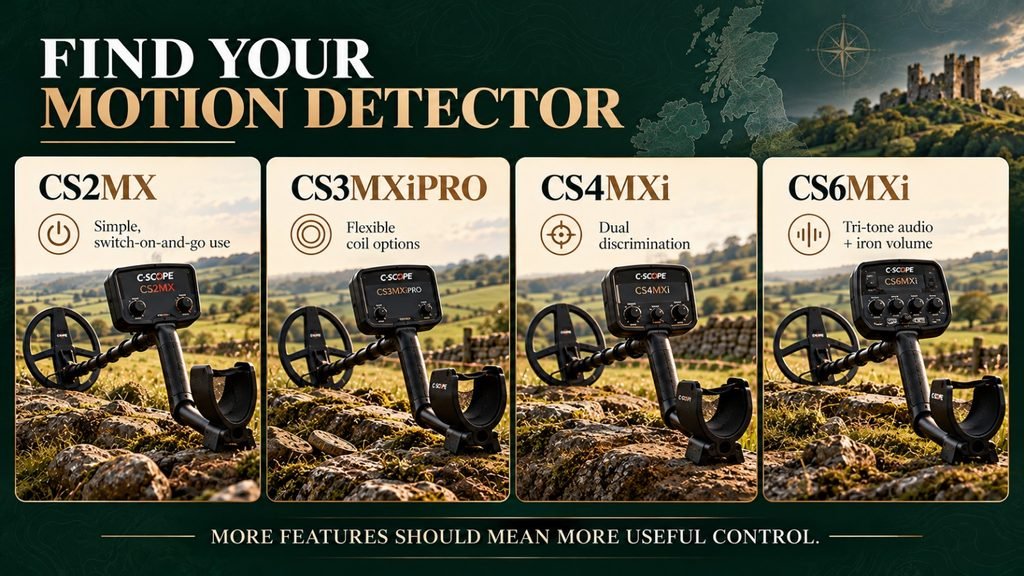
This is probably the most important decision you’ll make when choosing a C-Scope.
Forget the price for a moment. Think about how you actually like to detect.
Choose motion detection if you prefer to:
The CS2MX is a good place to start if you want simple operation. The CS3MXiPRO is worth considering for general-purpose use, while the CS4MXi and CS6MXi offer additional features for more specific requirements.
Choose non-motion detection if you prefer to:
The CS770XD is the accessible entry point, while the CS1220XD is aimed at experienced detectorists who want a more developed non-motion system.
One important point: non-motion doesn’t automatically mean better depth, and motion doesn’t automatically mean better performance. The right choice depends on the machine, the ground, the target and the way you search.
If you’re unsure, compare the operating styles before comparing specifications. That decision will narrow your options considerably.

Here’s a quick comparison of the eight models covered in this guide.
| Model | Listed price | Type | Best suited to |
| CS440XD | £199.99 | Motion | Beginners seeking an affordable British-made detector |
| CS770XD | £279 | Non-motion | First-time non-motion users; inland and beach detecting |
| CS990XD | £360 | Non-motion | Detectorists wanting audio and visual confirmation |
| CS2MX | £299.99 | Motion | Straightforward operation and systematic searching |
| CS3MXiPRO | £399.99 | Motion | General-purpose detection without complex menus |
| CS1220XD | £469.99 | Non-motion | Methodical detection and detailed target assessment |
| CS4MXi | £479.99 | Motion | Dual discrimination and additional ground controls |
| CS6MXi | £775 | Motion | Experienced users seeking advanced motion features |
The motion-versus-non-motion decision matters more than the price alone for many buyers.
The team at UK Metal Detectors can help you compare the models against the type of sites you search and the way you prefer to detect.
Call or visit UK Metal Detectors before making your decision.
C-Scope isn’t necessarily the right choice for everybody, and that’s perfectly fine. The point is to find a detector that suits your priorities rather than buying a machine because it has the longest specification sheet.
C-Scope has a genuine advantage here: its British manufacturing heritage and base in Colchester, Essex.
If you value buying from a manufacturer with a long history in the UK detecting market, it’s a brand worth considering. You also have a range that spans entry-level and more advanced machines without abandoning the same basic emphasis on straightforward audio communication.
Perhaps you’ve spent years using a conventional motion detector and are curious about a slower approach.
The CS770XD and CS990XD are useful models to investigate if you want to explore non-motion detection without moving straight to the more expensive CS1220XD.
Keep in mind that a different operating style may take time to get used to. It’s worth understanding how the machine behaves before deciding whether it suits your usual permissions.
The slower, more deliberate approach can also encourage careful recovery of finds. Whatever detector you choose, follow the NCMD Code of Conduct and make sure you have permission to detect on the land.
This is where the motion range deserves attention.
The CS3MXiPRO, CS4MXi and CS6MXi offer different levels of functionality, but you don’t have to navigate an elaborate menu system simply to begin detecting.
If you’d rather learn your machine’s tones, understand your ground and spend more time searching, that straightforward approach may appeal to you.
And remember, a more expensive detector won’t automatically produce more finds. Knowing your equipment and choosing suitable ground remain important parts of the hobby.
For newcomers, our beginner’s guide to using a metal detector is a useful place to start. You can also explore our metal detecting accessories guide if you’re putting together your first setup.
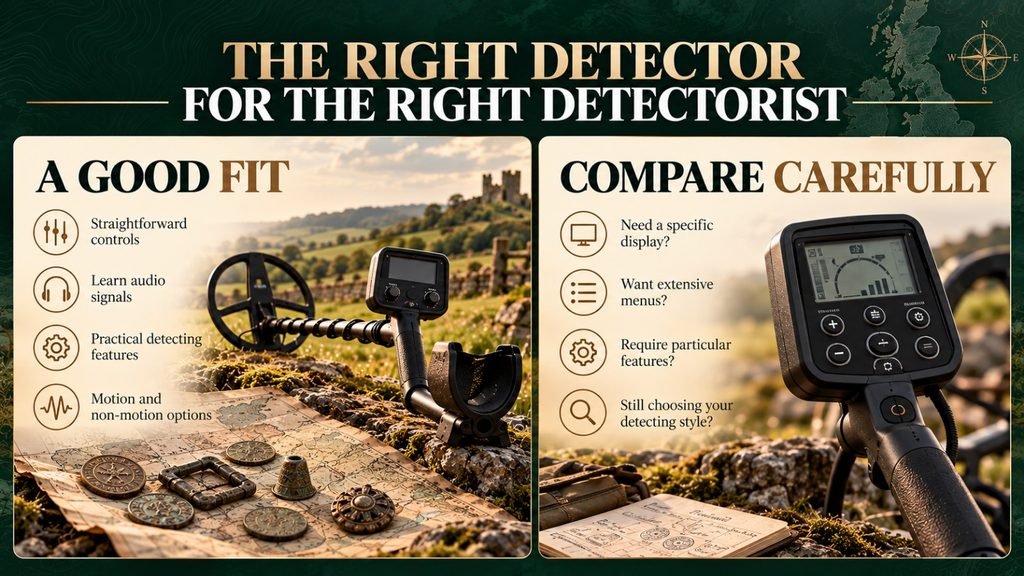
The C-Scope range takes a different approach from detectors that put extensive screens, menus and connectivity features at the centre of the experience.
Its appeal lies in straightforward audio discrimination, the availability of non-motion technology and a range of machines designed for different ways of detecting.
That doesn’t mean every C-Scope will suit every detectorist. If you want a particular feature that isn’t available on your chosen model, another machine may be a better fit. It’s always worth comparing specifications rather than buying on reputation alone.
But if you value clear audio responses, uncomplicated operation or the option to detect without continuously moving the coil, C-Scope deserves a place on your shortlist.
The best detector isn’t necessarily the most expensive one. It’s the one that makes sense for the ground you search and the way you like to detect.
Still deciding between motion and non-motion? Not sure whether the CS2MX, CS3MXiPRO or CS1220XD makes the most sense for your needs?
The team at UK Metal Detectors can help you compare the options before you commit.
Straight advice, no pressure just help finding a detector that suits the way you detect.
Yes, C-Scope metal detectors are worth considering if you want British-made equipment with straightforward audio discrimination. The range includes beginner-friendly models such as the CS440XD and more advanced options such as the CS3MXiPRO and CS6MXi.
Non-motion detection allows a C-Scope detector to register a target without continuous coil movement. Models such as the CS770XD, CS990XD and CS1220XD suit detectorists who prefer slow, methodical searching.
The CS440XD is the most affordable C-Scope model, offering lightweight motion detection and variable discrimination. The CS2MX is worth considering if you want automatic tuning and straightforward operation.
Motion detectors require coil movement to register targets, making them suitable for systematic searching. Non-motion detectors can detect targets with the coil stationary, allowing more deliberate signal investigation.
C-Scope metal detectors are manufactured in Colchester, Essex, UK, by C-Scope International. The brand’s British manufacturing heritage distinguishes it from many European-made detectors available in the UK.