
On this page
Relic Hunting Is a Different Game From Coin Shooting. Your Machine Should Reflect That.
A good coin hunting machine can be excellent at finding a Victorian penny or a silver coin in clean farmland. Relic hunting asks more from a detector. The target might be a Roman brooch sitting beside an iron fragment, a medieval strap end surrounded by farm debris, or a small Anglo-Saxon fitting that gives a weak signal where a coin hunter might simply keep walking.
That is what makes metal detecting relics in the UK so rewarding. Roman military fittings, Anglo-Saxon artefacts, medieval pilgrim badges and Civil War items can all turn up on agricultural land, but the ground is rarely clean around them. Centuries of farming, building and metalworking have left plenty of iron in the soil, so recovery speed and iron handling become just as important as raw depth.
The best metal detector for relic hunting UK sites therefore needs to do more than produce a deep signal. It needs to separate targets, remain stable in difficult ground, and give enough information for the detectorist to decide whether an uncertain signal deserves a dig. Three machines from UK Metal Detectors stand out for different reasons: the Reflex G6, Reflex G10, and Golden Mask.
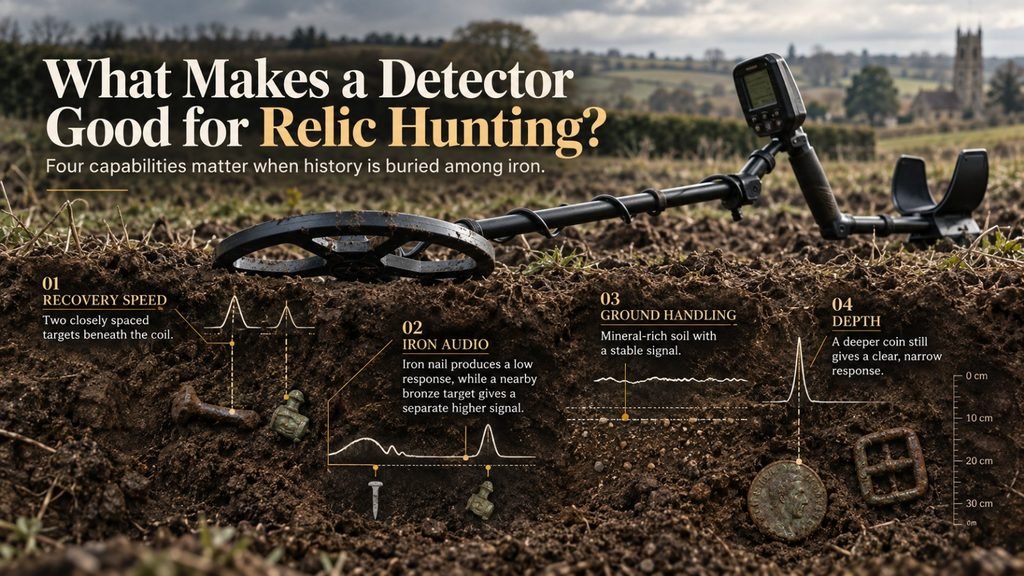
The best relic hunting metal detector UK users can choose needs three things above everything else: fast recovery speed, stable operation in difficult ground, and useful depth. Those characteristics matter because historical sites are rarely filled with neat, isolated targets. Frequency also has a role, but relic hunters need to think about it differently from someone mainly searching for modern or historical coins.
Iron is everywhere on old UK sites. Roman settlements, medieval occupation areas, and old farmsteads have all accumulated nails, tool fragments, and other iron objects over many centuries. That creates a problem when a desirable non-ferrous relic is sitting close to one of them.
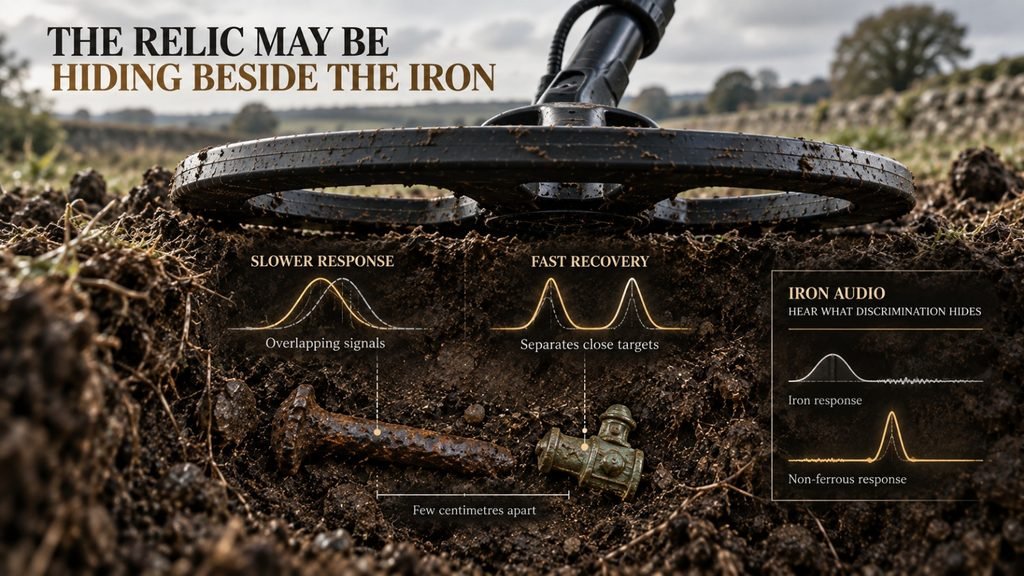
A detector with slower recovery can struggle to separate those responses. The iron signal can dominate what the machine is processing, leaving a nearby relic masked or producing a confusing response. Faster recovery gives the detector more opportunity to separate the individual targets, which is why this feature matters so much on serious relic permissions.
This becomes especially noticeable once a site has already been searched several times. The obvious signals are usually gone, while the remaining finds are hiding in the tight spaces between iron. That makes recovery speed the first characteristic worth considering, but iron audio is what makes those difficult signals much easier to interpret.
Discrimination can make detecting more comfortable, but heavy discrimination can also remove the very targets a relic hunter is looking for. Iron Audio offers another approach. Instead of completely silencing iron, the detectorist can hear it at a reduced volume and use that information to understand what is happening underneath the coil.
That matters because a good relic can sit right next to an iron object. Hearing the iron gives the detectorist another piece of information rather than simply removing the signal from consideration. The Reflex G6 is particularly suited to this approach, with its iron audio mode and fast recovery speed working together for iron-heavy ground.
Running with little discrimination also changes the way a site feels under the coil. There will be more digging, certainly, but there is also more information available from the ground. That approach becomes much more useful when the next challenge is dealing with mineralisation rather than simply separating iron.
Not every productive relic permission sits on light, easy-going soil. Roman sites in northern England, old settlements in the Midlands and historic ground elsewhere can present mineralised or iron-rich conditions that make a detector work harder. Ground conditions can affect stability, which in turn affects how confidently deeper signals can be interpreted.
A machine that becomes noisy while trying to compensate for difficult soil can make deep targets difficult to distinguish from ground response. Stable ground balance helps maintain usable performance instead of encouraging the detectorist to chase every false signal. For a more detailed explanation of how this works, the metal detector ground balance guide is useful before heading onto difficult relic ground.
Once recovery speed, iron audio, and ground handling are understood, the difference between relic hunting and conventional coin shooting becomes much clearer.
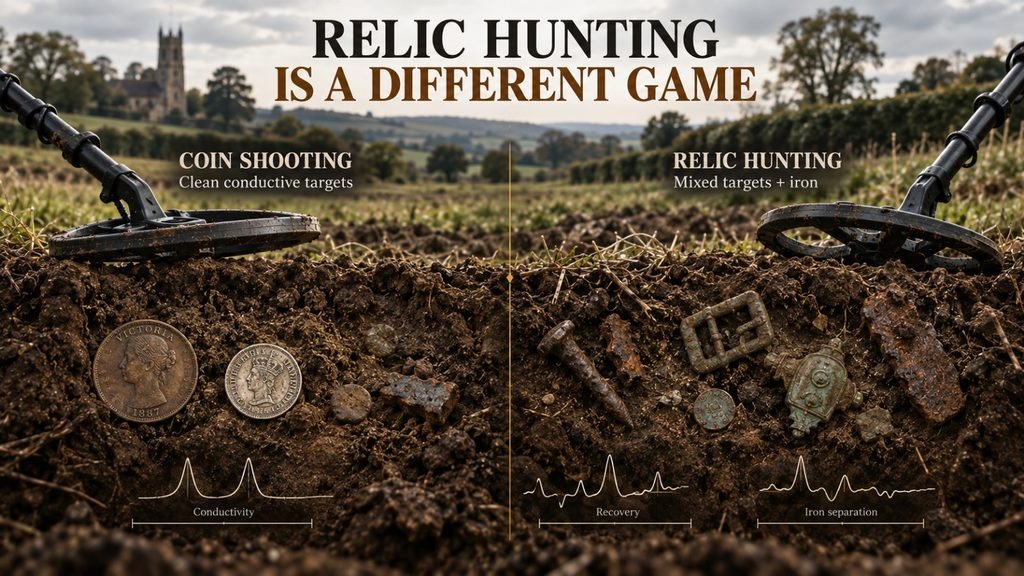
Coin shooting tends to reward conductivity and reliable target identification. Silver coins generally sit towards the higher end of the conductivity range, while copper and bronze coinage can produce recognisable mid-to-high responses. A relic hunter has a much messier target spread to deal with, which makes relying heavily on target ID a risky strategy.
A Roman bronze brooch, an Iron Age tool, a lead seal and a medieval copper alloy strap end can all produce very different responses. Even targets made from the same broad material can behave differently because their size, shape, orientation and surrounding soil affect the signal. Gold can also produce surprisingly low readings depending on the target itself.
That is why aggressive discrimination can work against a relic hunter. Filtering out everything that looks like an undesirable signal might make a coin field quieter, but it can also remove historical objects that happen to fall into those same ranges. Relic hunting rewards curiosity and signal interpretation more than a simple search for a particular number.
The metal detector discrimination guide explains how discrimination changes what a detectorist hears and how those settings can be approached more carefully on iron-heavy sites. Understanding that difference makes the next factor, iron density, much easier to appreciate.
Old sites can contain an enormous amount of iron. Nails, fragments, agricultural debris, and historical objects may all sit within a small area, and a desirable non-ferrous target can be almost impossible to isolate with an unsuitable machine or overly aggressive settings.
Coin shooting on cleaner farmland can be more forgiving. A strong coin signal with plenty of space around it gives the detector a relatively simple job. Relic hunting is different because the machine often needs to identify something useful while another target is sitting almost directly beside it.
Depth matters too, although it should never be viewed in isolation. Historical relics can be found deeper than the shallow modern targets that make up much of casual detecting, particularly where ground has remained relatively undisturbed.
A detectorist searching for significant Roman or medieval material therefore needs consistent performance rather than simply impressive depth claims. A machine that remains stable and gives a usable response is far more valuable than one that produces deep, uncertain noises. That brings the focus to the three machines that make the most sense for this particular style of detection.
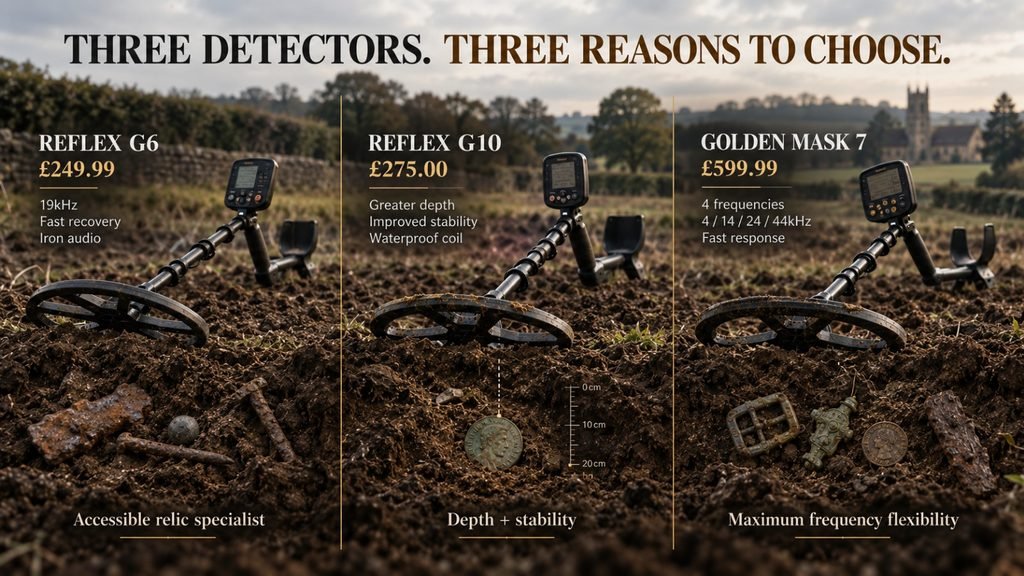
Three machines stand out for different types of relic hunters. The Reflex G6 offers an accessible entry into serious relic detecting, the Reflex G10 adds greater depth and stability, while the Golden Mask 7 gives experienced users four selectable frequencies for different target and ground situations.
At £249.99, the Reflex G6 is the most accessible of the three and a strong starting point for anyone moving from general coin detecting into more serious relic work. It operates at 19kHz and combines fast recovery speed with an iron audio mode, which is exactly the sort of combination that becomes useful once a permission starts producing dense iron.
The iron audio mode is particularly relevant on historical sites. Instead of simply removing iron from the detector’s response, the detectorist can keep it audible at reduced volume and use the sound to understand what is happening around a promising target. That can be valuable when a non-ferrous relic is sitting close enough to iron to create a mixed or uncertain response.
The G6 also has a waterproof search coil, making it suitable for the wet conditions that are simply part of UK detecting. Its depth capability is another reason it attracts serious interest, with the machine described as sensitive to a silver shilling at 14 to 17 inches. It is a “top-notch relic detector”, which fits the machine’s intended strengths particularly well.
Price: £249.99
Best for: Detectorists making their first serious move into relic hunting, or experienced coin hunters who want a capable machine for iron-heavy historical sites.
The Reflex G10 moves up only slightly in price to £275.00, but its appeal comes from the areas where relic hunters often need extra help. Greater depth on small targets and improved stability on high-mineralisation sites make it particularly interesting for detectorists who are regularly searching difficult ground.
Its improved LCD also gives a more accurate readout of metal type and signal indication. That matters because relic signals are not always predictable. A historical fitting can give an unexpected reading because of its shape, size, orientation, or proximity to iron, so having clearer information from the display can help with those uncertain decisions.
Stability becomes even more valuable when the soil itself is making the detector work harder. Instead of constantly questioning whether a response is a real target or ground interference, a more stable machine gives the detectorist a better starting point for investigating weak signals. The waterproof coil also suits the damp conditions commonly encountered during UK autumn and winter detecting.
The G10 therefore makes sense for someone who already understands the basics and wants more from a machine without making a major jump in price. It sits in a useful middle position, offering a step up from the G6 while remaining relatively straightforward for an active detectorist to use.
Price: £275.00
Best for: Relic hunters who want greater depth on small targets, improved display information and more confidence on mineralised ground.
At £599.99, the Golden Mask 7 is aimed at a different detectorist. Its defining feature is four selectable frequencies: 4kHz, 14kHz, 24kHz and 44kHz. That gives an experienced relic hunter considerably more flexibility when moving between different sites and target types.
Lower-frequency operation can be useful when dealing with larger conductive targets, while higher frequencies can offer a different approach to smaller targets. The ability to move between 4kHz, 14kHz, 24kHz and 44kHz means the detectorist is not locked into one frequency for every permission. That versatility is especially useful for someone whose season includes different historical periods and ground conditions.
The GM7 also includes wireless headphones and fast target response, while its handling is described as smooth across different ground conditions. The site description specifically positions the machine for users “searching for coins, relics, jewellery, or gold”, making its flexibility relevant beyond one particular type of detecting.
For an experienced detectorist who regularly researches different periods and works several types of permissions, that adaptability is the main attraction. It costs considerably more than the Reflex machines, but the four-frequency approach gives the GM7 a very different role rather than simply making it a more expensive version of the same detector.
Price: £599.99
Best for: Experienced relic hunters who work varied historical sites and want four selectable frequencies for different targets and conditions.
The best choice depends heavily on the ground being searched and the targets that are most likely to be there. A detectorist working heavily iron-contaminated Roman ground may have different priorities from someone concentrating on deeper medieval farmland, so a recommendation based on the actual permission is more useful than choosing from price alone.
Contact UK Metal Detectors with the type of ground being searched and the targets being chased. The team can help match the machine to the situation rather than simply pointing towards the most expensive option.
The affordable option

Golden Mask 32×28cm DD coil. Light for its size, with good ground coverage.
£129
Add to basketFull detailsIn stock
| Detector | Price | Best Relic Type | Key Strength | Recovery Speed |
| Reflex G 6 | £249.99 | All UK relics, iron-heavy sites | Iron audio, 19kHz, fast recovery | Excellent |
| Reflex G10 | £275.00 | Deep relics, mineralised ground | Depth on small targets, stable display | Excellent |
| Golden Mask 7 | £599.99 | Period-specific, varied relic type | Four frequencies, maximum adaptability | Very good |
The table makes the price difference clear, but price alone does not decide which detector belongs on a particular permission. The next step is getting the settings right, because even a capable machine can struggle if it is configured like a coin-shooting detector.
Relic hunting settings should generally favour information over silence. The goal is not to make the detector produce fewer signals. The goal is to make those signals easier to understand, especially when desirable targets are mixed with iron.
High discrimination can feel tempting after a few hours of digging nails. The problem is that historical relics do not politely stay inside the target ranges a detectorist expects. Bronze, lead, iron alloy, and other materials can produce responses that overlap with objects normally dismissed as junk.
Starting with very low discrimination, or none where practical, leaves more information available. Iron audio can make that approach less tiring by giving iron its own audible character instead of forcing every target into the same response. The G6 and G10 are particularly relevant here because their iron audio capability supports this style of searching.
Digging more targets takes longer, but the extra information is the point. On a site where an important object could be sitting beside a nail, reducing the number of holes is not necessarily the same thing as improving the results.
Sweep speed matters enormously on dense relic ground. Moving the coil quickly across a clean field can cover plenty of ground, but a heavily iron-contaminated site requires more patience because the detector needs a chance to separate closely spaced responses.
A slower, methodical sweep also makes repeatable signals easier to recognise. If the response changes dramatically every time the coil passes over the same spot, that is useful information in itself. Good relic hunting often feels slower than ordinary coin shooting, but that slower pace is what allows difficult signals to be investigated properly.
Coin hunting can tolerate more selective discrimination because the target range is often narrower and the main objective is identifying desirable conductive targets. Relic hunting needs a wider net because the objects of interest can fall almost anywhere across the detector’s response range.
That does not mean every relic hunter should use identical settings. Soil, iron density, target type, and detector choice all affect the approach. The best metal detector for coins UK guide is useful for comparing the more coin-focused approach with the broader settings normally preferred for relic work.
Once the detector is configured for the job, the next question is just as important: where should that detector actually be used?
The sensible middle

The most powerful coin detector in the Golden Mask range.
£649.99£699.99Save £50
Add to basketFull detailsIn stock
Historical activity is rarely distributed evenly across the countryside. Old roads, settlements, military sites, river crossings and areas of long-term agriculture can all create promising permissions, but research should come before the coil goes into the soil.
Roman forts, marching camps, roads, settlements and river crossings can be particularly interesting for relic hunters. Military activity produced a wide range of metal objects, including fittings, personal items and equipment components, while nearby civilian areas can contain an equally varied collection of everyday objects.
The Midlands, East Anglia, northern England and parts of southern England all contain extensive Roman archaeology, but the quality of a permission depends on its specific history rather than simply its location. A field next to documented Roman activity may be more interesting than a large area with no historical evidence at all.
Research therefore matters as much as detector choice. The best places for metal detecting in the UK guide can help identify the types of locations worth researching before approaching landowners.
Anglo-Saxon and Viking-period material can include strap ends, pins, weights, fittings and fragments of personal items. Agricultural areas in the Midlands, East Anglia and Yorkshire can be particularly interesting because occupation and movement have left material across large areas of historic countryside.
These periods can also overlap with earlier and later activity. A single permission might contain Roman material, Anglo-Saxon objects and medieval finds because people repeatedly used the same favourable areas for settlement, travel or agriculture.
That mixture is part of the attraction. It also makes responsible detecting essential, because good permissions can remain productive for years when detectorists respect landowners, record finds and follow recognised standards of conduct. The NCMD Code of Conduct provides useful guidance for responsible detecting practice.
Medieval farmland can produce pilgrim badges, seals, dress accessories and everyday objects associated with people who lived and travelled through the area. Former settlements, abbeys, market centres and pilgrimage routes are all worth researching when seeking permission.
These areas can sometimes have less concentrated iron than Roman military sites, although every field is different. That means depth and signal interpretation can become more important, particularly when searching for smaller objects that have been buried for centuries.
Permission should always come first. Historical interest does not give automatic access to private land, and sensitive archaeological locations can have additional restrictions that must be checked before detecting.

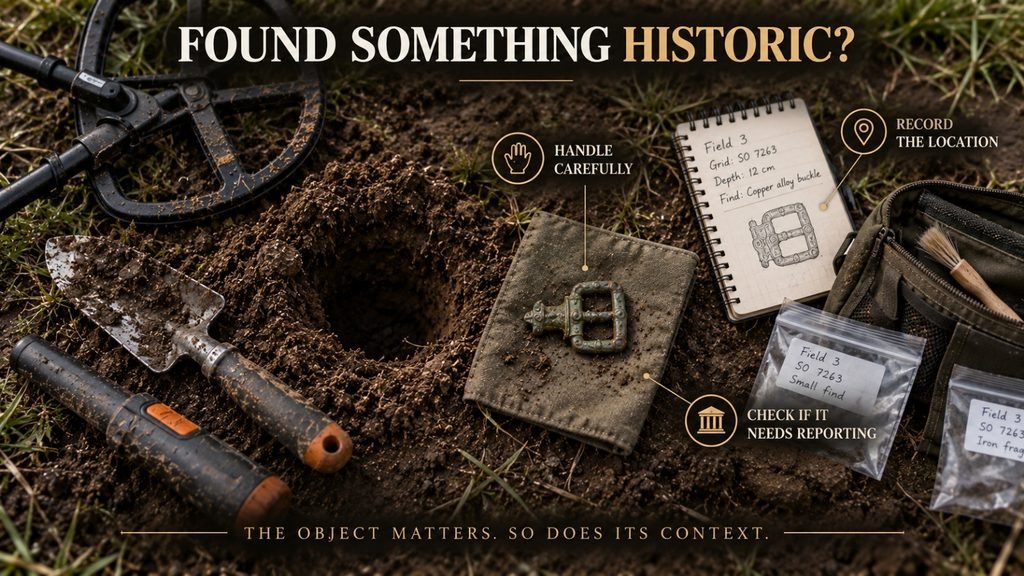
Finding the object is only the first part of responsible relic hunting. Once something potentially historic comes out of the ground, resist the urge to clean it immediately, because rubbing, scraping or aggressive cleaning can damage surfaces and remove details that are useful for identification.
Place the object in a separate finds bag and make a note of the approximate location and depth while the information is still fresh. Keeping finds from different locations separate also makes later recording much easier, particularly after a long day in the field.
The Portable Antiquities Scheme provides a way to record significant archaeological finds that are not necessarily Treasure and contributes those discoveries to the national archaeological record. Treasure rules are more specific, and certain qualifying finds, including some objects made from precious metals and older objects, may need to be reported through the appropriate legal process within the required timeframe.
If there is any doubt about whether a find could fall under the Treasure Act, it is better to seek proper guidance than make an assumption in the field. Careful handling and accurate recording protect both the object and the information surrounding its discovery, which is often just as valuable as the item itself.
The serious choice
A good relic machine does not magically turn every signal into a Roman brooch. What it does is give the detectorist a better chance of hearing the difficult signals that other approaches can lose, particularly when iron is close to the target. Recovery speed, sensible discrimination and stable operation are the foundations, while experience turns those raw signals into decisions about what deserves a spade.
The Reflex G6 makes the most sense for detectorists looking for strong relic capability without a large investment. The Reflex G10 is the logical step up for those wanting greater depth on small targets and improved stability, while the Golden Mask 7 gives experienced users four frequencies and much more flexibility across different types of ground and historical targets.
Autumn is an excellent time to get serious about relic hunting. Freshly worked farmland can expose ground that has been hidden for years, and the right machine gives those deeper, masked signals a better chance of being heard.
Ready for the relic hunting season?
If there is a particular type of permission being searched, a historical period being targeted, or a current detector that is no longer delivering the results expected, the team at UK Metal Detectors can talk through the options before a decision is made.
Contact UK Metal Detectors and explain the ground and targets being searched. The right machine depends on the situation, and honest advice is more useful than simply choosing the most expensive detector.
For many detectorists, the Reflex G6 at £249.99 is a strong starting point because it combines 19kHz operation, fast recovery speed and iron audio. The Reflex G10 at £275.00 is another strong choice where greater depth on small targets and stability on mineralised ground are priorities. Experienced detectorists working varied sites may prefer the Golden Mask 7 at £599.99 because its four selectable frequencies provide greater flexibility.
Fast recovery speed, useful iron audio and stable performance in difficult ground are three of the most valuable characteristics for a relic hunting metal detector UK detectorists can rely on. Relic targets can sit across a much wider range than typical coin targets, so excessive discrimination can remove useful signals. Good relic detecting therefore depends on hearing more of the ground and learning which responses deserve further investigation.
UK detecting can produce material from many periods, including Roman, Anglo-Saxon, Viking, medieval and Civil War contexts. Finds can include brooches, strap fittings, pins, weights, personal items, pilgrim badges, seals, musket balls and other historical objects. The exact material found depends heavily on the history of the permission, which is why researching the site before detecting is so valuable.
Yes, because the target range and ground conditions can be very different. Coin shooting often places greater emphasis on identifying conductive targets, while relic hunting requires attention to targets across a much wider response range and frequently involves dense iron. Fast recovery speed and the ability to hear rather than completely reject iron are therefore particularly useful for serious relic hunting.
Permission requirements apply to relic hunting just as they do to other forms of metal detecting. Written landowner permission should be obtained before detecting on private land, while protected archaeological sites such as scheduled monuments have additional legal restrictions. Finds that meet the legal definition of Treasure must also be reported according to the applicable rules, so detectorists should understand their responsibilities before heading onto historic ground.
Not sure which of these suits the ground you search? Tell us where you detect and we will point you at the right one, including the cheaper one when that is the honest answer. We use these machines ourselves.