
On this page
Knowing when to upgrade a metal detector UK detectorists actually use comes down to one simple question: is the machine holding you back, or are you still learning what the current machine can do?
One detectorist may have spent 18 months using an entry-level machine and started noticing that other people are finding targets on the same fields that never show up in their pouch. Another may have owned a mid-range detector for six months, had several quiet sessions and started wondering if a more expensive machine would suddenly change the results. Both are reasonable situations, but they need very different answers.
An upgrade can make a noticeable difference when the current machine has reached a genuine technical limit. It can also be a very expensive way of avoiding a settings or technique problem. The useful part is knowing which situation applies before spending money, and that is what this guide is designed to help with.
That distinction matters because whether it is worth upgrading my metal detector cannot be answered by looking at price alone. A more expensive detector does not automatically produce more finds, particularly if the current machine is still being used with unsuitable settings or technique.
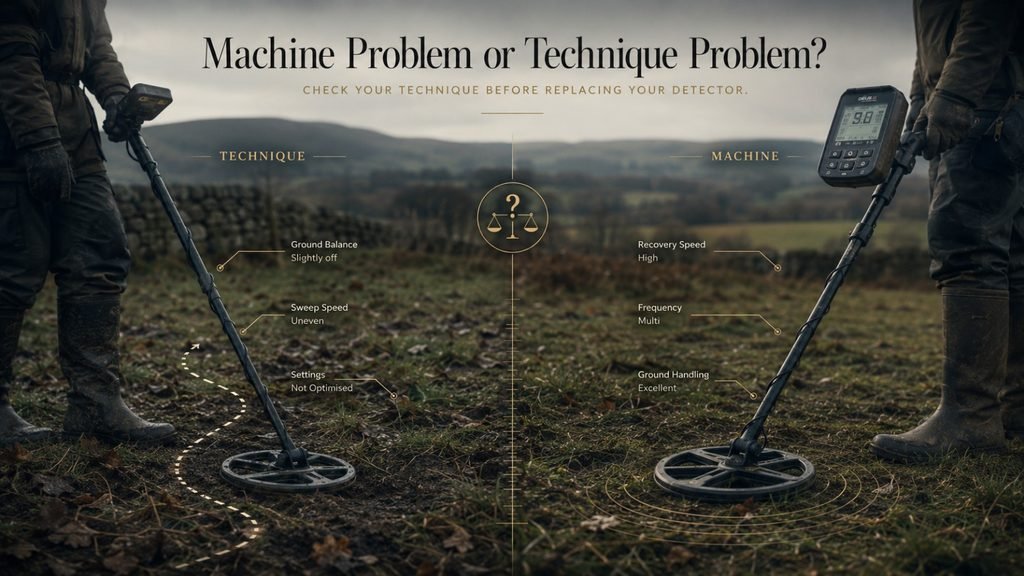
Before looking at a replacement, check how the current detector is actually being used. Ground balance needs to suit the soil being searched, sensitivity needs to remain stable rather than simply being pushed to maximum, and sweep speed needs to be slow enough for the detector to process targets properly. Discrimination can also make a major difference, especially on UK farmland where iron and desirable targets can sit close together.
A detectorist who sweeps too quickly or runs excessive discrimination can miss targets with a more expensive machine just as easily as with an entry-level one. The same applies when ground balance has not been recalibrated after moving onto different soil. The metal detector discrimination guide and metal detector ground balance guide are useful checks before deciding that new equipment is the answer.
Once those basics have been ruled out, the upgrade question becomes much clearer. There are situations where the detector itself really does have a ceiling, and those signs tend to repeat themselves on the same type of ground.
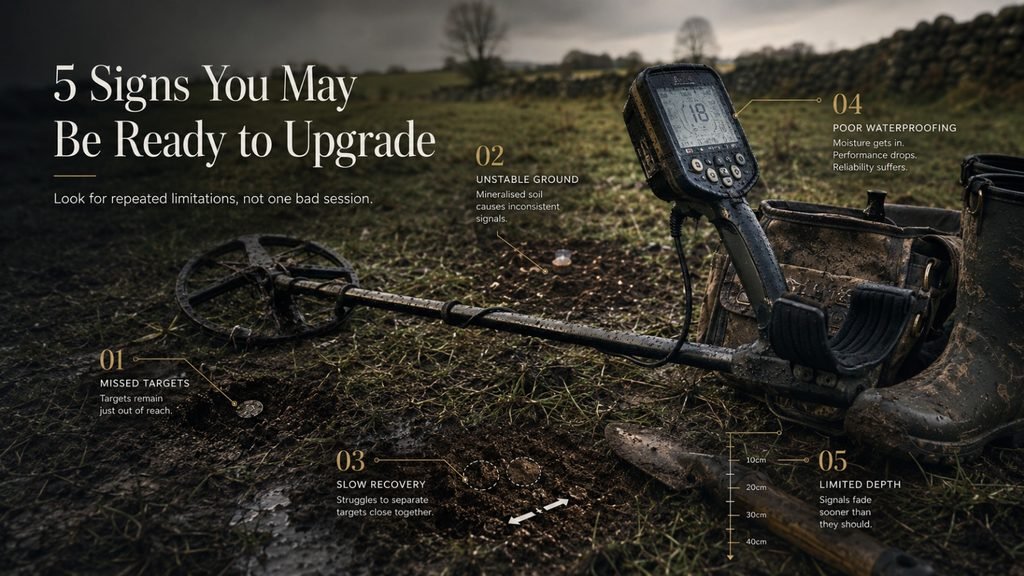
Once technique and settings have been checked, repeated problems with the machine become much more meaningful. The signs you need a new metal detector are not simply a few poor sessions or an empty finds pouch. They are consistent limitations that show up under the conditions where you actually detect.
The strongest evidence comes from direct comparison on the same permission. If experienced detectorists are repeatedly finding targets in areas you have already searched, and your settings and technique are sound, the difference may be equipment rather than luck.
Recovery speed is particularly relevant on iron-heavy farmland because desirable targets can sit close to unwanted iron. A detector with slower processing may struggle to separate those signals, while a faster machine can give the detectorist a better chance of recognising the target. Frequency also matters for certain targets, particularly small or thin objects such as hammered silver.
One missed target proves very little, because detecting always involves an element of chance. A repeated pattern across the same ground is different, especially when another detectorist using a more capable machine is consistently finding targets that your detector does not report clearly. That repeated comparison is one of the strongest reasons to investigate a metal detector upgrade UK rather than simply changing settings again.
A detector that works well in one environment may become difficult to use in another. Mineralised soil, wet sand and changing ground conditions can expose limitations that are barely noticeable on easier ground.
If a detector chatters, falses or becomes difficult to stabilise on a particular permission despite sensible settings, the problem deserves closer attention. Wet beach sand can be particularly demanding, while heavily mineralised ground can make stable operation harder for machines with more limited ground handling. If another detectorist can operate consistently on the same ground with a more capable machine, the difference becomes easier to identify.
This does not mean every unstable signal requires a new detector. Settings, coil condition, and sweep technique should be checked first. If the instability remains after those checks and regularly prevents productive searching, the machine may simply not be suited to the ground being covered.
For many UK detectorists, recovery speed is one of the most noticeable reasons to consider an upgrade. Farmland can contain a mixture of iron and desirable targets, sometimes close enough together that a slower detector struggles to separate them.
A detector with faster recovery can process nearby signals more effectively, giving the user a better opportunity to hear and investigate a good target beside iron. The Reflex G6, for example, uses 19kHz operation and fast recovery speed alongside iron audio and proper ground balance. Those capabilities are particularly relevant when the problem is not a lack of targets, but difficulty separating them.
If a field produces occasional coins but feels as though more should be there, recovery speed is worth considering. It is not a promise that a faster detector will suddenly fill the pouch, but it can remove a specific technical limitation that matters on iron-heavy ground.
The UK weather creates another practical reason to upgrade. A detector that cannot comfortably handle the conditions where you want to search can restrict how often and where it gets used.
Constantly avoiding drizzle, worrying about moisture around the control box, or staying away from wet beach areas can turn waterproofing into more than a convenience. A detector with a waterproof coil and better protection for the conditions being encountered gives the detectorist more freedom to search without constantly watching the forecast.
This matters most when wet conditions are part of normal detecting rather than an occasional inconvenience. If the current detector repeatedly stops you from searching the ground you actually want to cover, better weather resistance can be a genuine upgrade rather than an unnecessary luxury.
Depth is one of the easiest things to blame when a session produces disappointing results, but it is also one of the most misunderstood. Soil conditions, target size and mineralisation all affect how deeply a signal can be detected, so a machine’s advertised capability does not translate into one guaranteed depth in every field.
The stronger indication is repeated performance on known ground. If historically productive land is producing only shallow modern targets with the current machine, while a more capable detector is consistently responding to deeper desirable targets under similar conditions, depth may be part of the problem.
The important point is consistency. One deep find does not prove a detector is excellent at depth, just as one shallow session does not prove it lacks depth. When the same limitation appears repeatedly under comparable conditions, it becomes a reasonable part of an upgrade decision.
The affordable option
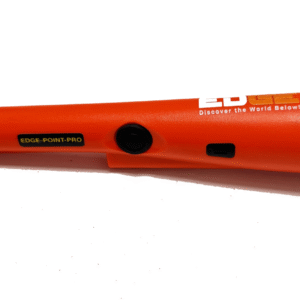
Pinpointer. Finds the target in the hole instead of the spoil.
£49.95£69.99Save £20.04
Add to basketFull detailsIn stock
Those signs help identify a real limitation, but knowing what an upgrade actually improves prevents another common mistake. Buying a more capable detector only helps when its extra capability matches the problem being experienced.
Recovery speed can make a major difference on iron-heavy farmland, particularly where coins and other desirable targets sit close to unwanted metal. Frequency also matters for particular target types, with higher-frequency operation offering useful sensitivity characteristics for smaller targets and thin hammered silver.
Ground balance quality becomes more valuable as the ground becomes difficult. Stable operation on mineralised soil or wet beach conditions can make a bigger difference to a session than simply having a higher price tag. Target ID can also become more useful as detector capability improves, giving the user more information when deciding which signals deserve investigation.
Water resistance, ergonomics, battery performance and general build quality can improve the experience of longer sessions too. Those benefits may not directly create more finds, but a detector that is easier and more comfortable to use can encourage longer, more consistent detecting.
A better detector cannot improve a poor permission. If the ground has little historical activity or has already been heavily searched, spending another few hundred pounds on equipment will not create targets that are not there.
It also does not automatically improve signal interpretation. A detectorist who has not learned how different targets respond can still ignore a good signal after upgrading. Basic technique remains just as important, including sweep speed, coil control, ground balance and sensible discrimination.
That is why accessories should also be considered before replacing the whole detector. A suitable pinpointer, headphones or coil can sometimes address a practical problem for considerably less money than a new machine. The metal detecting accessories guide is worth checking before committing to a full upgrade.
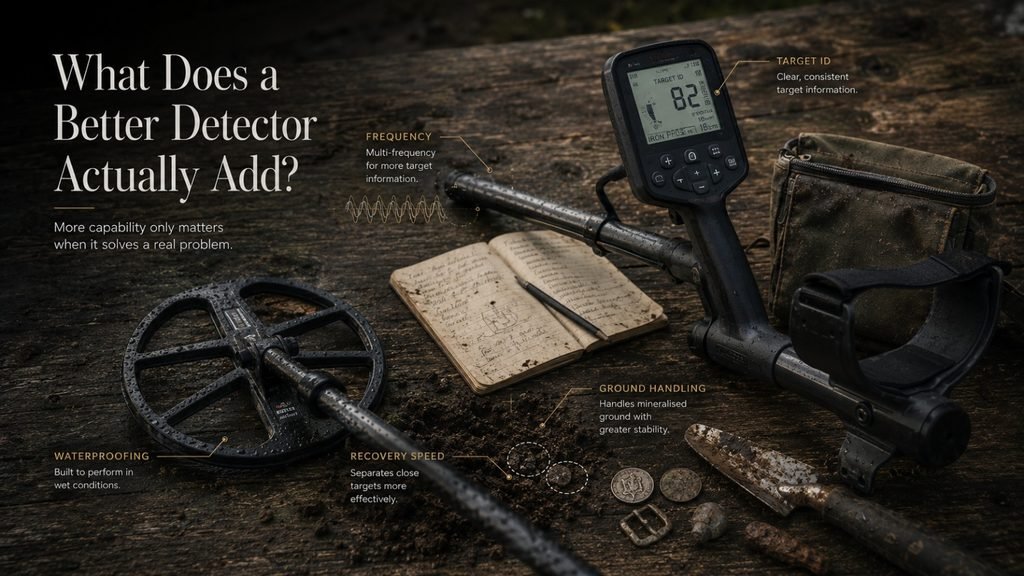
Once the reason for upgrading is clear, budget becomes much easier to judge. The best metal detector upgrade UK buyers choose is not necessarily the most expensive option. It is the machine that adds the capability needed to solve the problem.
At the entry level, the Lander XD50 at £99.99 and Edge-Tec at £149 sit in the range designed to make getting started straightforward. The Lander XD50 is a turn-on-and-go detector with preset ground balance and no VDI screen, while the Edge-Tec provides an icon display and more information.
These machines can be perfectly suitable for learning the hobby and detecting on easier UK farmland or general ground. Their limitations become more relevant when the detectorist starts working in difficult mineralised conditions, iron-heavy sites, or wants more control over how the machine responds.
For someone still learning target signals and basic settings, this price range can be enough for quite a while. The upgrade question becomes stronger once the detectorist can clearly explain what the current machine cannot do.
This is where many detectorists will notice the biggest practical jump from an entry-level machine. The Reflex G6 is £249.99, while the Reflex G10 is £275.
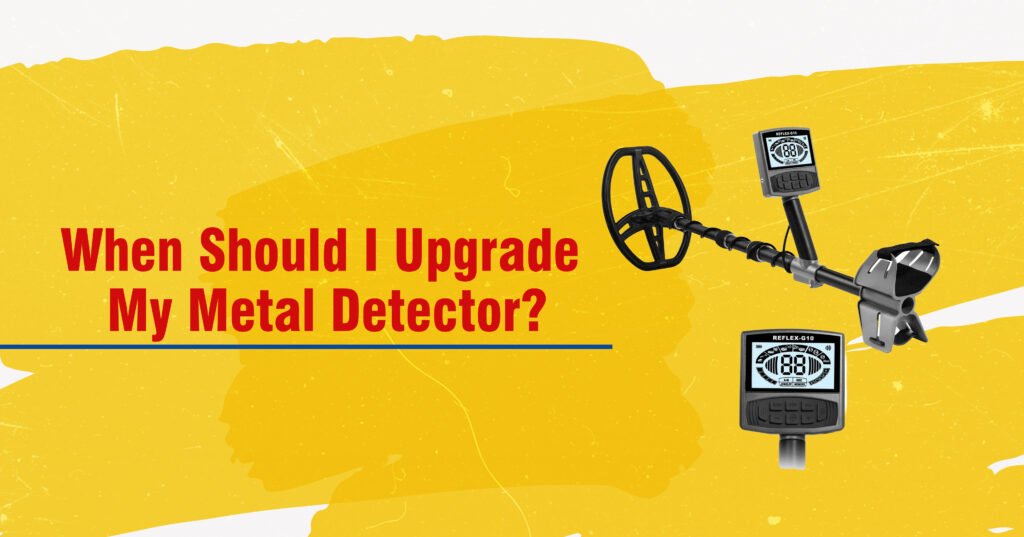
The G6 brings 19kHz operation, fast recovery speed, iron audio, proper ground balance and a waterproof coil. Those features directly address several of the problems that can appear when an entry-level detector starts being used seriously on UK farmland, beach ground and more challenging sites.
The G10 moves another step up, with improved LCD accuracy, greater depth on small targets and stable operation on high-mineralisation sites, alongside its waterproof coil. For many detectorists making their first serious upgrade, the £199 to £275 range is where the additional capability becomes easier to justify because the improvements relate directly to common detecting problems.
If the main goal is coin hunting, the best metal detector for coins UK guide can help put those options into a wider coin-focused context.
Moving beyond the mid-range makes more sense when the detectorist has already developed strong technique and knows exactly what additional capability is required. At this level, the decision should be based on the type of detecting being done rather than simply assuming that a higher price will produce proportionally more finds.
An experienced detectorist who understands frequency, ground conditions, target behaviour and the limitations of the current machine is in a much better position to benefit from advanced equipment. Someone still learning the basics may spend considerably more without being able to use the additional capability effectively.
The price jump therefore needs to be treated as a capability decision, not a status upgrade. The further up the range the purchase goes, the more specific the reason for buying should become.
Professional gold detection equipment starts from around £1,300 and moves into a very different category from general-purpose coin and relic detecting. These machines are intended for specialist applications where the detectorist has a clearly defined requirement that standard equipment does not address.
That could mean a specific gold prospecting objective or another specialist detection application. They should not be viewed as the natural next step for every detectorist who has outgrown an entry-level machine. At this price, the reason for buying needs to be specific enough to justify specialist equipment rather than simply being “more depth”.
Not Sure Which Upgrade Is Right for Your Ground?
The right upgrade depends on three things: the machine currently being used, the UK ground being detected on most often, and the targets being sought. Those three factors together are far more useful than choosing a machine simply because it costs more. The team at UK Metal Detectors can help assess the situation and explain whether an upgrade actually makes sense.
Contact UK Metal Detectors with the current machine and the type of ground being searched for an honest recommendation.

The sensible middle

Golden Mask 32×28cm DD coil. Light for its size, with good ground coverage.
£129
Add to basketFull detailsIn stock
The price ranges show what is available, but the better buying decision starts with the problem rather than the product. A useful metal detector upgrade UK decision should be based on what the current machine is failing to do consistently.
General disappointment is not enough. A specific problem is much more useful, such as constant instability on mineralised ground, poor separation around iron, inadequate waterproofing or difficulty detecting the target types being pursued.
The upgrade should solve that particular problem rather than simply offer a longer list of features. If the problem cannot be clearly explained, more time with the current detector may be more valuable than spending money on another one.
Ground conditions should have a major influence on the decision. A detectorist mainly working on easier farmland has different requirements from someone regularly searching wet beaches or heavily mineralised soil.
Think about where most sessions actually happen, not where you might detect one day. A specification that looks impressive on paper is less useful if it does not address the conditions faced on most outings.
Before buying, give the current detector a fair test with sensible settings. Check discrimination, sensitivity, ground balance and sweep speed, then compare its performance under consistent conditions.
If the machine suddenly performs better after those changes, the issue was probably not the detector itself. If the same limitation remains despite correct use, the case for an upgrade becomes much stronger.
For many detectorists making their first upgrade, the £199 to £275 range offers a sensible point to investigate because it moves beyond basic entry-level capability without immediately moving into specialist equipment. The Reflex G6 at £249.99 and Reflex G10 at £275 sit within that range.
Spending more can make sense once the detectorist has genuinely reached the limits of a mid-range machine. The important part is matching the budget to a clearly identified need rather than increasing the budget simply because a more expensive detector exists.
Knowing when not to buy is just as useful as knowing when to upgrade the metal detector UK detectorists are asking about. In some cases, keeping the current machine and improving the way it is used will produce a better return than replacing it.
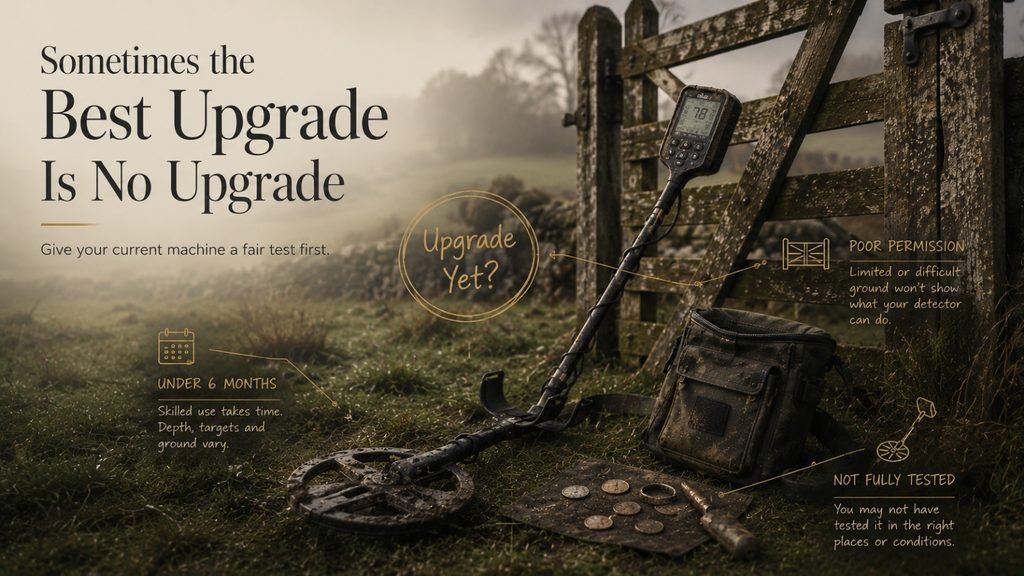
Six months can be a surprisingly short period in metal detecting. There is still a lot to learn about signal behaviour, settings, ground conditions and the way different targets respond.
A detectorist who upgrades before understanding the current machine may simply carry the same habits over to a more expensive model. Give the existing detector enough time and different ground conditions to establish whether its limitations are real.
A poor permission can make even a very capable detector look disappointing. If the land has little historical activity, has already been searched heavily, or simply does not contain many detectable targets, changing machines will not solve the underlying problem.
Better site research and permission building may therefore be a better investment. Responsible detecting matters too, so the NCMD Code of Conduct is worth understanding before focusing heavily on equipment.
An entry-level detector used only in a garden or on one disappointing beach has not necessarily been given a fair test. Try it on suitable ground, use sensible settings and adopt a slow, methodical sweep before deciding it has reached its limit.
That gives a much clearer baseline for comparison. If the detector still struggles in the conditions it is intended to handle, an upgrade becomes a decision based on evidence rather than frustration.
The serious choice
The quickest answer to whether it is worth upgrading my metal detector depends on the problem being experienced rather than the age or price of the current machine.
| Situation | Recommendation |
| Under 6 months on current machine | Learn the machine before upgrading |
| Consistent false signals on mineralised UK ground | Upgrade if settings and ground balance have been checked |
| Missing coins other detectorists find on the same field | Investigate recovery speed and frequency |
| Poor results on poorly researched permission | Improve permissions first |
| Struggling on beaches in wet sand | Consider better ground handling and waterproofing |
| Wanting to find hammered silver specifically | Consider a machine with suitable higher-frequency capability |
| Budget £150 to £300 | Investigate the Reflex G6 or G10 |
| Budget £400 to £500 | Consider advanced equipment only if the current machine is genuinely limiting |
| Specific gold prospecting goal | Look at professional specialist equipment from around £1,300 |
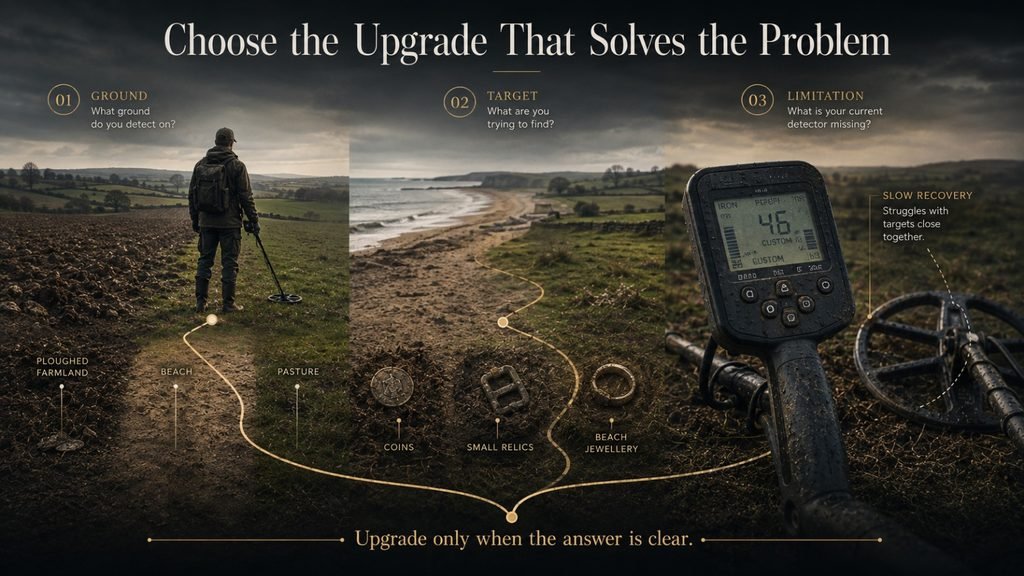
The answer to when to upgrade metal detector UK detectorists should follow is simple: upgrade when a specific limitation has been identified, not simply because a newer or more expensive machine looks appealing. The strongest case comes when technique and settings have already been checked, the ground is suitable, and the current detector repeatedly struggles with a problem that a more capable machine is designed to address.
That is also why a metal detector upgrade UK decision should start with the machine, ground and targets rather than the price tag. The right upgrade can make sessions more productive when recovery speed, ground handling, frequency or waterproofing is genuinely holding the detectorist back. The wrong upgrade simply costs more while leaving the original problem untouched.
If you are still asking Is it worth upgrading my metal detector, the answer may only take ten minutes to work out with the right information. Tell the team what machine you have, what ground you detect on and what you are currently finding, and they can give a straightforward view on whether an upgrade makes sense.
Tell Us What You Have, What You Detect On, and What You Are Finding
That is enough to work out whether an upgrade is likely to make a meaningful difference and which type of machine fits the situation. There is no point moving to a more expensive detector if the current one Contact UK Metal Detectors for an honest recommendation based on your current machine, ground, and targets.
Not sure which of these suits the ground you search? Tell us where you detect and we will point you at the right one, including the cheaper one when that is the honest answer. We use these machines ourselves.