
On this page
Most detectorists spend hours comparing frequencies, discrimination modes, and target ID systems, then give surprisingly little thought to the search coil attached to the bottom of the shaft. That is a mistake because the coil is the part of the machine actually working against the ground. It creates the electromagnetic field, receives the returning signal, and determines how much ground is covered with each sweep.
Changing the coil can also be a much more targeted upgrade than replacing the entire detector. A different size or coil design can change how the same machine behaves on an iron-heavy field, a wet beach, or a relatively clean permission. The right choice depends less on having the biggest coil available and more on matching the coil to the ground and the targets being searched.
This guide explains metal detector coils in plain English, including DD and concentric designs, small and large coils, and what each option actually changes during a UK detecting session. By the end, choosing a metal detector coil upgrade should feel much less like guesswork.
What a Metal Detector Coil Actually Does
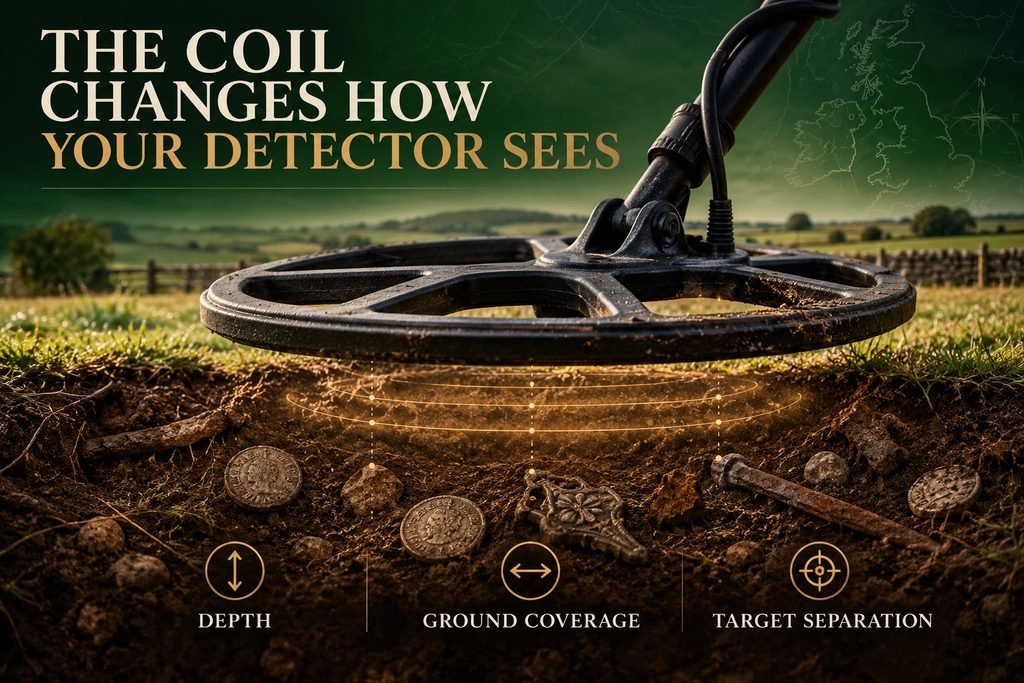
A metal detector search coil is the component at the end of the detector shaft that sends an electromagnetic field into the ground and receives the response from buried metal. When the field reaches a metallic object, it induces electrical currents in the target, which creates a secondary magnetic response. The coil detects that response and passes the information to the control box, where it becomes the tones, target IDs, and other information on the screen.
That makes the coil the starting point for almost everything the detector tells you. Its design influences detection depth, ground coverage, and how well the machine can separate nearby targets. Two detectors with similar electronics can behave quite differently if one is fitted with a small DD coil and the other with a large coil. That difference becomes especially noticeable once the ground gets mineralised or crowded with iron.
Coil choice therefore comes down to three practical questions: how deep the targets are likely to be, how much ground needs to be searched, and how close those targets are to unwanted metal. A large coil can cover more ground and provide more depth on larger targets, while a smaller coil can make a cluttered site much easier to work. The coil geometry then adds another layer, because DD and concentric coils create different detection patterns.
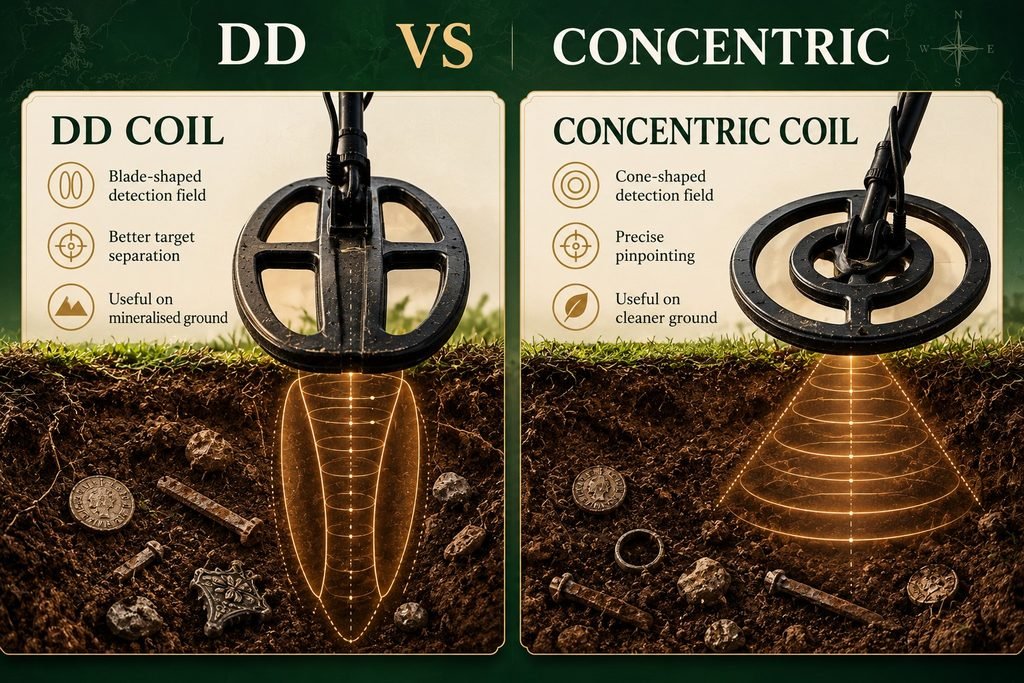
The two main coil geometries are concentric and Double-D, usually called DD. A concentric coil creates a cone-shaped detection field, while a DD coil creates a blade-shaped field running from the front of the coil towards the back. Garrett’s official guide to coil types describes the same basic difference and explains why DD coils are widely used where mineralised or difficult ground is involved.
A concentric coil uses circular transmit and receive windings arranged around one another. The resulting electromagnetic field is strongest around the centre and narrows as it moves deeper into the ground, creating the familiar cone shape. That gives the coil a very defined centre point, which is one reason concentric coils have a reputation for precise pinpointing.
The trade-off is ground coverage. Because the deepest part of the detection field is concentrated around the centre, the coil needs more overlap between sweeps to make sure no ground is missed at maximum depth. On clean, low-mineralisation ground, that is not necessarily a major problem. In fact, a good concentric coil can be a very effective option where there is little iron and accurate pinpointing matters.
The problem appears when several targets are close together. The cone-shaped field can interact with more than one object at the same time, making the detector’s response harder to interpret. On an old UK site where nails, iron fragments and non-ferrous finds can sit close together, that can increase the chance of target masking.
A DD coil uses two overlapping D-shaped windings. The resulting detection field is blade-shaped rather than cone-shaped, extending from the front of the coil towards the back. The detailed breakdown of how DD coils differ from concentric coils explains how this shape changes both ground coverage and target separation.
That blade-shaped field is why DD coils are so useful on UK ground. Detection is not concentrated only at one central point, so the coil can maintain useful detection across more of its length. This also means the detectorist can work with less sweep overlap while still covering the ground effectively.
Target separation is the other major advantage. A narrower detection zone gives the detector a better chance of seeing a non-ferrous target sitting close to an iron object as a separate response. That matters on old farmland, former settlement sites and other permissions where centuries of human activity have left plenty of iron in the topsoil.
DD coils also handle mineralised soil better than equivalent concentric designs in many conditions. Published comparisons commonly put the depth advantage at around 10 to 15 percent for DD over equivalent concentric coils in mineralised ground, although actual performance depends on the detector, coil, target and soil. The important point is not to treat that percentage as a guaranteed depth increase. The real benefit is that a DD coil can remain more stable in difficult ground, allowing the detector to make better use of its available performance.
DD coils make more sense for most UK detecting conditions, but that does not make concentric coils obsolete. On clean, low-mineralisation ground with little iron contamination, a quality concentric coil can provide excellent depth and very accurate pinpointing. The focused centre of its detection pattern can also make target recovery straightforward.
A concentric coil therefore still has a place for detectorists working relatively clean permissions. The choice simply changes once mineralisation, iron or target density increases. For most UK detectorists looking for one coil that handles a broad range of conditions, DD is the more practical starting point.
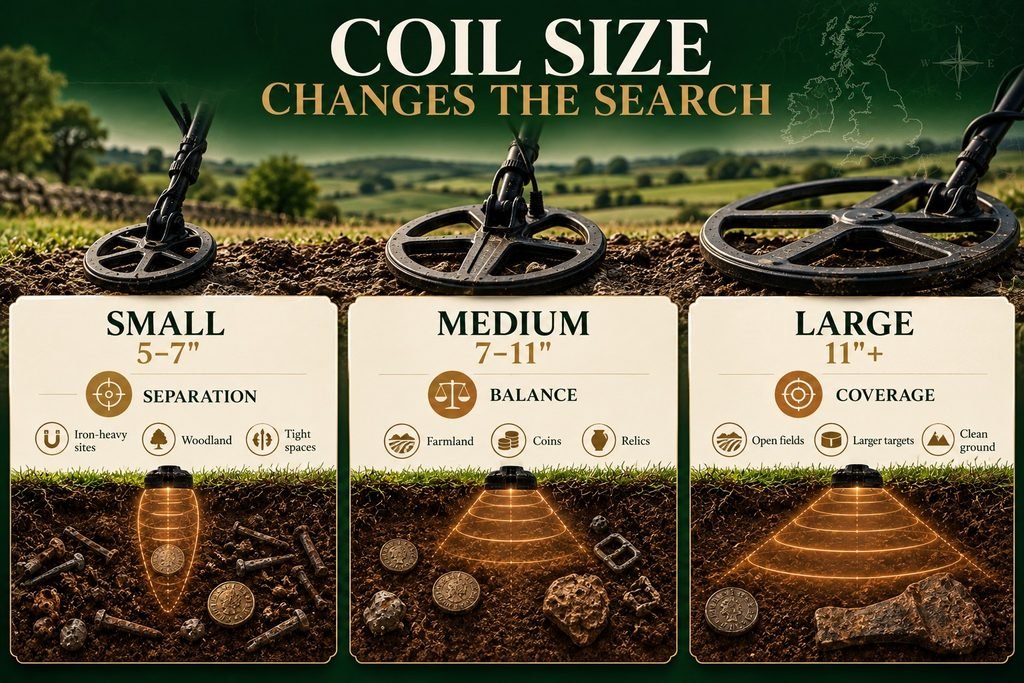
Coil size affects depth, ground coverage, small-target sensitivity and target separation, so there is no single size that works best everywhere. Small coils are generally better for tight spaces and iron-heavy ground, medium coils provide the most useful all-round balance, and large coils favour open ground where coverage and larger targets matter most. The right size depends on what is under the soil as much as what is above it.
Small coils concentrate the detection area into a relatively tight footprint. That makes them particularly useful where several targets are close together, because the detector is less likely to process a large number of objects simultaneously. On an iron-heavy UK relic site, that can make the difference between a vague, broken response and a repeatable signal worth investigating.
Small coils are also easier to manoeuvre around trees, scrub, rocks, stubble and other obstacles. A 5-inch coil can work into spaces where a 13- or 15-inch coil would simply be awkward. The compromise is ground coverage and depth on larger targets, so a small coil is normally chosen for separation and control rather than for sweeping the largest possible area.
Medium coils sit in the useful middle ground between coverage and control. The 9 to 11 inch range is popular because it provides enough coverage for farmland while remaining manageable during a long detecting session. It also gives good sensitivity to the coin-sized targets that make up much of everyday UK detecting.
For someone who wants one coil to handle ordinary farmland, parks and general coin or relic hunting, this is usually the most sensible size range. A medium DD coil provides a practical combination of depth, coverage and target separation without becoming cumbersome. That balance explains why standard coils on many detectors sit around this size.
The Reflex G6, for example, comes with an 11-inch DD coil as standard, putting it directly into this all-round category. Golden Mask 6 and Golden Mask 7 machines also use Golden Mask coils, giving detectorists access to different sizes when the standard setup is not quite right for the ground.
Large coils are designed for detectorists who want to cover more ground with each pass and pursue deeper or larger targets on suitable ground. A 13, 14, or 15-inch coil can make sense on a large, relatively clean permission where the targets are spread out and the main objective is efficient coverage.
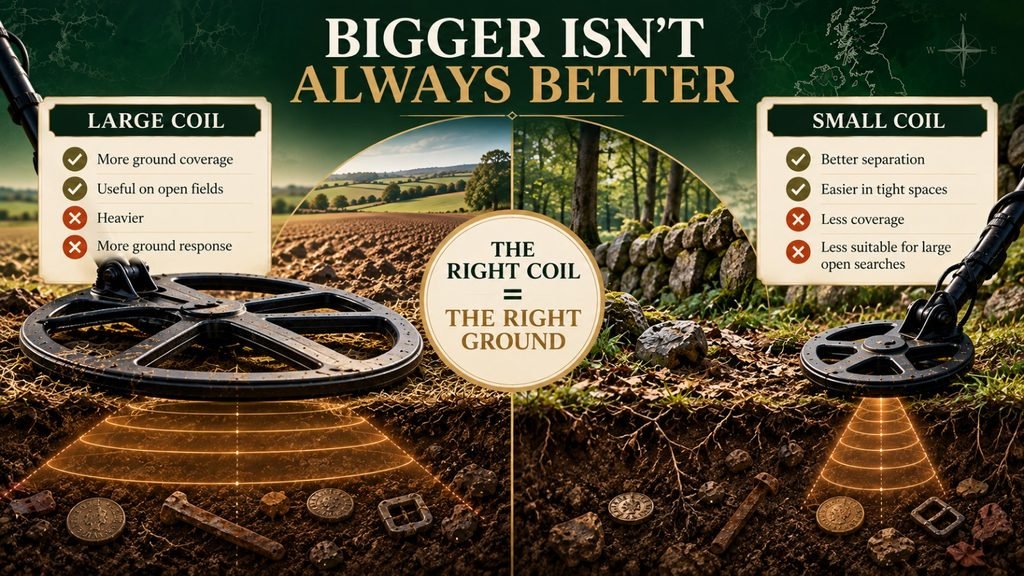
There are drawbacks. Larger coils are heavier, can make a detector more nose-heavy, and are harder to control around obstacles. They can also pick up more of the surrounding ground, which can become a problem when mineralisation is high.
A large coil therefore makes the most sense when the ground allows it. On a clean, open field, the extra coverage can be useful. On a heavily mineralised or iron-infested site, going smaller can produce a much more usable detector.
The affordable option
Pinpointer. Finds the target in the hole instead of the spoil.
£49.95£69.99Save £20.04
Add to basketFull detailsIn stock
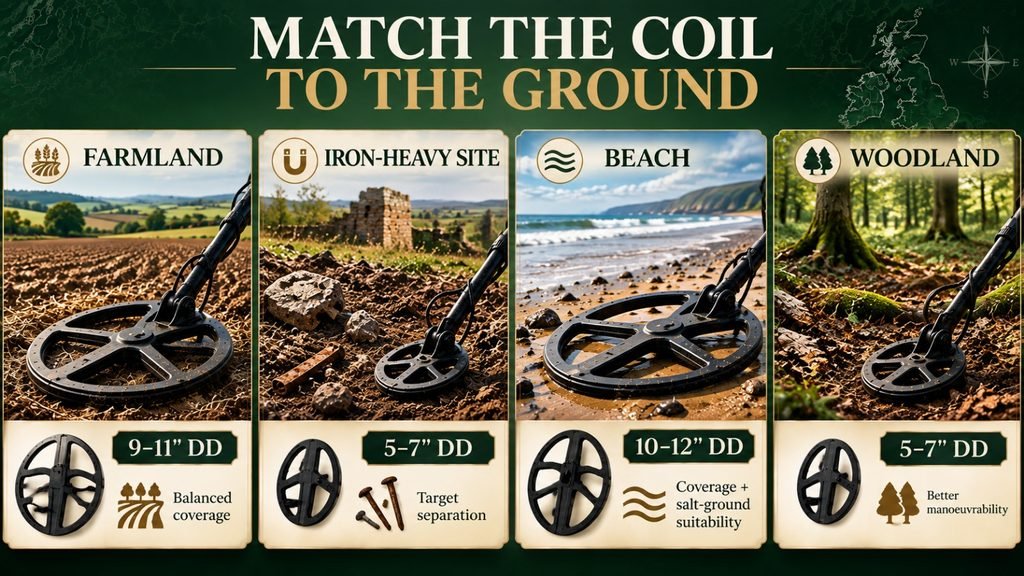
The size and geometry make the most sense once they are connected to a real detecting situation. For most UK farmland, a medium DD coil is the sensible all-round choice, while smaller DD coils become more useful as iron density and obstacles increase. Larger DD coils have their place on open, relatively clean permissions where coverage and larger targets take priority.
A 9 to 11 inch DD coil is a strong all-round choice for typical UK arable farmland. It provides enough coverage to work a large field without making the machine unnecessarily difficult to control, while DD geometry helps with the iron and mineralisation commonly encountered in agricultural ground.
Freshly ploughed fields can be particularly interesting because previously buried targets become accessible at different depths and positions. A medium DD coil lets the detectorist cover that newly disturbed ground efficiently while retaining useful target separation. If the field is especially iron-heavy, dropping to a smaller DD can make sense.
The relationship between the coil and ground balance is worth understanding here because mineralisation can change how stable the detector feels. The metal detector ground balance guide explains how the detector compensates for the soil response and why recalibrating can matter when conditions change.
Roman, Anglo-Saxon and medieval sites can contain an uncomfortable amount of iron. Nails, fragments and other ferrous objects can sit close to the non-ferrous targets detectorists actually want to recover. A smaller DD coil reduces the amount of ground being processed at one time, giving the detector a better chance of separating nearby targets.
That does not mean every iron signal should be ignored. A promising non-ferrous response can become unstable when iron is close by, and discrimination settings can sometimes hide useful information if they are set too aggressively. The metal detector discrimination guide explains how discrimination, target IDs and target masking interact on difficult UK ground.
Dry sand is generally easier to work than wet salt sand, so a medium DD coil around 10 to 12 inches can provide a useful balance of coverage and depth. The larger footprint helps detectorists cover popular beach areas efficiently, especially when searching for modern coins and jewellery.
Wet salt sand is a different problem because salt affects detector signals. A DD coil is generally the more suitable choice for this environment, but the coil also needs to be suitable for the detector and intended use. Waterproofing matters as much as size if the coil will be used around the waterline.
Mineralised ground can change the entire experience of a detecting session. The detector may become noisy, target IDs may become less stable, and a large coil can make the problem more obvious because it interacts with more ground at once.
A medium or small DD coil is usually the more practical direction in these conditions. The smaller footprint reduces the amount of mineralised ground being processed at one time, while DD geometry is better suited to difficult soil than a comparable concentric design. The result can be a quieter, more usable detector even when the underlying ground remains challenging.
Not Sure Which Coil Fits Your Machine or Your Ground?
Coil compatibility varies by detector model, and not every coil from every manufacturer fits every machine. If there are questions about which coil upgrade suits a specific detector and the UK ground being searched, the team at UK Metal Detectors can advise on compatibility and the right option before any purchase is made.
Contact UK Metal Detectors for straight advice on coil upgrades with no pressure.
The practical guidance above becomes easier to apply when the available coil sizes are put into context. UK Metal Detectors stocks Golden Mask search coils covering small, medium and larger detecting requirements, with prices ranging from £99 to £139 in the options covered here. Each one suits a different type of session rather than simply being a more expensive version of the previous size.
The 5-inch DD Spider is the specialist option for tight spaces and target separation. Its small footprint makes it particularly useful on iron-heavy relic sites, woodland and areas where a larger coil becomes difficult to manoeuvre.
At £99, it provides a relatively accessible way to change how a compatible machine behaves without replacing the detector itself. The trade-off is straightforward: less ground is covered with every sweep, but the tighter detection area can make a cluttered site easier to work.
The 9×10 inch elliptical DD sits in the practical middle of the range. Its dimensions make it suitable for general detecting where coverage matters but the detectorist still needs good control around normal farmland conditions.
The elliptical shape also gives the coil a useful footprint for systematic sweeping. At £119, it fits the category that will make the most sense to many detectorists looking for an everyday coil rather than a specialist option.
The 13×11 inch Fighter S and 12.5×15 inch elliptical DD move the focus towards coverage and larger, deeper targets on suitable ground. The Fighter S is supplied as the standard coil on the Golden Mask 6, while the 12.5×15 inch option provides a larger alternative for detectorists who want to cover more ground.
The important point is that bigger should not automatically mean better. These coils make more sense on large, relatively clean permissions than on tight woodland or heavily iron-contaminated sites. The right upgrade is the one that solves a problem with the current setup, not simply the one with the largest dimensions.
The sensible middle

Golden Mask 32×28cm DD coil. Light for its size, with good ground coverage.
£129
Add to basketFull detailsIn stock
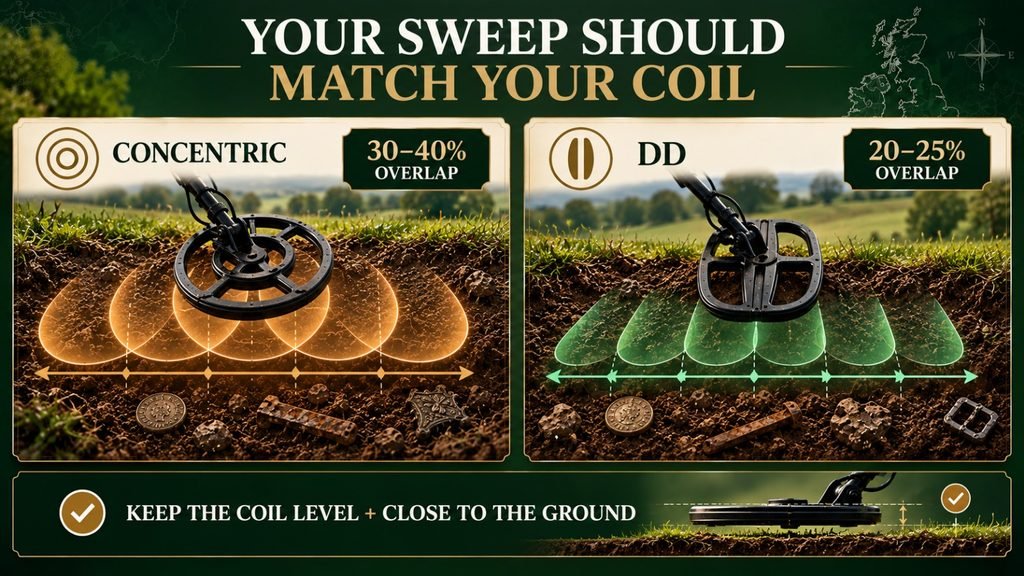
Coil choice changes the way the detector should be swept, particularly because different detection patterns require different levels of overlap. Concentric coils benefit from tighter overlap, around 30 to 40 percent, while DD coils can generally work with around 20 to 25 percent overlap because their blade-shaped detection pattern provides more consistent coverage along the coil’s length.
That difference becomes meaningful over a full day in a large field. A detectorist using a DD coil can maintain efficient coverage without having to overlap every pass as heavily as a concentric coil. The result is not simply a faster swing, but a more efficient search pattern across the permission.
The sweep should remain controlled regardless of coil size. A common mistake with a larger coil is to assume that its extra coverage means it should be swung faster. The detector still needs enough time to process the response from each target, particularly where signals are weak, deep or close together.
Keeping the coil level and close to the ground also matters. A large coil lifted at the end of every swing loses some of the practical advantage its size provides, while an uneven sweep can make target responses harder to compare from pass to pass. The beginner’s guide to using a metal detector covers the basic sweep technique in more detail for anyone still building confidence with the machine.
Large coils can tempt detectorists into covering ground quickly, especially on an open field. That only works if the sweep remains controlled enough for the detector to process each signal properly.
A slower, consistent sweep is usually more useful than a fast swing followed by uncertainty about whether a faint response was real. The same principle applies to small coils too, although the smaller footprint naturally means more passes are required. Coil size changes the coverage, but good technique still determines how effectively that coverage is used.
The serious choice
The simplest way to choose a coil is to match the size and design to the ground, target density, and type of detecting being done. For most UK farmland, medium DD coils provide the most useful balance, while small DD coils become more valuable as iron density or obstacles increase.
| Scenario | Recommended Size | Recommended Type | Reason |
| UK farmland coin hunting | 9 to 11 inch | DD | Handles iron mineralisation and balances depth with coverage |
| Iron-heavy relic sites | 5 to 7 inch | DD | Better target separation in dense iron |
| Freshly ploughed autumn fields | 9 to 11 inch | DD | Good balance of depth and coverage on newly accessible targets |
| Beach, dry sand | 10 to 12 inch | DD | Coverage and depth |
| Beach, wet salt sand | 10 to 12 inch | DD, waterproof | Better suited to salt mineralisation |
| Mineralised UK ground, Cornwall or Wales | 7 to 10 inch | DD | More stable handling of difficult ground |
| Large open, low-iron permissions | 13 to 15 inch | DD elliptical | Coverage and depth on suitable ground |
| Woodland and tight terrain | 5 to 7 inches | DD or elliptical DD | Easier manoeuvrability around obstacles |
A coil is not just the part attached to the bottom of the detector. Its size and geometry determine how the machine interacts with the ground, how much area each sweep covers and how easily the detector can separate one target from another. For most UK conditions, a medium DD coil provides the strongest all-round combination, while small DD coils earn their place on iron-heavy sites and larger coils suit open, cleaner permissions.
The most useful upgrade is therefore not automatically the biggest or most expensive coil. It is the one that fixes the limitation being experienced with the current setup. A detectorist struggling with iron may need separation, while someone covering a large clean field may need coverage.
For the broader metal detecting accessories guide, there is more to consider beyond the coil, including pinpointers, digging tools and other equipment that can make a full detecting session easier.
Want to Know Which Coil Upgrade Suits Your Machine and Your Ground?
Coil compatibility and the right choice for specific UK detecting conditions are both questions worth getting right before spending. The team at UK Metal Detectors can confirm compatibility with a specific machine and advise on which size and geometry is most suitable for the ground being searched.
Contact UK Metal Detectors for coil upgrade advice from people who detect on UK ground themselves.
A DD coil uses two overlapping D-shaped windings that create a blade-shaped detection field running from the front of the coil towards the back. A concentric coil uses circular windings that create a cone-shaped detection field with its strongest depth around the centre. DD coils generally provide better target separation and more stable performance in mineralised or iron-heavy ground, while concentric coils can offer very accurate pinpointing on cleaner ground.
For most UK farmland and general coin hunting, a medium coil around 9 to 11 inches provides a useful balance of coverage, depth and target separation. Smaller 5 to 7 inch DD coils make more sense on iron-heavy relic sites or in woodland where manoeuvrability matters. Larger 13 to 15 inch coils are better suited to open, relatively clean permissions where coverage and larger targets are the priority.
A larger coil can provide greater depth and ground coverage, particularly on larger targets and suitable, relatively clean ground. It also tends to be heavier, less sensitive to very small targets, and more difficult to use in tight spaces. In mineralised soil, a smaller DD coil can sometimes provide better effective performance because it produces less ground response and runs more stably.
Yes, a coil can be upgraded when the replacement is specifically compatible with the detector model. Coil compatibility depends on the manufacturer and machine, so a coil should never be selected by size alone. UK Metal Detectors stocks Golden Mask options including the 5 inch DD Spider at £99, 9×10 inch elliptical DD at £119, 13×11 inch Fighter S at £129 and 12.5×15 inch elliptical DD at £139.
For typical UK farmland coin and relic hunting, a medium DD coil in the 9 to 11 inch range provides a practical combination of depth, coverage and target separation. A smaller DD coil can be more useful when the field is heavily contaminated with iron, while a larger DD elliptical coil suits open ground where coverage and larger targets matter more. The most suitable coil therefore depends on the specific ground and targets rather than simply choosing the largest available option.
Not sure which of these suits the ground you search? Tell us where you detect and we will point you at the right one, including the cheaper one when that is the honest answer. We use these machines ourselves.