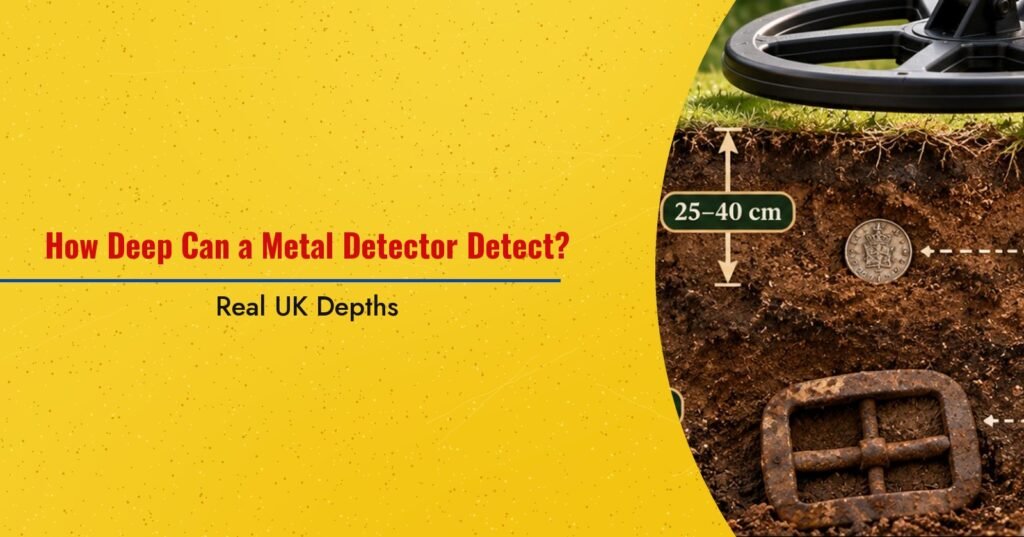
Most hobby metal detectors find coins at around 25 to 40 cm, depending on the machine, the target and the soil. Larger objects are usually detected deeper, and specialist ground scanning equipment reaches further still, into metres rather than centimetres. Those deeper machines are not built to find individual coins, though. They are built for large masses and cavities.
That difference matters, because a detector advertised with an impressive depth figure will not necessarily pick up a small silver coin buried deep in a field. The depth range printed on a product page tends to describe the best case rather than the typical one.
If you are thinking about buying a new metal detector because your current one does not seem to reach deep enough, it is worth understanding what it can actually do first.
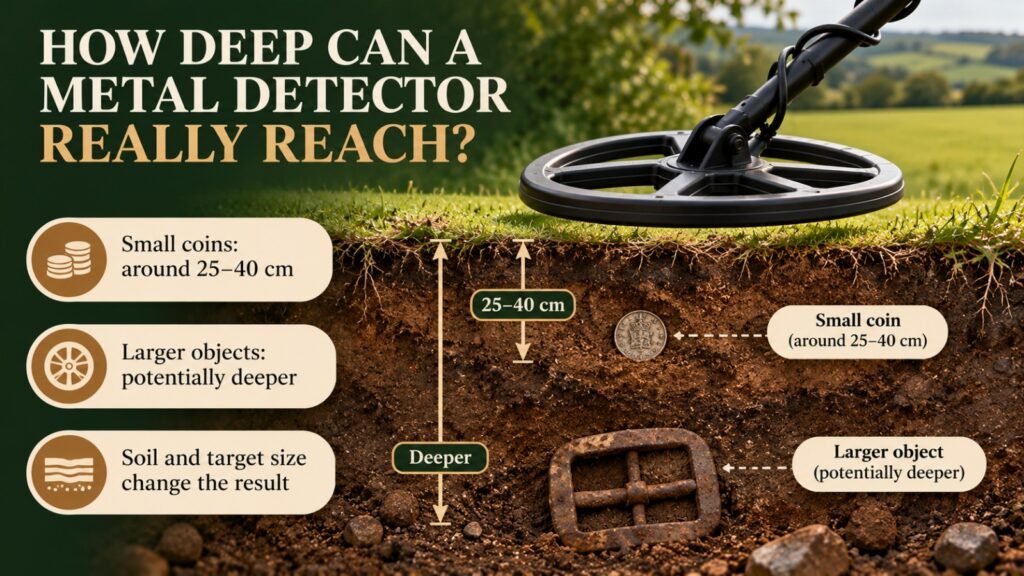
A hobby metal detector will generally locate smaller objects down to about 25 to 40 cm, while larger objects can be detected deeper. That is a realistic starting point for most people searching UK fields.
You will see slightly different figures quoted elsewhere, often around 10 to 16 inches, and sometimes 30 to 50 cm for larger finds. These numbers do not contradict each other. They describe different targets in different conditions. A larger object is easier to detect at depth than a thin coin at the same depth.
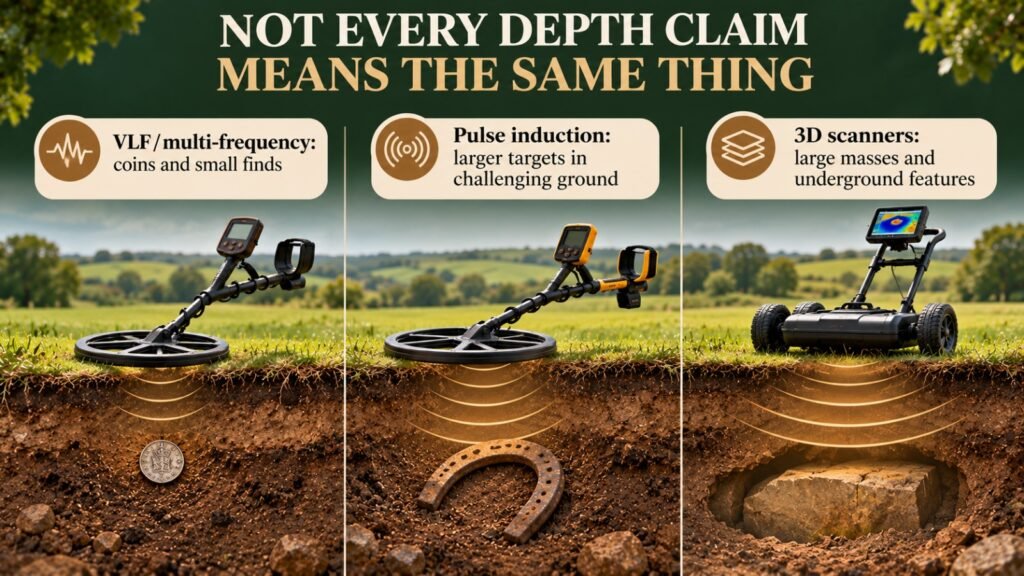
Here is how the main detector types compare.
| Detector type | What it realistically finds | Depth guide | Main limitation |
|---|---|---|---|
| Standard VLF or multi frequency | Coins, jewellery and everyday metal objects | Typically 25 to 40 cm for hobby detecting | Small targets become harder to detect at depth |
| Pulse induction | Larger metal targets, particularly in difficult ground | OKM Pulse Nova states up to about 3 m, Gold Seeker up to 3.5 m | Figures refer to larger targets, not individual coins |
| 3D ground scanners | Large buried masses, structures and cavities | Stated or reported figures range from about 8 m to 40 m | Not designed to find individual coins |
The table gives a general picture rather than a guide to what you will find on your next outing. Target size, orientation and ground conditions can change the result considerably.
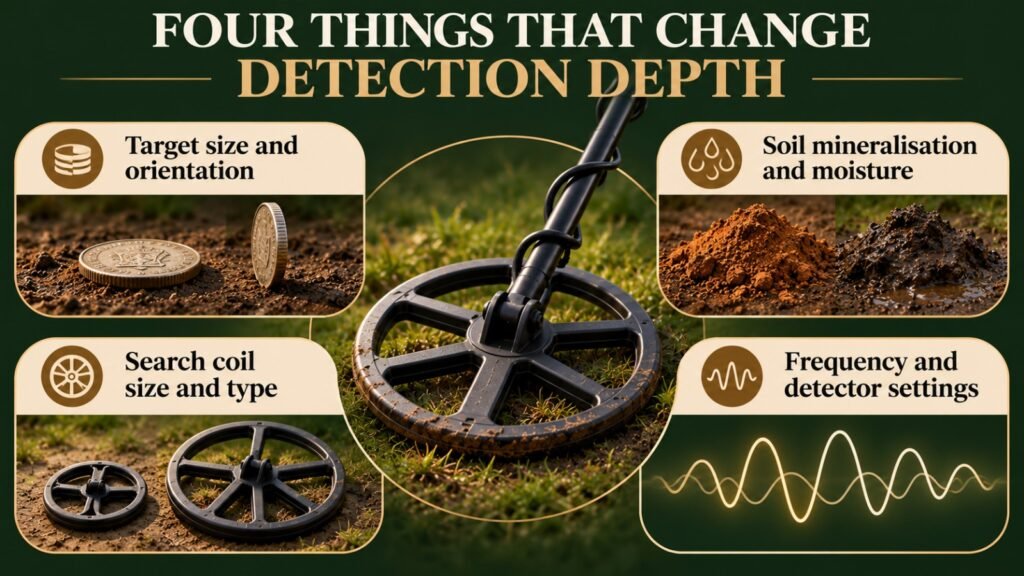
The depth you reach in the UK depends on what you are looking for, the ground you are searching, the coil fitted and the machine itself. Two people using the same detector in the same field can get different results.
Size makes an obvious difference. A large copper object is easier to detect than a small, thin silver coin.
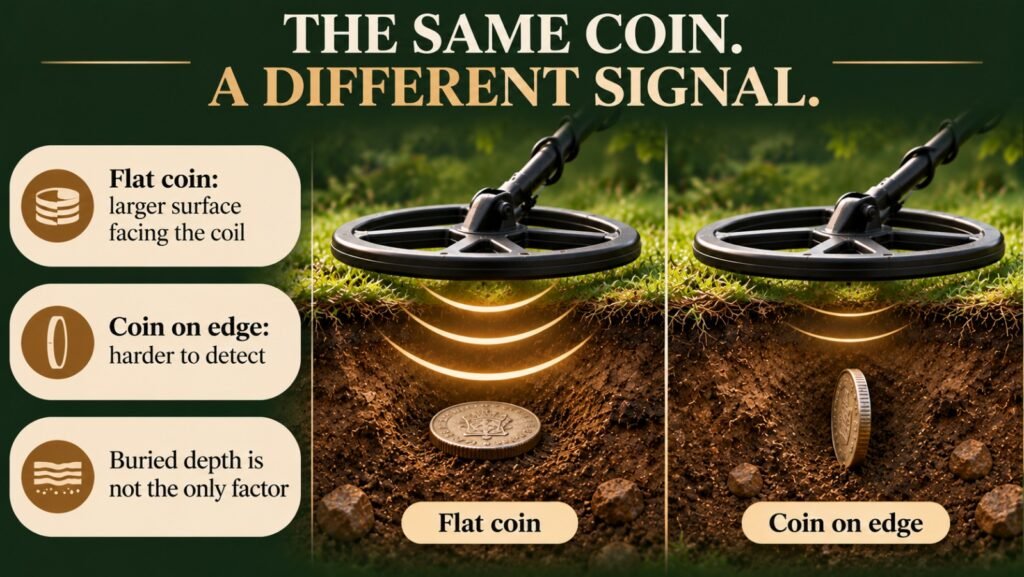
Orientation matters just as much. Picture a flat hammered silver coin lying in the soil, then picture the same coin sitting on its edge. The edge on coin is harder to detect, because the metal area facing the coil is much smaller.
This is why a maximum depth rating should never be read as a promise. The same machine can reach a large object easily and still miss a small one much closer to the surface.
UK soil varies enormously. One field might be light arable soil that behaves predictably, while the next is heavy clay holding moisture, or iron rich ground throwing out false signals.
Soil mineralisation affects how cleanly a detector reads a signal, and moisture changes the response depending on the soil and the object. A machine that runs beautifully in one location can be unstable in another.
This is where ground balance earns its keep, by letting the detector settle into mineralised soil. Our metal detector ground balance guide explains how it works and why the correct setting matters.
The search coil is the part of the machine that transmits and receives the electromagnetic field, so its size and type shape how the detector responds to different targets.
A large coil sweeps more ground at once, but bigger is not automatically better. A smaller coil is often the better choice in iron and in crowded, trashy ground.
The right choice depends on what you are looking for and where you are searching. Our metal detector coils guide explains the differences.
Detector technologies work in different ways. VLF machines are popular for general coin and relic detecting, while multi frequency machines work across several frequencies to help identify a wider range of targets.
Frequency affects how a detector responds to objects of different sizes and conductivity. Lower frequencies generally suit larger or highly conductive targets, while higher frequencies can offer better sensitivity to smaller ones.
Settings matter too. Poor ground balance, heavy discrimination or an unsuitable sweep speed all change what the detector picks up. Sometimes the machine is not the problem. The settings are.
A coin can typically be detected at roughly 25 to 40 cm by a hobby metal detector, although the real figure depends on its size, metal composition, orientation and the soil around it.
A large copper coin and a thin hammered silver coin will not give the same response. The copper coin usually produces a stronger signal, while the smaller silver target can become difficult to read at the same depth.
There is another distinction worth understanding. An air test is not the same as finding something buried in the ground. An air test measures how a detector responds to a target with no soil around it. It is useful for comparing responses, but it does not recreate a real search. Mineralisation, moisture and nearby metal all affect the signal once an object is underground.
The depth reading on your screen is an estimate too. The Reflex G10, for example, displays coin depth in steps of 2, 4, 6 and 8 inches, and beyond. Those readings give you an idea of where a target sits, but they are not a direct measurement of its exact position.
If you are looking for a detector mainly for coin hunting, our best metal detector for coins guide can help you work out what to look for.
There is a practical point as well. A deeper signal usually means more digging, and sometimes a much bigger hole. Follow the NCMD Code of Conduct and make sure every hole is properly filled before you leave the site.
Not sure whether depth is your problem? Before looking at a deeper machine, tell us the detector you own and the kind of ground you search, and we can talk through whether different settings, a different coil or a different machine makes more sense. Contact our team for advice.
The deepest systems available are not ordinary coin detectors. They are specialist machines built to locate larger buried masses, underground structures and cavities, where the target is considerably bigger than a coin.
This is where advertised depths get confusing. A manufacturer may state that its equipment reaches several metres underground, and that does not mean it can locate a small metal object at that depth.
Consider the different systems available. The OKM Pulse Nova is stated to reach up to about 3 m, while the Gold Seeker has a stated maximum of 3.5 m. Both use pulse induction technology. These figures relate to larger targets and should not be compared directly with the coin detection depth of a standard hobby detector.
For specialist 3D ground scanners the stated and reported figures go considerably further. The OKM Fusion Light is listed at 8 m. The OKM eXp 6000 Professional has a customer reported figure of 25 m, while the UIG Ground Scanner is stated to reach up to 30 m. The Deep Seeker is advertised with a maximum of 40 m.
These figures depend heavily on soil conditions and the size of the object. Large masses and cavities are the intended targets. They are not realistic coin detection depths. Our 3D ground scanner buying guide explains the different systems and where each one fits.
There is another technology worth separating from metal detectors altogether. The OKM Gepard GPR 3D is a ground penetrating radar system, with a reported depth of up to 40 m on substantial underground features. It uses radar to examine what lies beneath the surface, which makes it a different tool from a conventional metal detector.
One thing is worth making absolutely clear. Nobody is detecting a single coin 40 metres underground with any of these technologies. A large underground structure and a small coin are entirely different targets.
Most detectorists do not need an exceptionally deep machine for everyday searching. Most finds sit within the top 30 cm of soil, so getting the best out of a standard detector is usually the better starting point.
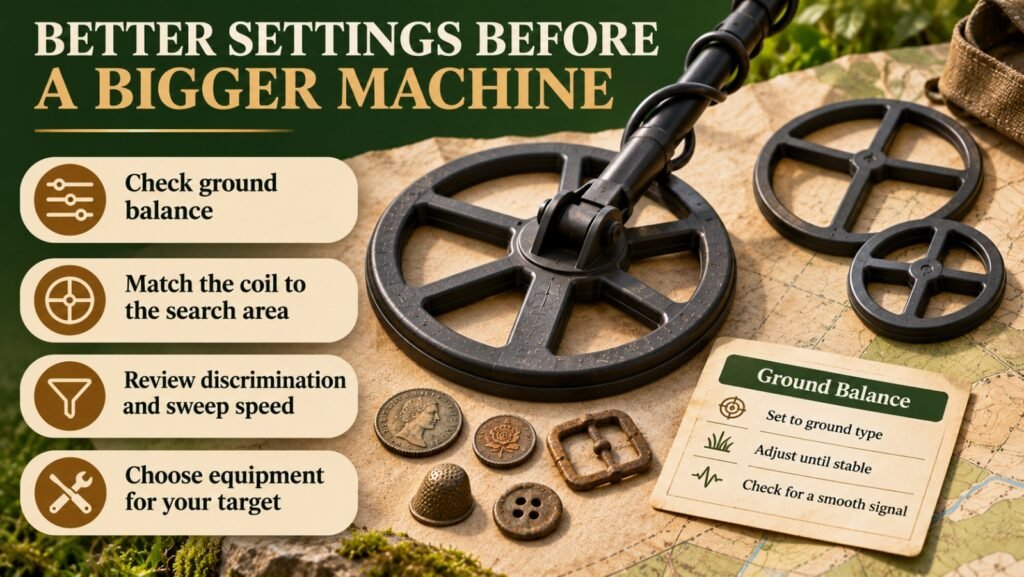
Before looking at specialist equipment, check how you are using the machine you already own. Is the ground balance correct? Are you using a suitable coil? Is your sweep speed consistent? Are your discrimination settings filtering out targets you actually want? These things can make a noticeable difference.
There are situations where extra depth genuinely makes sense. If you are researching a site where larger buried objects or substantial underground features are the target, a 3D ground scanner may suit the job better than a standard detector.
Pulse induction equipment is also worth considering in mineralised or salty ground, where conventional detectors can struggle to perform consistently. Our pulse induction metal detectors guide explains where this technology fits.
The important thing is to match the machine to the job. If you are mainly searching for coins, jewellery and small historical finds in ordinary UK fields, a good hobby detector is likely to be far more practical than a specialist scanner. If gold is the target, our best metal detector for gold guide covers the machines built for it.
The honest answer to how deep a metal detector can detect is that it depends far more on what you are trying to find than on the biggest number printed on a product page. A standard detector can be perfectly capable of finding coins and historical objects without any specialist scanning equipment.
If you are considering going deeper, tell us what you want to detect and where you will be searching. We can talk through whether pulse induction, a ground scanner or a standard detector is the sensible choice, including the times when you do not need to spend more. Contact our team for advice on choosing the right detector for your needs.
Most hobby metal detectors typically find objects around 25 to 40 cm underground. The actual depth depends on the target’s size, orientation, detector technology and soil conditions. Larger metal objects can be detected deeper than small coins.
A coin can typically be detected at around 25 to 40 cm with a suitable hobby detector, although smaller or thinner coins may be harder to locate. A large copper coin can produce a stronger signal than a thin hammered silver coin. Ground conditions and detector settings also affect the result.
There is not one straightforward answer, because specialist equipment is designed for different targets. The Deep Seeker is advertised with a maximum depth of 40 m for large targets, while other specialist scanners have different stated or reported capabilities. These figures do not apply to individual coins.
Soil mineralisation, moisture, target size, target orientation, coil design and detector settings all influence detection depth. Heavy clay and iron rich soil can make detecting more difficult. Correct ground balance and a suitable coil can help improve performance.
Yes, specialist pulse induction machines and 3D ground scanners can detect certain larger targets at those depths, depending on the equipment and ground conditions. However, this does not mean they can find small coins that deep. Standard hobby detectors are generally intended for much shallower targets.