

Autumn is the best time of year for UK coin hunters, and most serious detectorists already know it. The harvest is done, the farmers are ploughing, and fields that were locked up all summer are suddenly open again. Freshly turned soil brings coins that have been sitting just below detection range for decades back to the surface. It happens every September, and every September the detectorists who show up with the right machine come home with finds while everyone else spends the afternoon digging iron.
If the question going into this season is whether the current detector is the right tool for serious coin hunting in the UK, this guide is written for exactly that moment. It covers what separates a genuinely good coin shooting metal detector from a general-purpose machine, which UK coins are hardest to find and why, what settings actually work on UK farmland, and which three detectors from UK Metal Detectors are worth looking at seriously this autumn.
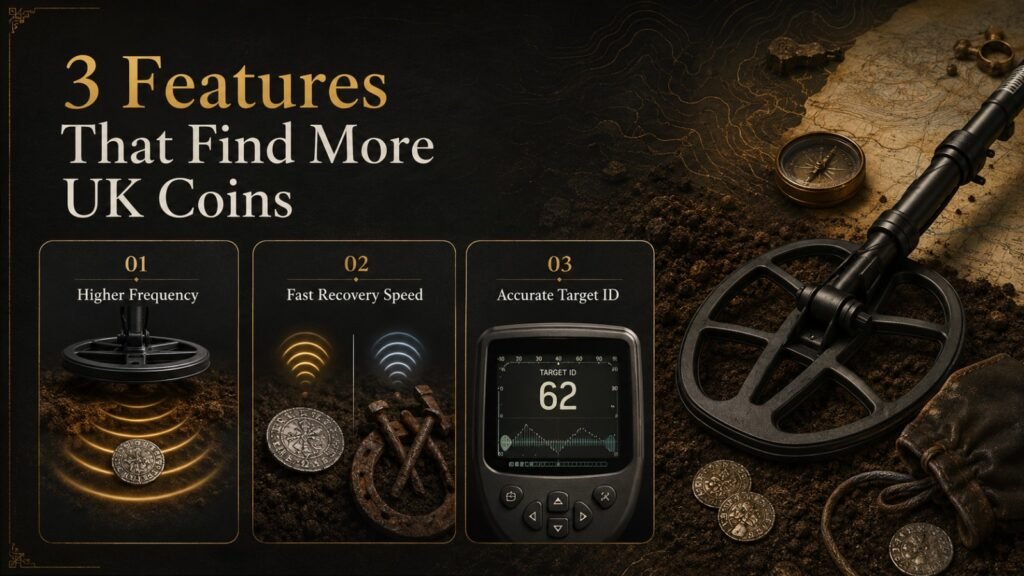
Most people searching for the best metal detector for coins UK expect a straightforward answer. The reality is that UK coin hunting is more demanding than coin hunting almost anywhere else in the world, and the reasons come down to three things: frequency, recovery speed, and target ID accuracy. Get all three right and productive sessions follow. Get one of them wrong and good coins stay in the ground.
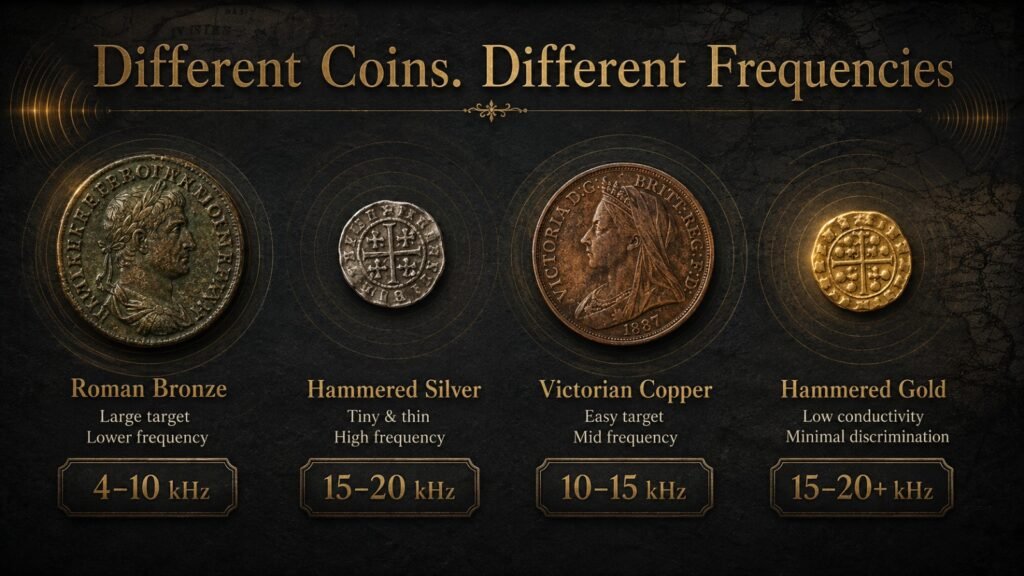
Not all UK coins are the same kind of target. A Victorian copper penny is a large, flat, highly conductive disc that most decent machines find without difficulty. A medieval hammered silver cut-quarter is less than 10mm across, worn thin by centuries in the ground, and sitting right at the edge of what many detectors can reliably pick up at depth. Lower frequencies, around 5 to 10kHz, penetrate deeper and suit large conductive targets like Roman bronze and Georgian copper. Higher frequencies from 15kHz upward are more sensitive to small, low-conductivity targets like thin hammered silver. The best coin hunting metal detector UK either runs at the right frequency for the coins being targeted or offers selectable frequencies so the machine can adapt to what the site is producing.
UK farmland has iron in it. A lot of iron. Centuries of farming have left nails, horseshoes, wire, and agricultural fragments distributed through the topsoil of almost every productive detecting site in England, Wales, and Scotland. A detector with slow recovery speed misses coins sitting near iron because it is still processing the iron signal when the coin passes beneath the coil. Fast recovery speed resets the machine quickly between targets and catches the coin that a slower machine leaves in the ground. On any genuinely productive field, this single characteristic makes a noticeable difference to the finds count at the end of the day.
Target ID gives a conductivity number representing what is buried. Silver coins typically read between 75 and 95 on most machines. Copper reads 65 to 80. Hammered silver at depth reads considerably lower, sometimes between 40 and 55, which overlaps with lead and alloy junk. This is exactly why signal consistency matters more than the number itself. A signal that reads the same value from three different angles and holds a clean tone on each pass is almost always worth digging, regardless of what the ID says. For a full guide to reading signals and setting discrimination correctly for UK coin hunting, the metal detector discrimination guide covers all of this in detail.
Understanding what each coin type demands from a machine is what separates a detectorist who finds things from one who keeps searching the same ground without result. This is the section most coin hunting metal detector UK guides skip entirely.
Roman bronze, including sestertii, as, and follis, runs between 25 and 35mm across. Large, flat, and highly conductive, these coins respond well to most mid-range machines on typical UK farmland. The challenge is condition: heavily encrusted Roman bronze in clay-rich Midlands soil reads inconsistently. Roman silver denarii are smaller and thinner, requiring better sensitivity and a higher operating frequency to register reliably at depth.
This is the category that makes experienced UK detectorists obsessive about frequency and recovery speed. Hammered silver coins were struck by hand from the 13th century through to the 1660s. They are thin, small, irregularly shaped, and frequently bent from centuries of ground pressure. A cut-quarter of a medieval penny can be smaller than a thumbnail. Hammered silver coins sit in the same conductivity range as aluminium foil on many machines. That means running with very low discrimination settings is essential. More rubbish gets dug as a result, but the hammered silver that higher discrimination would have silenced gets found. That means running with very low discrimination settings is essential. More rubbish gets dug as a result, but the hammered silver that higher discrimination would have silenced gets found.
Pennies, halfpennies, and farthings from the 18th and 19th centuries are the workhorses of UK coin hunting. Common, clearly identifiable, and found at depths between 5 and 30cm depending on the site. Most mid-range detectors handle these reliably. The challenge on productive farmland is that these coins share their ground with a lot of iron, which is precisely where fast recovery speed becomes the deciding factor between finding them or walking over them.
Medieval bronze coinage responds well to machines running at 15kHz and above. Hammered gold is the find most detectorists do not plan for, but it turns up on sites with known medieval or Roman activity. Gold is a relatively poor electrical conductor compared to silver, which means hammered gold reads low on the conductivity scale and sits in the same range as junk that aggressive discrimination rejects without a second thought. The only protection against missing it is running open settings and trusting signal consistency over target ID.
Three machines, three different points in the market, all available from UK Metal Detectors. Each one genuinely suits metal detecting coins UK conditions. The right choice depends on where a detectorist is in the hobby and what kind of ground they are working.
The Reflex G6 runs at 19kHz. That frequency is the reason it tops this list for coin shooting in the UK. High enough to register thin, small hammered silver that lower-frequency machines miss. Stable enough in mineralised UK farmland soil to run cleanly without the constant false signals that plague machines not tuned for British conditions. Its recovery speed is genuinely excellent at the price point, and on iron-heavy UK farmland that is not a small thing. It is the reason the G6 pulls coins from sites other machines have already been over.
The iron audio feature is particularly valuable for serious coin hunters. Running with minimal or no discrimination is how hammered silver gets found, but it means hearing a lot of iron in the process. Iron audio keeps iron signals audible at reduced volume rather than silencing them completely. The machine stays informative without becoming exhausting across a six-hour session on a productive field. The G6 is sensitive to a silver shilling coin at 14 to 17 inches depth, which on autumn farmland means reaching targets that have sat below the ploughline throughout the history of the site. The 2025 Combo Sports Pack is included with the machine.
Best for: Detectorists stepping up from a beginner machine to something properly capable, or experienced coin hunters who want a UK-tuned machine with fast recovery at a sensible price.
The G10 is the natural step up from the G6. Same core thinking applied with more capability. Where the G6 excels at mid-depth coin hunting across typical UK farmland, the G10 pushes deeper on small targets without sacrificing stability in challenging conditions. Reviews from UK Metal Detectors customers mention Roman bronze coins found at genuine depth, small coins giving clear signals on highly mineralised sites, and stable performance on beaches where machines with less refined ground handling continuously give false signals.
The improved LCD gives a more accurate readout of metal type and signal indicator compared to the G6. That matters when a hammered silver conductivity reading is nudging into the ambiguous mid-range and the decision to dig or move on needs something concrete to work from. The G10’s waterproof search coil also handles the wet autumn and winter conditions that UK farmland reliably delivers from October onwards. A coil that loses performance in wet ground is a liability for the best six weeks of the detecting year.
Best for: Active detectorists who want noticeably more depth and stability for their coin hunting without stepping into professional machine pricing.
The Golden Mask 7 runs at four selectable frequencies: 4kHz, 14kHz, 24kHz, and 44kHz. That range gives it more frequency spread than any other machine on this list, and it’s what makes it the true all-rounder of the group. Drop to 4kHz for deeper Roman bronze on historically productive sites. Sit at 14 or 24kHz for everyday coin shooting on typical UK farmland. Switch up to 44kHz for maximum sensitivity to small hammered coins, thin medieval silver, and fine gold. That flexibility means adapting to what a site is producing rather than working at a single compromise frequency regardless of what the ground holds.
On a site where the morning session produces Roman bronze at depth and the afternoon field has a history of medieval silver, the GM7 adjusts. A fixed-frequency machine works at its best frequency and leaves everything else to chance. The GM7 uses the new 7G search coil for added depth and stability over previous Golden Mask coil designs, along with an FX ground balance mode built specifically for high-mineralisation and wet soils, four user-modifiable factory presets (Field, Park, Gold, and Beach/HR), and wireless headphones included as standard, so there’s no cable between the control box and your ears on a long session. The control box is rain-resistant rather than fully waterproof, so it’s built for UK autumn and winter conditions without needing to be babied.
Best for: More experienced coin hunters who understand what different frequencies do and want the ability to tune to the specific coin type a site is likely to produce.
Not Sure Which Detector Suits Your Ground?
All three detectors are excellent for UK coin shooting, but the best choice depends on the farmland you search, the types of coins you’re hoping to find, and your level of experience. Instead of guessing, speak to the team at UK Metal Detectors. They can recommend the most suitable detector based on your ground conditions, detecting goals, and budget, with honest, practical advice and no sales pressure.
Get in touch with UK Metal Detectors for expert advice before you choose your next detector.

The most consistent piece of advice from experienced UK coin hunters is to run less discrimination than instinct suggests. The temptation is to filter aggressively so every signal is a likely good find. On UK farmland, the reality is that hammered silver reads in the same conductivity range as common junk, and discriminating it out means missing it completely. Start with iron-only rejection 0 to 15 on most machines and dig everything else. Over multiple sessions on the same site, patterns emerge showing which ID ranges consistently produce junk. Narrow notch rejections can then be added carefully without closing off the ranges where good coins sit. The metal detector discrimination guide walks through this process step by step for UK soil conditions.
Autumn farmland detecting happens on wet ground. Moisture increases soil conductivity and shifts the ground balance point that was correct at the start of the session. A calibration done at the dry gate in early September becomes progressively less accurate through an October and November session after rain. Recalibrating mid-session is not optional on wet farmland in autumn. It is what keeps the machine stable and finding coins rather than fighting the soil. The metal detector ground balance guide covers exactly how this works and why wet UK conditions make regular recalibration one of the most important habits a coin hunter can develop.
Slower is almost always better on coin hunting sites. A slow, methodical grid gives the machine more processing time over each signal and catches the coins sitting close to iron objects, which is the situation UK farmland presents repeatedly. Covering twice the ground at half the effectiveness is one of the most consistent reasons detectorists leave coins in fields they have already searched. Steady pace, 30 percent overlap on each pass, and consistent coil height of 1 to 2cm above the surface produces better results than rushing.
The faint, slightly broken tones on UK farmland a coin at depth, partially masked by nearby iron, are the signals most often missed through speaker audio in open air. Headphones catch them. Wind, farm noise, and general outdoor background sound all work against speaker audio on detecting sessions. The GM7 includes wireless headphones as standard. The G6 and G10 both support wired headphones. Using them on every session is part of the setup that makes a coin-focused machine produce the results it is capable of.

Norfolk and Suffolk lead the UK for PAS-recorded finds year after year. Light arable soil, relatively low mineralisation, and a network of Roman roads and settlements make this the country’s most productive farmland for coin hunting. The G6 and G10 perform particularly well in East Anglian conditions where their depth capability is not fighting heavy mineralisation.
Staffordshire, Warwickshire, and Worcestershire sit in the heart of Anglo-Saxon England and have produced significant coin finds including major hoards. Heavier, clay-rich Midlands soils are more demanding on machines. The G10’s stability in mineralised conditions earns its value here, and the GM7’s frequency flexibility also helps when switching between Roman and medieval coin searches across different areas of the same permission.
Medieval hammered silver and Viking-period silver have been found across Yorkshire farmland consistently. Mineralisation varies by area, but the post-harvest window in Yorkshire produces some of the most productive coin hunting sessions in England for detectorists with the right permissions and the right machine. For a full guide to which UK regions produce which finds and what ground conditions to expect, the best places for metal detecting in the UK guide covers every major area in detail.

Written permission from the landowner is required before detecting on any private farmland in the UK. The NCMD Code of Practice covers the responsible detecting standards that keep permissions open and the hobby respected. NCMD membership also provides the public liability insurance that most landowners require before granting access, and is a condition of entry at most organised events and rallies. Any coin find over 300 years old made of gold or silver must be reported to the local coroner within 14 days under the Treasure Act 1996. Recording significant coin finds with the Portable Antiquities Scheme, managed by the British Museum, contributes to the national historical record and takes a few minutes per find.
| Detector | Frequency | Best For | Key Strength |
| Reflex G6 | 19kHz | Hammered silver, all UK coins | Iron audio, 17-inch silver depth, fast recovery |
| Reflex G10 | Fixed | Deep coins, mineralised ground | Stability on difficult UK soil, deep small coins |
| Golden Mask 7 | 4 / 14 / 24 / 44kHz | Versatile, any UK coin type | Four switchable frequencies, wireless headphones included |
The best metal detector for coin shooting UK is not simply the most expensive machine. It is the one that matches the ground you search, the coins you hope to recover, and the way you like to detect. The difference between a detector that misses hammered silver and one that finds it consistently is rarely luck. It comes down to operating frequency, recovery speed, and the confidence to run lower discrimination when iron is everywhere. All three detectors in this guide are capable of producing excellent coin finds on the right permissions with the right settings. The real question is which one best suits your detecting style and the type of sites you search most often.
Autumn permissions are opening, fields are being ploughed, and coins that have spent decades just beyond detection range are moving back within reach. Turn up prepared, detect responsibly, and your next signal could be a piece of British history.
The best metal detector for coin shooting in the UK depends on the type of coins you want to find and the ground you search. For most UK farmland, the Reflex G6 offers an excellent balance of recovery speed, sensitivity, and value. Detectorists looking for greater depth may prefer the Reflex G10, while experienced users who want multiple frequency options should consider the Golden Mask 7.
There isn’t one frequency that suits every coin. Lower frequencies around 4-10kHz are better for larger, deeper coins such as Roman bronze, while higher frequencies between 15-20kHz are more sensitive to small hammered silver and thin medieval coins. Multi-frequency or selectable-frequency detectors provide the greatest versatility.
Yes. Many modern detectors include preset search modes that make them suitable for beginners. As experience grows, users can adjust settings like discrimination, recovery speed, and ground balance to improve performance on different sites.
For most UK farmland:
These settings help improve target separation and increase the chances of finding valuable historic coins.
Yes, but permission is required before detecting on private land. Detecting is prohibited on protected archaeological sites without the appropriate consent. Treasure finds must be reported under the Treasure Act, and recording significant discoveries with the Portable Antiquities Scheme is considered best practice.
UK detectorists regularly recover:
The exact finds depend on the history of the site and local soil conditions.
Yes. Many experienced detectorists consider autumn the best season because harvested and freshly ploughed fields become accessible. Ploughing can also bring older coins closer to the surface, making them easier to detect.
While not essential, headphones are strongly recommended. They make it much easier to hear faint signals from deep or partially masked coins, especially on windy farmland or in areas with significant iron contamination.