On this page
The Moment the Detector Beeps and Everything Changes
You’ve been working a field for an hour, getting the usual mix of bottle caps and foil, when the signal changes. Strong, repeatable, a tone that makes you stop and sweep again. You dig carefully, checking the plug, and there is something in the soil that wasn’t there a moment ago in your awareness. The excitement is immediate and genuine. So is the uncertainty. Because now comes the question that every detectorist faces eventually, and that almost no guide properly prepares you for: what do you do next?
What happens in the next few minutes, hours, and days after a find can determine its historical value, its legal status, and whether you end up with a reward or a criminal record. The UK has a considered, well-developed framework for handling finds that protects both the history in the ground and the people who uncover it. But it only works if you know what it requires. This guide walks you through the complete chain of events from field to final outcome, whether that’s a coin going quietly into your finds box, a report to the coroner, a museum valuation, or a reward cheque arriving months down the line.
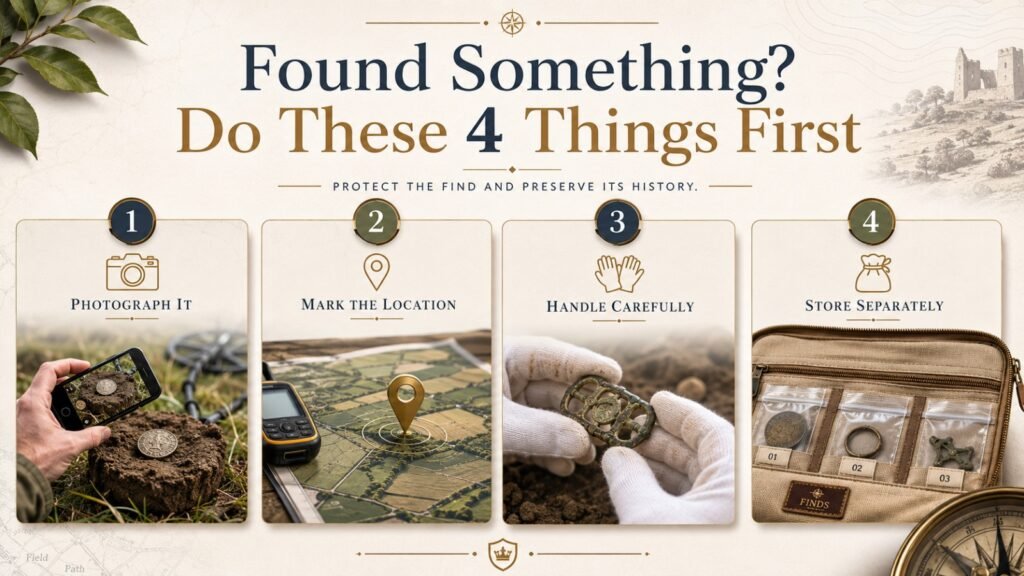
The decisions made in the first five minutes after a find can determine whether it retains its full historical, legal, and monetary value or loses all three. Most detecting guides spend their time telling you how to find things. The moment of discovery itself gets a paragraph, if that. Here is what actually matters.
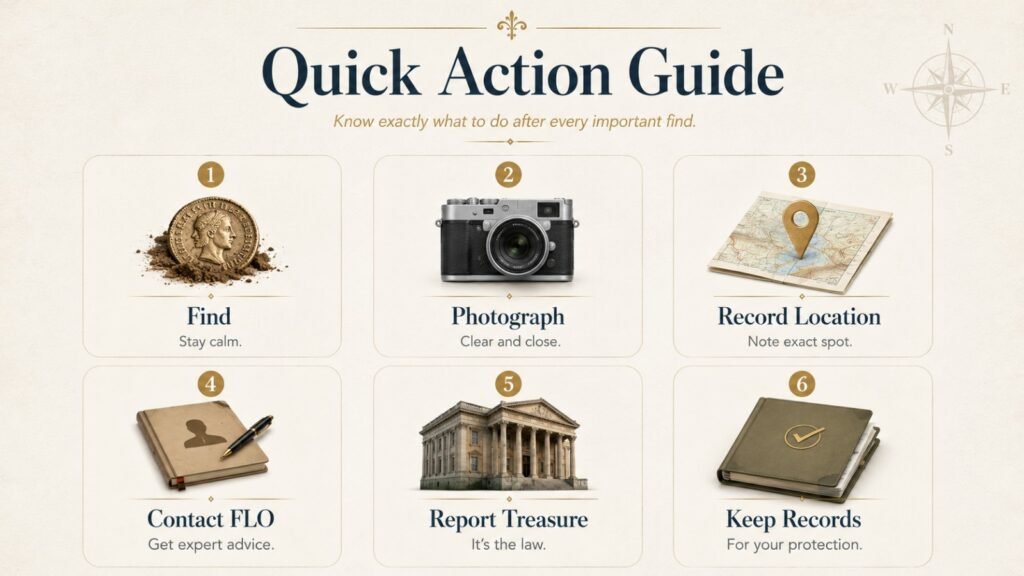
The instinct when you pull something from the ground is to rub the soil off on your jacket or the knee of your trousers. It feels natural. It is one of the most damaging things you can do. Soil particles are abrasive, and a single wipe across the face of a thin, hammered silver coin can leave scratches that permanently reduce its legibility and its value. Leave the find dirty. The soil has been there for centuries; it can wait another hour while you get home and clean it properly using the correct method for its metal type.
Take photographs in situ, meaning in the hole, before you lift the find and then again once it’s been lifted and placed on neutral ground. These images are not just a record for your own satisfaction; they are part of the find’s provenance. If the object turns out to be significant, the findspot photographs form part of the reporting evidence your Finds Liaison Officer will need, and potentially the coroner. A find without a documented context is a diminished find, both scientifically and in terms of what the report can establish about it.
GPS coordinates from your phone, a grid reference from your app, or, at a minimum, a written description of exactly where on the site you were standing. The exact findspot is legally required information for any potential Treasure report. The Treasure Act 1996 requires not just what was found but where, down to the district level for the coroner’s jurisdiction and as precisely as possible for PAS recording. Do this before you move on to the next signal. Memory of exactly where you were standing fades faster than you’d think.
If you’re finding multiple objects in close proximity, coins in a cluster, fragments near each other, or associated items, keep each one separate with its own location note. Objects found together in the same spot are treated as a “same find” group under the Treasure Act, which directly affects whether they qualify as Treasure and how any reward is calculated. Mixing them into the same bag because it’s convenient loses the spatial relationship between them, and that relationship can matter enormously.
With the find safely at home, the next step before any cleaning, any reporting, or any decision about what to do with it is identification. Getting this wrong means applying the wrong cleaning method, potentially missing a legal reporting obligation, or unknowingly sitting on something significant.
Under good light, a bright desk lamp, not overhead room lighting, and with a magnifying glass or a basic loupe, work through these in order. What colour is the metal: gold-yellow, silver-grey, copper-brown-green, or iron-black? What are the size and weight, roughly? Is there any legible text, portrait, or decorative design? Does the shape suggest a coin, a brooch, a seal matrix, a tool fitting, or something else? Can you estimate an approximate period from the style modern, Victorian, medieval, Roman, or prehistoric? You don’t need to reach a confident identification at this stage. You need to have a reasonable working hypothesis before you decide on the next step.
The Portable Antiquities Scheme database at finds.org.uk is publicly searchable by object type, material, and period, and it is the single best free identification resource available to UK detectorists. It holds over 1.4 million recorded finds with detailed photographs, descriptions, measurements, and identifying features, maintained directly by the British Museum (Portable Antiquities Scheme, British Museum). Before contacting anyone, spend time here. Search your object type, refine by material and rough date range, and compare the photographs carefully. The database has almost certainly seen something similar to what you’ve found.
If your identification suggests the find may be gold of any period, Roman or earlier silver, part of a group of coins from the same spot, prehistoric metalwork, or anything where the word “hoard” feels like it might apply, stop. Do not clean it. Do not post it to social media asking for opinions. Wrap it carefully in acid-free tissue, store it somewhere safe, and contact your Finds Liaison Officer before taking any further action. The reason is straightforward: cleaning or handling the wrong object incorrectly can irreversibly damage it, and some objects require the FLO’s involvement before anything else happens. If you’re unsure how to clean what you’ve found once you do get the green light, our guide to how to clean coins found metal detecting covers the correct approach by metal type.
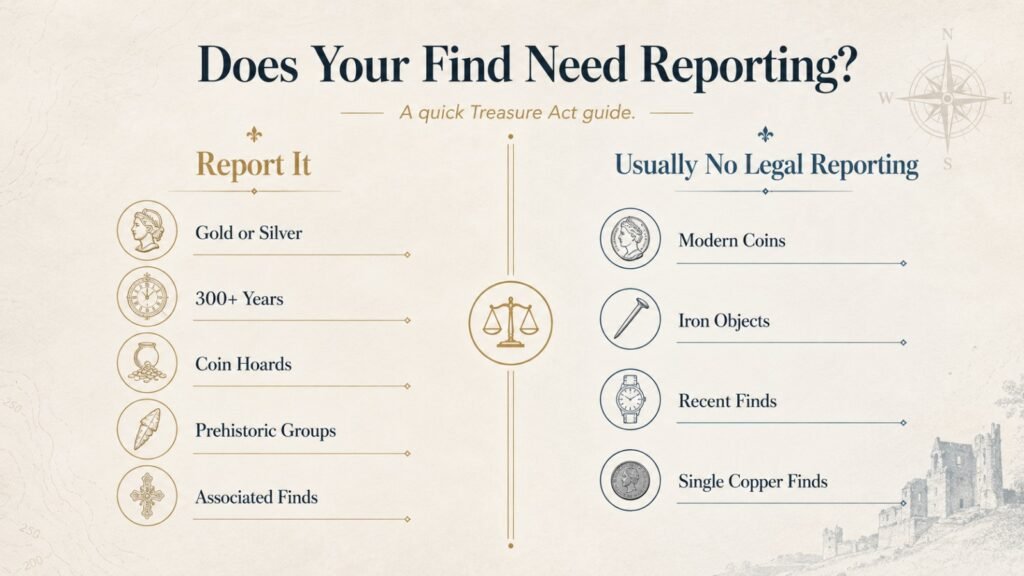
Once you have a working identification, the legal question becomes central: Does this finding need to be reported? The answer depends on whether it meets the definition of Treasure under the Treasure Act 1996, and knowing that definition accurately is not optional.
The Treasure Act 1996 applies in England, Wales, and Northern Ireland. As confirmed by official government guidance (GOV.UK, Report Treasure, 2025), a find legally qualifies as Treasure and must be reported if it meets any of the following criteria: any metallic object at least 300 years old containing at least 10% gold or silver by weight; two or more coins from the same find that are at least 300 years old and contain at least 10% precious metal; any group of ten or more coins from the same find that are at least 300 years old, regardless of their metal content; any prehistoric base-metal object, or a group of two or more prehistoric base-metal objects found together; and any object found in association with another object that qualifies as Treasure. The criteria are specific, and they are the law; knowing them is not optional.
Failing to report a find that qualifies as Treasure is a criminal offence under the Treasure Act 1996. The penalty is an unlimited fine, up to three months in prison, or both. This is not a civil matter or an administrative oversight; it is a criminal one, and it is treated accordingly. The 14-day reporting window runs from either the day of discovery or the day on which you reasonably concluded the find might be Treasure, whichever comes later. That distinction matters: if you found something weeks ago and only now realise it might qualify, the clock starts from today.
Single non-precious metal objects under 300 years old are not Treasure. Neither are modern coins, iron objects of any age, nor single copper or brass objects unless they form part of a qualifying group. These finds are not required to be reported under the Treasure Act. That said, not being legally required to report something is not the same as there being no value in recording it. The PAS voluntary recording process exists for exactly this category of find, and we’ll come to that shortly.
In Scotland, the governing law is Treasure Trove rather than the Treasure Act, and the scope is significantly broader. All finds of archaeological significance, regardless of material, age, or metal content, belong to the Crown and must be reported to the Treasure Trove Unit at National Museums Scotland. Where the English system asks “Does this meet a specific legal threshold?”, the Scottish system asks “Does this have potential historical interest?” and if the answer might be yes, it must be reported. Scottish detectorists need to understand this distinction clearly before they detect, not after.
Finding something unusual is exciting, but identifying it correctly is just as important. Before cleaning or handling a potentially historic item, compare it with the Portable Antiquities Scheme database or speak to your local Finds Liaison Officer if you think it could qualify as Treasure.
If you’re looking for advice on the best detector settings, search coils, or accessories that can help you recover finds more safely and accurately, we’re always happy to help.
Contact our team for product advice and metal detecting support.
The affordable option

Simple controls and light enough for a first machine.
£79.95£99.95Save £20
Add to basketFull detailsIn stock
Knowing you need to report something and knowing how to actually do it are two different things. The good news is that the process is more straightforward than most detectorists expect, and your Finds Liaison Officer does the bulk of the formal work.
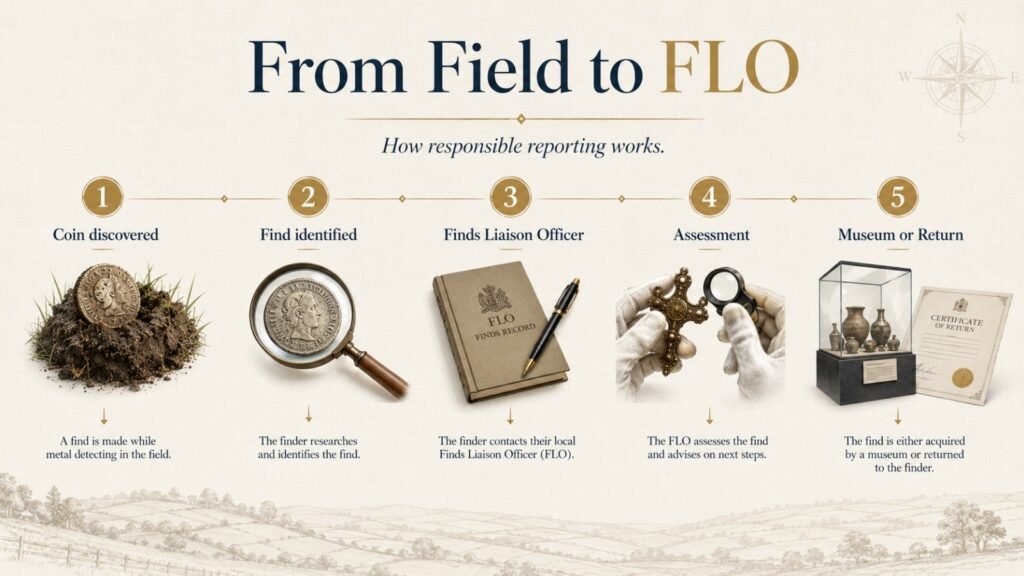
Contact your local FLO as soon as possible, ideally within a few days of the discovery, and definitely within the 14-day legal window. FLO contact details for every county in England and Wales are listed at finds.org.uk/contacts (Portable Antiquities Scheme, Advice for Finders). You can reach them by email with photographs and a grid reference, by phone, or in person if they have a scheduled drop-in at a local museum. If you notify your FLO fully within the 14-day window, this is considered to have fulfilled your legal reporting obligation in most cases, the FLO handles the formal notification to the coroner on your behalf, so you do not need to contact the coroner directly.
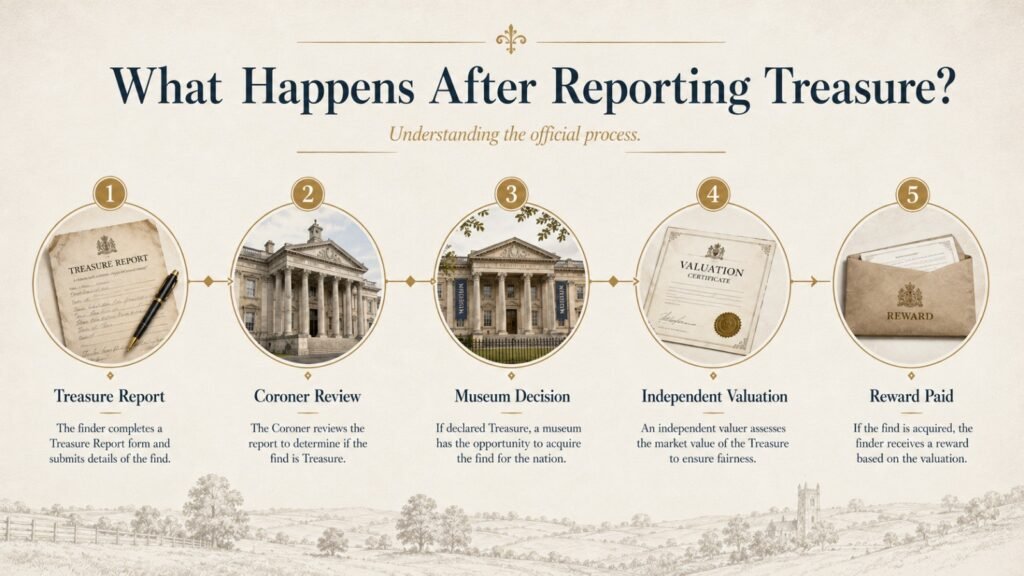
What you’ll need to provide is: your full name and contact details; the landowner’s full name and contact details; the exact location of the find, with a grid reference if possible and the administrative district at minimum; the date of discovery; the circumstances of discovery, including that it was found with a metal detector and the approximate depth of recovery; and photographs of the find both in situ and lifted. The FLO will examine the object, make an initial assessment of its likely status under the Treasure Act, and complete the formal Treasure report. From there, the case goes to a coroner’s inquest to determine legally whether the find constitutes Treasure. If it does, relevant museums are formally notified and given the opportunity to acquire it.
Even when a find doesn’t meet the legal threshold for Treasure, recording it voluntarily with the Portable Antiquities Scheme is strongly recommended by the detecting community, by the National Council for Metal Detecting, and by the British Museum, which manages the scheme. The PAS makes all recorded finds publicly available on its online database, and the cumulative record it holds is genuinely transforming our understanding of how people lived across Britain through the centuries. Recording is free, takes a few minutes either in person with your FLO or through the self-recording function at finds.org.uk, and means your find contributes to that record rather than sitting undocumented in a box. The object remains yours, recording changes nothing about ownership.
Report to the Treasure Trove Unit at National Museums Scotland as promptly as possible. Report forms are downloadable from the TTU website. Include clear photographs and the precise find location. The TTU assesses all reported finds, and if the Crown claims the item, it is allocated to a Scottish museum by the independent Scottish Archaeological Finds Allocation Panel, known as SAFAP. The process is transparent, and the timelines are generally reasonable.
The Treasure Act criteria apply in Northern Ireland as they do in England and Wales, but there is an additional legal layer: any digging or excavation specifically to search for archaeological objects requires a licence from the Department for Communities. Contact the Historic Environment Division for guidance before making any significant decisions about a find. The licensing requirement exists separately from the Treasure reporting obligation, and both must be respected.
Once a find has been reported and the coroner’s inquest confirms it legally constitutes Treasure, the process moves into its final phase. This is the part most detectorists are curious about but rarely ask directly.
If a museum wishes to acquire the find, the case goes to the Treasure Valuation Committee, an independent expert body whose role is to assess the market value of the object. The TVC recommends a reward to the Secretary of State for Culture, Media and Sport, and both the finder and the landowner have the opportunity to comment on the proposed valuation before it is finalised. The committee asks an independent expert to value the find and recommend how much the Treasure is worth and how that reward should be distributed between those eligible to receive a share. The valuation aims to reflect what the object would achieve at open market, not a reduced or arbitrary figure.
The standard arrangement is a 50/50 split between the finder and the landowner, equal shares of the total reward. This split can be altered if the Search Agreement between the two parties specifies a different arrangement, which is one of several practical reasons why a written agreement before you detect on any land matters. If the detectorist was trespassing, detected without permission, or deliberately concealed the find rather than reporting it, they may receive a significantly reduced share of the reward or no reward at all. The system is designed to reward transparency and proper conduct throughout.
If no museum wishes to purchase the find after Treasure status has been confirmed, the objects are returned to the finder and landowner to deal with as their Search Agreement specifies. A formal certificate is issued disclaiming Crown interest in the item. The find is yours or shared between finder and landowner as agreed, and you can do with it what you choose.
Timescales vary considerably, and it is worth being realistic about this. Straightforward single-object cases can move through in a few months. Significant hoards requiring detailed expert assessment take much longer. The Chew Valley Hoard, found in January 2019, received its final Treasure Valuation Committee assessment of £4.3 million in October 2024, five years after it came out of the ground. That was an exceptional case, but it illustrates that the process is thorough precisely because the stakes are significant, and patience is part of the responsibility
The sensible middle

All rounder with full discrimination control. Inland, beach and parks.
£149.95£199.95Save £50
Add to basketFull detailsIn stock
Some discoveries require a different response than the standard process above. Knowing these in advance means you won’t hesitate at the moment it matters.
Stop digging immediately, and do not disturb or move anything. Mark the location from a safe distance and contact the local police and the landowner without delay. Human remains, regardless of how ancient they appear, require police involvement and potentially a coroner’s investigation. This applies even if you believe the remains are clearly historic. The decision about age, significance, and how to proceed belongs to the authorities, not to you.
Do not touch it. Do not attempt to lift it, move it, or identify it more closely. Mark the location clearly from a safe distance and leave the area. Call 999 and report it to the police. The UK’s ground holds a significant quantity of unexploded ordnance from both World Wars in arable fields, in coastal areas, and in places you wouldn’t expect. Civilian handling of live munitions is genuinely dangerous. This is one of the very few situations in which the correct response is to leave the site entirely and let trained professionals deal with it.
If you start finding coins or objects in close proximity to each other, stop digging. This is one of the most critical moments in the hobby, and the most important one to get right. Proceeding to excavate a hoard without proper documentation destroys the archaeological context that makes the find scientifically significant and legally uncomplicated. The spatial relationships between the objects, how they were arranged, what was on top of what, all of this is evidence, and a spade removes it permanently. Call your FLO immediately. Eric Lawes, who found the Hoxne Hoard in 1992, stopped digging after the first few coins and called in the professionals. That decision preserved the context of the largest late Roman gold and silver hoard ever found in Britain.
It is exactly the right model to follow, and the full story of how that find unfolded is told in our famous metal detecting finds UK guide.
If you find something that is clearly lost, rather than buried, a ring with a personal inscription, a watch with identifying marks, or a modern wallet, the ethical and legal approach is to make a genuine attempt to return it to its owner. Modern jewellery that can be identified as belonging to someone is not yours to keep. If you cannot trace the owner directly, hand it in to the local police station. The law on found property is distinct from the law on archaeological finds, and treating them the same way creates problems you can easily avoid.
Ownership of finds is one of the most consistently misunderstood areas of UK detecting, and getting it wrong creates difficulties with landowners and with the law.
The legal starting position is clear: anything found in the ground on private land belongs to the landowner, not the detectorist, unless your Search Agreement specifies otherwise. Most NCMD-standard search agreements include a finds-sharing arrangement, commonly a 50/50 split on finds valued above a certain threshold, with smaller everyday finds retained by the detectorist as agreed. The agreement you signed before you set foot on that field is the document that determines who owns what you find. This is why having a written Search Agreement in place before detecting on any private land is not a formality; it is the legal foundation of the entire arrangement. For guidance on how to approach landowners and what a proper search agreement should include, the metal detecting permission guide covers the full process in detail.
Once a coroner’s inquest confirms that a find legally constitutes Treasure, it vests in the Crown. The finder and landowner receive a financial reward equivalent to the assessed market value, shared as described above, but the objects themselves pass out of their possession into a museum’s collection. This is not a loss in financial terms, since the reward represents full market value, but it is worth understanding clearly before you find yourself in that position. The reward is real and can be substantial. The objects, however, are part of the public record from the moment Treasure is declared.
The serious choice
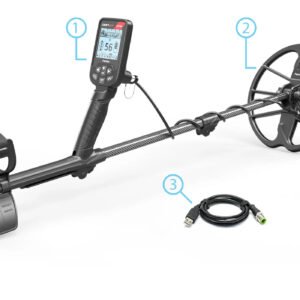
15 kHz, fully waterproof, light, with six search modes.
£299.95£349.95Save £50
Add to basketFull detailsIn stock
| Stage | Action |
| Moment of discovery | Photograph in situ. Record GPS location. Do not rub or clean. |
| Multiple objects in the same spot | Stop digging. Call your FLO immediately. |
| At-home identification | Use finds.org.uk PAS database. Magnifying glass, good light. |
| Might be Treasure | Contact your local FLO within 14 days. Do not clean or sell. |
| Definitely not Treasure | Record voluntarily with the PAS. Keep per your Search Agreement. |
| Human remains | Leave immediately. Call 999. |
| Live ordnance | Do not touch. Leave the area. Call 999. |
| Scotland | Report to the Treasure Trove Unit regardless of material or age. |
| Reward | Shared 50/50 with the landowner after the Treasure Valuation Committee assessment. |
What makes UK metal detecting one of the most respected versions of the hobby anywhere in the world is the framework that surrounds it and the community’s willingness to work within it. Every find reported correctly, every FLO contacted promptly, every Search Agreement honoured: these are the things that keep agricultural land open to detectorists, that maintain the trust that landowners extend to the people who ask to search their fields, and that ensure the PAS database continues to grow as the remarkable public record of British history it has become.
The moment your detector gives that signal is genuinely exciting. What comes next, handled correctly, is how that moment becomes something lasting for you, for the landowner, and for the history that was sitting in the ground waiting to be found.
If you’re thinking about where to search next, our guide to the best places for metal detecting in the UK covers the sites, the permissions, and what each type of ground is likely to produce.
Whether you’re buying your first detector, upgrading your current setup, or looking for accessories that improve recovery and target identification, choosing the right equipment makes every outing more enjoyable.
Browse our range of trusted metal detectors, search coils, pinpointers, and accessories to find the right setup for your next search.
Get in touch for friendly product advice and recommendations.
PPA
Photograph the find in situ before moving it, record the GPS location, and leave it uncleaned until you can identify it properly at home. If the find appears to be over 300 years old and contains gold or silver, contact your local Finds Liaison Officer within 14 days. This is a legal requirement under the Treasure Act 1996. For all other finds, recording voluntarily with the Portable Antiquities Scheme at finds.org.uk is strongly recommended and takes only a few minutes.
Broadly: any metallic object at least 300 years old containing at least 10% gold or silver by weight; two or more coins from the same find that are over 300 years old with at least 10% precious metal content; ten or more coins from the same find over 300 years old regardless of metal; and prehistoric base-metal objects or assemblages. Failing to report a qualifying Treasure find within 14 days of discovery or of realising it might be Treasure is a criminal offence carrying an unlimited fine or up to three months in prison under the Act.
Report it to your local Finds Liaison Officer within 14 days. The FLO examines the find, completes the formal Treasure report, and notifies the coroner on your behalf. A coroner’s inquest then determines whether the find legally constitutes Treasure. If a museum wishes to acquire it, the independent Treasure Valuation Committee sets a market-value reward that is shared equally between the finder and landowner.
Your local Finds Liaison Officer is the primary contact for any find of potential historical significance in England and Wales. FLO contact details for every county are listed at finds.org.uk/contacts. In Scotland, contact the Treasure Trove Unit at National Museums Scotland. In Northern Ireland, contact the Department for Communities Historic Environment Division, noting the additional licensing requirements that apply there.
Every day, non-Treasure finds modern coins, iron objects, and non-precious metal items under 300 years old are generally yours to keep under the terms of your Search Agreement with the landowner. Anything that qualifies as Treasure under the Treasure Act vests in the Crown once declared by a coroner, but the finder and landowner receive a financial reward equal to the assessed market value. The objects themselves go to a museum; the reward is the finder’s return.
Not sure which of these suits the ground you search? Tell us where you detect and we will point you at the right one, including the cheaper one when that is the honest answer. We use these machines ourselves.