
On this page
This article is about gaining permission to metal detect in the UK. Permission and insurance are essential things you need if you own a metal detector and plan to go detecting in the UK which is probably different in other countries but I’m in the UK so I’m going to cover the UK.
Got permission and need a machine? Browse our beginner metal detectors to get started.

Metal detecting – gaining permission is about approaching the landowner and it must be the landowner not a tenant it has to be the person who legally owns the land. Most people approach farmers because farmers have lots of land. Now, there’s no easy way of doing this, there’s people that will tell you all different ways of getting permission but the simple fact of the matter is you have to go and knock on doors, be polite and be prepared to be told no, because there are a few farmers out there and I don’t understand why but they don’t want people on their land. At the end of the day, it is their land just be polite, and to be perfectly honest I found 99% of farmers have been friendly.

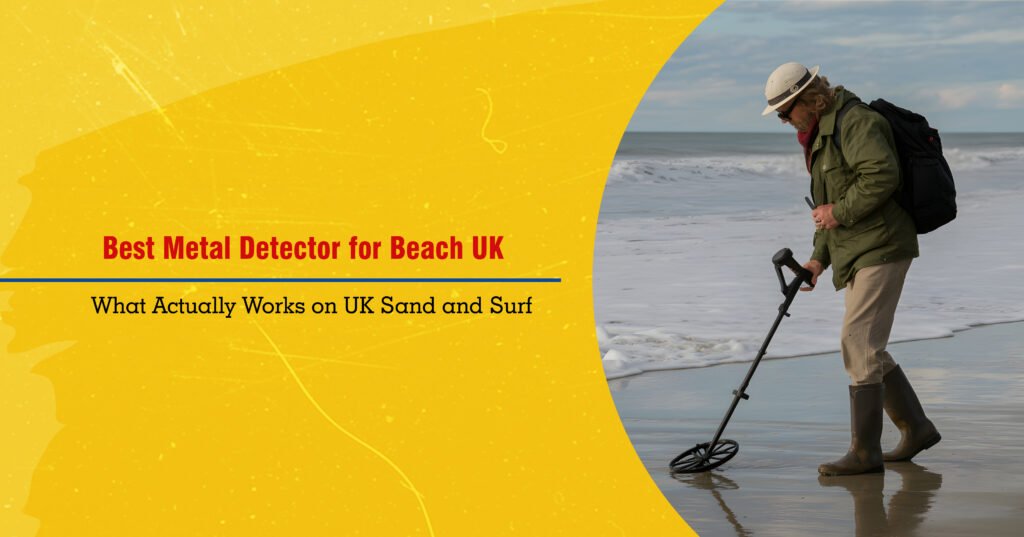
You can go on some beaches with a metal detector, but not all beaches because there could be sites with special scientific interest and they could also be privately owned, most of the beaches in the UK are owned by the Crown and if you go on the Crown Estate website you will see that the crown allows metal detecting on the foreshore off their beaches and obviously do your own research go online and find out what permission is required for that particular beach. A great detector for the beach by the way is the REFLEX-G6 which is stable on wet sand and deals well with high mineralisation.


All Land in the UK is owned, a lot of people do not realise this, but every single piece of land is owned either by the Crown, Privately, Local Authorities, City Council’s, or Town Councils. There is no such thing as public land in the UK there’s public access but that’s not public land so this basically means that things like parks, we have the right to go onto for recreation, but we don’t have the right to do anything else on that park and we certainly do not have the right to dig up holes and go metal detecting. It is a quick way to get yourself arrested and yes you can get arrested in the UK for metal detecting.

Try the less obvious places and by that, I mean sometimes you will not get access to massive farms simply because people have already been knocked back, or, they have already given someone permission. So, what you want to do is go to the smaller farms, and Small-Holdings. Go to people that just have four or five acres, knock on the door, and say to them “hello, I’m Tim my hobby is metal detecting, would you be interested in letting me go on your fields?” They may say no but if the owner of that house is a history geek like us, they will say yes!

I highly recommend joining the National Council of Metal Detecting. Which includes public liability insurance, you pay something like eight pounds per year. It is unlikely you will need to make a claim but farmers like it that you are a responsible detectorist being a member of a government approved body like National Council of Metal Detecting.
I hope you have enjoyed reading our latest post on Metal Detecting – Gaining Permission. For more on getting started, have a look at our other guides and our beginner machines.
Before you ask for permission, you need to know exactly who you are asking.
This sounds obvious, but it is one of the biggest reasons beginners fail. They drive around spotting promising fields without ever properly researching ownership. Then they knock on the wrong farmhouse door, contact the wrong person, or ask a tenant who has no authority to approve access.
The groundwork matters.
The easiest starting point is the HM Land Registry.
Their “Find a Property” service lets you search by map location and obtain ownership details for a small fee. In most cases, you will receive the registered owner’s name and correspondence address.
It is not perfect. Roughly 10% of land in England and Wales remains unregistered, particularly older rural estates that have stayed within the same families for generations. But for most modern farmland, it is extremely useful.
When land is unregistered, local knowledge often works better than databases.
Village pubs, parish notice boards, local feed stores, and even postmen usually know who farms what land in rural communities. Long-time residents often know field names, farm ownership history, and tenancy arrangements better than official records.
Experienced detectorists rarely look at land randomly.
They study it.
Old Ordnance Survey maps, tithe maps, and historical aerial overlays can reveal old pathways, vanished buildings, former settlements, Victorian fairgrounds, and Roman route alignments that no longer appear on modern maps.
The National Library of Scotland map viewer is one of the best free research tools available for this.
The MAGIC Map system is equally important because it shows protected archaeological areas, stewardship schemes, Scheduled Monuments, SSSIs, and environmental restrictions before you ever approach a landowner.
This matters enormously. Approaching someone about land that cannot be legally detected immediately tells them you have not done your homework.
In Scotland, the equivalent service is ScotLIS.
It provides ownership and land information online and is widely used by detectorists researching permissions north of the border.
This catches people constantly.
The landowner and the farmer working the land are not always the same person.
Many large estates lease fields to tenant farmers under agreements that contain specific conditions relating to archaeology, access, and land use. If a tenant grants permission without the landowner’s approval, the permission may not actually be valid.
Good detectorists clarify this immediately.
“Are you the owner, or is the land tenanted?” is a completely normal and sensible question to ask politely during discussions.
Once you know who controls the land, you are ready for the most important part of the entire process: the approach.
This is where permissions are won or lost.
Not with paperwork. Not with legal knowledge. Not with expensive equipment.
With people skills.
Most landowners decide whether they trust you within the first minute of meeting you. Experienced detectorists understand this deeply. That is why the approach matters so much.
Face-to-face conversations outperform letters and phone calls almost every time.
Farmers are practical people. They prefer seeing who they are dealing with. Your attitude, tone, and presentation tell them far more than any carefully worded email ever could.
Timing matters too.
Mid-morning on weekdays is usually far better than early mornings, evenings, harvest periods, or lambing season. During harvest, even the friendliest farmer is often exhausted and under pressure. Bad timing turns easy conversations into instant refusals.
Dress normally. Clean boots. Sensible clothing. No camouflage. No military-style gear. No detector over your shoulder.
And absolutely do not walk up carrying digging tools.
That instantly creates the impression you already expected permission before even asking.
One of the biggest mistakes beginners make is asking generic questions.
“Can I metal detect on your land?” feels random and intrusive.
A far stronger approach sounds more like this:
“I’ve been researching the history around this area and noticed an old route running through the fields near the south lane. I wondered whether you might ever consider allowing responsible metal detecting there.”
That sounds completely different.
It shows thought. Research. Respect.
Farmers respond far better when they feel you are genuinely interested in the history of the land rather than simply chasing treasure stories.
This surprises many beginners.
Talking excitedly about gold and valuable finds often works against you.
Experienced detectorists know this from painful experience.
If you tell a farmer you are likely to uncover incredible treasure and then spend months recovering musket balls, Georgian buttons, and scrap brass, disappointment builds quickly. Worse still, some landowners begin imagining vast fortunes buried beneath every field.
Neither outcome helps you.
The strongest permissions are built around history, not greed.
Show interest in the story of the land itself. Old maps help enormously. Mentioning historical records, parish history, or old field names often creates far better conversations than discussing valuables.
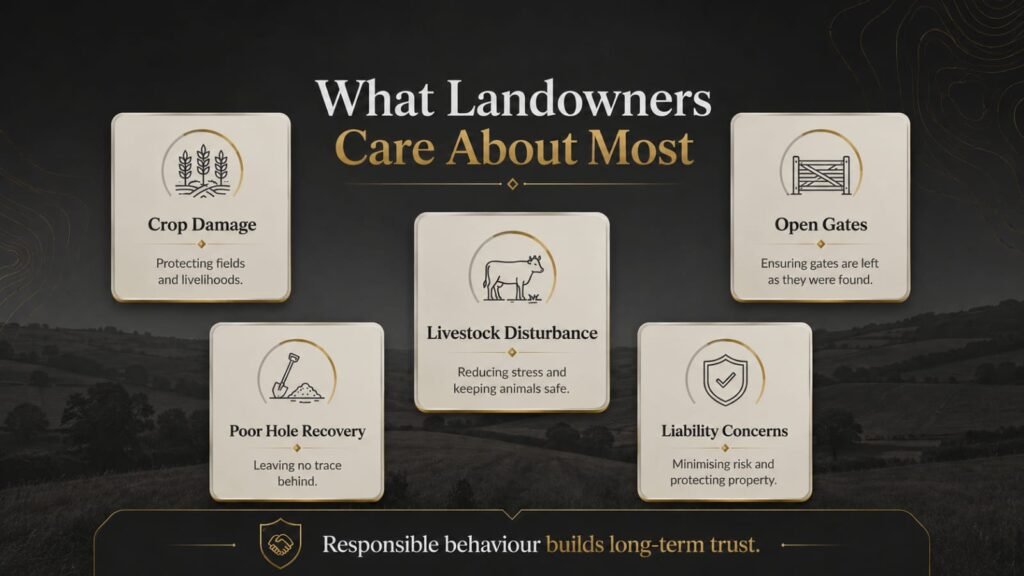
Farmers worry about very practical things:
Good detectorists calm these concerns naturally during conversation.
Explain that you replace every plug carefully. Mention insurance. Make it clear you respect boundaries and always check before visiting.
You are not “selling” yourself. You are showing you understand how farms actually work.
Letters are less effective than face-to-face conversations, but they are not useless.
Older landowners in particular often appreciate handwritten letters because they feel personal and respectful.
Keep it short. One page maximum.
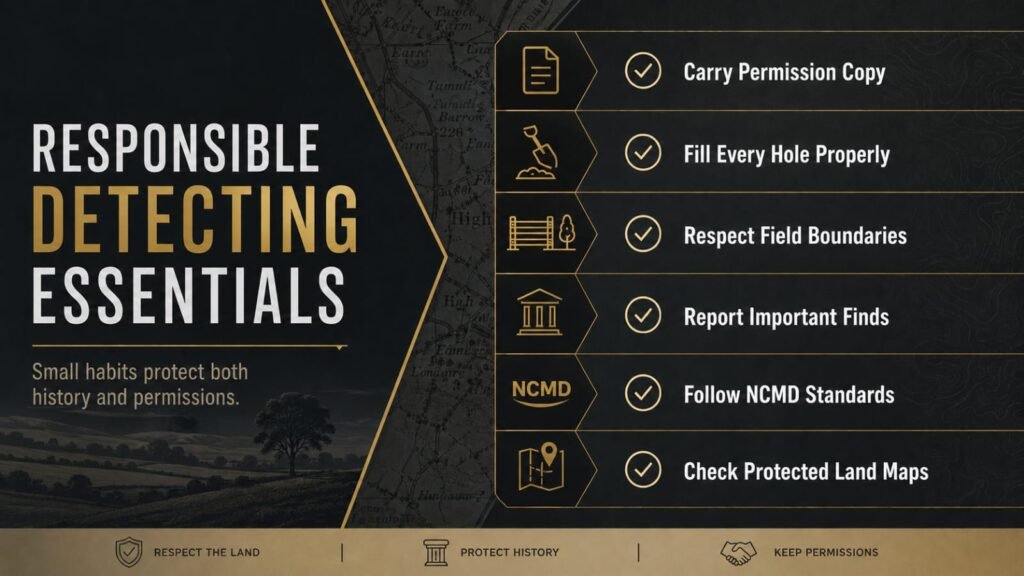
Mention the specific land by name. Reference something historical connected to the area. Include a stamped, addressed envelope. Mention NCMD membership if you have it because insurance and accountability matter to landowners.
Mass-produced template letters rarely work because farmers recognise them immediately.
Certain things almost always reduce your chances:
And this is important: if someone says no, accept it politely and leave well.
Rural communities have long memories.
Many excellent permissions come through relationships rather than cold approaches.
One good farmer introduction often leads to neighbouring farms. Local clubs regularly have long-standing permissions stretching back decades. A trusted detectorist recommendation carries real weight in rural areas.
This is why reputation matters so much in the UK detecting culture.
Once permission is granted, the next step is making sure everything is properly documented.
A handshake agreement is legally workable in many situations.
Plenty of long-term permissions across the UK still run entirely on trust.
But written agreements protect everybody.
And the moment valuable finds become involved, clarity matters enormously.
Imagine uncovering a significant coin hoard or a valuable gold artefact after years on a permission.
Now imagine there was never any written agreement explaining ownership splits, reporting procedures, or expectations.
That situation destroys relationships very quickly.
Written permission prevents misunderstandings before they ever begin.
It also helps in ordinary day-to-day situations. If someone questions why you are detecting on private land, a signed agreement instantly resolves the issue.
Professional detectorists carry theirs every time they detect.
The standard document most UK detectorists use comes from the National Council for Metal Detecting (NCMD).
Their Search Agreement forms for England, Wales, and Scotland are widely recognised throughout the hobby because they are simple, practical, and easy for landowners to understand.
The agreement normally includes:
Most agreements are time-limited rather than permanent. That is actually helpful because it allows permissions to be reviewed each year naturally.
This is the conversation many beginners avoid.
Do not avoid it.
Be clear from the beginning about how valuable finds will be handled. The NCMD commonly recommends 50/50 splits for higher-value discoveries, but arrangements vary widely.
Some landowners refuse any share. Others want equal division on everything significant.
The important thing is clarity.
Modern farming agreements often include archaeological restrictions tied to government environmental schemes.
If land sits within Countryside Stewardship or Higher Level Stewardship programmes, detection may carry additional reporting obligations or complete exclusions on certain areas.
This matters enormously to farmers because breaching scheme conditions can create financial penalties.
Always ask directly whether stewardship agreements apply to the land.
Print two signed copies.
One stays with the landowner. One stays with you.
And every time you detect that land, carry your agreement.
It is one of the simplest ways to look professional and avoid unnecessary problems.
New to Metal Detecting in the UK?
The right detector makes all the difference, from finding more targets to enjoying every hunt.
UK Metal Detectors stocks beginner to professional machines, with expert advice to help you choose the right detector for UK conditions.
The affordable option
Pinpointer. Finds the target in the hole instead of the spoil.
£49.95£69.99Save £20.04
Add to basketFull detailsIn stock
If you spend any serious time around UK detectorists, one organisation comes up constantly: the NCMD.
For many landowners, it is one of the first things they ask about.
The National Council for Metal Detecting is the main representative body for detectorists across the UK.
It exists to support responsible detecting, maintain standards within the hobby, and represent detectorists nationally on heritage and legal matters.
Membership is not legally required.
But in practical terms, it changes everything.
From a farmer’s perspective, NCMD membership signals three important things immediately:
That matters enormously.
Most landowners are not worried about detectorists stealing treasure. They are worried about irresponsible people damaging land, leaving holes, disturbing livestock, or creating liability issues.
NCMD membership reassures them that you take the hobby seriously.
Membership typically provides:
Many organised rallies now require proof of NCMD or FID membership before allowing attendance.
Insurance is one of the biggest practical reasons to join.
If accidental damage occurs on farmland, public liability cover protects both you and the landowner. Even simple accidents involving gates, livestock, or equipment can become serious issues without insurance.
This alone makes membership worthwhile for most detectorists.
The Federation of Independent Detectorists (FID) is the other major UK organisation.
Both NCMD and FID memberships are widely accepted across clubs, rallies, and permissions.
Most experienced detectorists simply recommend joining one before actively seeking permissions.
New detectorists sometimes hear about Finds Liaison Officers and assume they exist to “take away finds.”
That misunderstanding could not be further from reality.
Most experienced UK detectorists view their local FLO as one of the most valuable contacts they have.
Finds Liaison Officers work as part of the Portable Antiquities Scheme, which is managed by the British Museum.
They are professional archaeologists whose role is to work directly with detectorists and members of the public.
Their job is not to punish responsible detectorists.
Their job is to record history.
Through the Portable Antiquities Scheme, more than a million archaeological finds discovered by the public have been documented and added to the national historical record.
That database is now one of the most important archaeological resources in Britain.
Landowners respond extremely positively when they realise their land’s history is being professionally recorded.
Instead of looking like someone simply removing objects from fields, you become part of a process contributing genuine historical knowledge.
That distinction matters.
Many farmers become deeply interested once findings are properly identified and linked to the history of their own land.
A good FLO can:
Over time, this also builds credibility for you as a responsible detectorist.
The Portable Antiquities Scheme provides a full county contact directory here:
If you are serious about detecting responsibly in the UK, building a relationship with your FLO is one of the smartest things you can do.
Because alongside permissions, there is one legal framework every detectorist absolutely must understand: the Treasure Act.
The Treasure Act sounds intimidating when people first hear about it.
In practice, responsible detectorists deal with it quite calmly because the rules are straightforward once you understand them.
In England, Wales, and Northern Ireland, certain finds legally qualify as Treasure and must be reported to the local coroner within 14 days.
Failing to report a qualifying Treasure is a criminal offence.
Scotland operates differently under its own Treasure Trove system.
In simplified terms, Treasure usually includes:
The exact rules contain technical details, but your local FLO will guide you if anything appears potentially significant.
The golden rule is simple:
If you think it might qualify, report it.
Once reported, the item is assessed to determine whether a museum wishes to acquire it.
If acquired, a reward is normally paid and shared according to the agreement between the detectorist and the landowner.
If not acquired, the item is returned.
This is exactly why written agreements matter so much.
Many beginners are surprised to learn that ordinary finds legally belong to the landowner unless agreed otherwise.
Again, this is why clear permissions and written agreements are essential from the start.
Scotland operates under different laws entirely.
Any archaeological object found in Scotland may fall under Crown claim regardless of material.
Detectorists in Scotland should familiarise themselves with Treasure Trove Scotland before detecting.
The serious choice
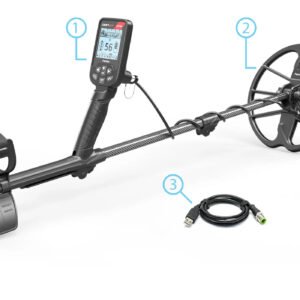
15 kHz, fully waterproof, light, with six search modes.
£299.95£349.95Save £50
Add to basketFull detailsIn stock
This is the question almost every beginner asks eventually.
Where can you actually go?
The answer depends entirely on the type of permission involved.
Most serious detectorists focus on farmland.
Particularly arable land.
Ploughing continuously brings older material closer to the surface, which is why productive permissions often improve after each cultivation cycle.
One good farm can produce finds for decades.
These permissions usually come through direct approaches, networking, or club relationships.
And importantly, they improve over time. The longer a farmer trusts you, the more likely additional fields and neighbouring permissions become available.
Beach detecting remains extremely popular because it offers relatively accessible legal detecting opportunities.
The Crown Estate generally permits detecting on foreshore areas between high and low tide in England, Wales, and Northern Ireland under certain conditions.
However, always check current rules before visiting because restrictions vary by location.
Local councils operate completely differently from each other.
Some welcome responsible detecting. Others require permits. Some prohibit it entirely.
Never rely on assumptions or forum comments. Check directly with the council itself.
For beginners, rallies are often the fastest way onto quality land legally.
Organisers secure permissions, insurance requirements, and access arrangements beforehand. You simply attend.
Large UK detecting events often include hundreds of detectorists detecting historically productive land over weekends.
Well-known rallies include:
For live rally listings, the UK Detectorist Events Calendar is one of the most widely used resources.
This is arguably the smartest route for complete beginners.
Established clubs already hold permissions, organise group digs, and introduce newcomers to proper detecting practices.
Many lifelong permissions begin through club introductions.
The NCMD club directory is available here:
Responsible detectorists avoid restricted land completely.
This includes:
Understanding these boundaries is part of what separates responsible detectorists from irresponsible ones.
Getting permission is only half the skill.
Keeping it is where experienced detectorists separate themselves from everyone else.
Most long-term permissions survive because of consistency and respect, not spectacular finds.
This is non-negotiable.
Poor hole recovery is probably the single most common reason permissions disappear.
A field should look untouched when you leave it.
Not “mostly fine.” Completely fine.
Show photographs of interesting finds. Share historical information. Explain what you are discovering.
Many farmers become genuinely fascinated once they realise the history beneath their own fields.
And when landowners feel included, permissions strengthen naturally.
Never assume you can simply arrive whenever you want.
Always check before visiting during sensitive periods involving crops, livestock, or seasonal work.
Good detectorists work with farms, not against them.
Nothing destroys trust faster than wandering into neighbouring fields without permission.
If you were granted access to one field, detect that field only unless invited elsewhere.
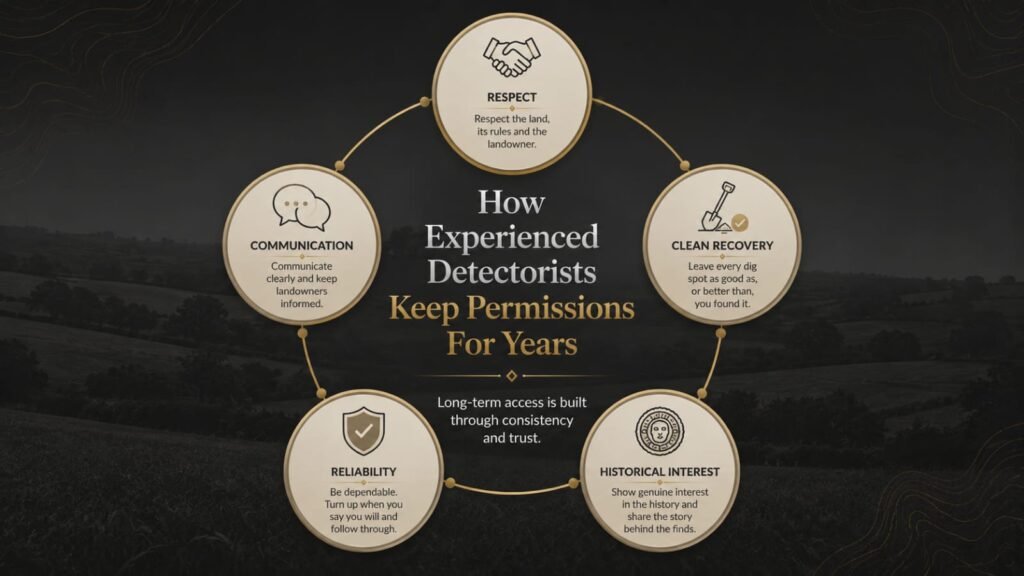
Old maps, farm history, census records, and historical photographs mean a lot to many rural families.
A small gesture of shared historical interest often builds far stronger relationships than people expect.
Using the Portable Antiquities Scheme benefits both you and the landowner.
When finds from a farm become part of the national archaeological record, many landowners feel genuine pride in that contribution.
That feeling strengthens permissions enormously over time.
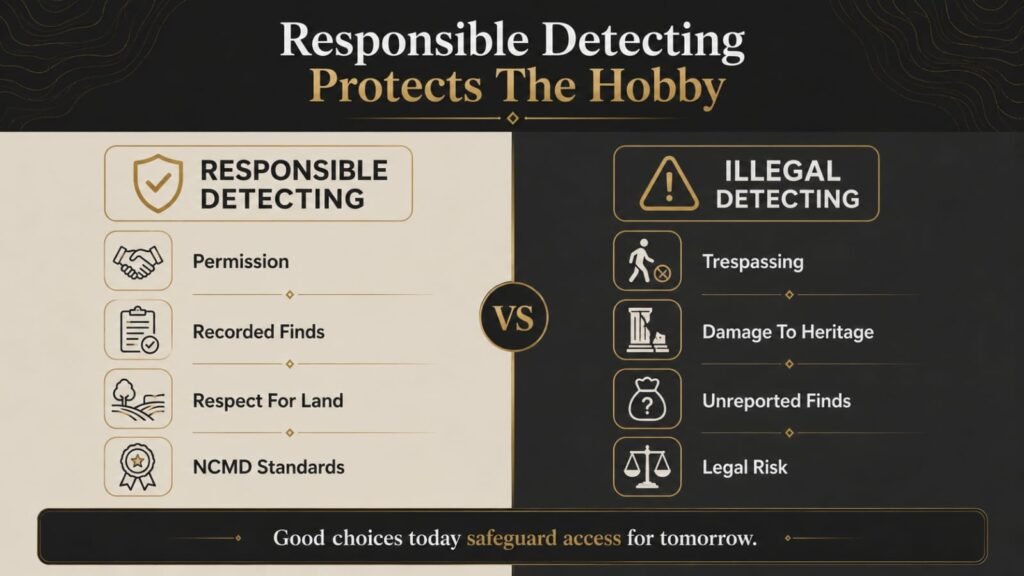
Nighthawking is one of the biggest problems facing the hobby in the UK.
The term refers to illegal metal detecting without permission, often at night and frequently on archaeologically sensitive land.
Responsible detectorists despise it.
Not only because it is illegal, but because it damages trust across entire regions. A farmer who has been illegally targeted often refuses future permission requests from legitimate detectorists for years afterwards.
It also destroys archaeological context permanently.
Once objects are ripped from the ground without proper recording, vital historical information disappears forever.
The UK detecting community actively reports nighthawking through heritage and police reporting systems because protecting the reputation of responsible detecting matters deeply to serious hobbyists.
And thankfully, the overwhelming majority of UK detectorists care enormously about preserving that reputation.
Most beginners imagine landowners are automatically hostile to metal detecting.
In reality, most farmers are simply cautious.
They want to know who you are, whether you are responsible, and whether you understand how to behave properly on working land.
That is all.
When you approach respectfully, communicate clearly, and show genuine interest in the history of the land rather than fantasies of treasure, permissions become far more achievable than people expect.
And once you earn one good permission, everything changes.
You begin learning the land properly. You understand seasonal patterns. You build trust with the farmer. You revisit productive areas after ploughing and rain. Over time, the permission becomes more valuable not just because of the finds, but because of the relationship behind it.
That is the real heart of UK metal detecting culture.
Not chasing instant riches.
Building long-term access to extraordinary history through trust, patience, and respect.
Ready to Start Detecting Legally and Responsibly?
Whether you are buying your first detector or upgrading to a more advanced machine, UK Metal Detectors offers one of the UK’s best selections of beginner and professional metal detecting equipment, backed by real detecting knowledge and expert support.
Contact the Team Today for Expert Advice on Choosing the Right Detector
Not sure which of these suits the ground you search? Tell us where you detect and we will point you at the right one, including the cheaper one when that is the honest answer. We use these machines ourselves.