
On this page
The thing that surprises most people about Britain’s greatest archaeological discoveries is who found them.
Not university teams with decades of funding. Not professional excavators working on carefully planned digs. In many cases, the people behind these discoveries were retired gardeners, weekend hobbyists, chefs, farmers, or detector club members spending a day in a field.
That is what makes UK metal detecting so fascinating. Some of the most important pieces of British history ever recovered were sitting quietly beneath ordinary farmland, waiting for somebody patient enough to hear the right signal.
Britain’s landscape has an unusual advantage. Roman roads, Anglo-Saxon settlements, Viking activity, medieval trade routes, and centuries of farming have layered history across the same ground. A field that looks completely unremarkable today may have been a Roman market, a Saxon gathering place, or the site of a medieval settlement hundreds of years ago.
The stories in this guide are not simply about treasure. They are about decisions. Again and again, the people who made these discoveries chose to stop digging, call experts, protect the site, and work with archaeologists. Those choices preserved information that would otherwise have been lost forever.
And when looking across the most famous metal detecting finds UK history has produced, a pattern becomes impossible to ignore. The discoveries may look like luck from the outside, but almost every one of them came after years of persistence.
Before getting into the finds themselves, it helps to understand why so many of these discoveries ended up in museums rather than private collections.
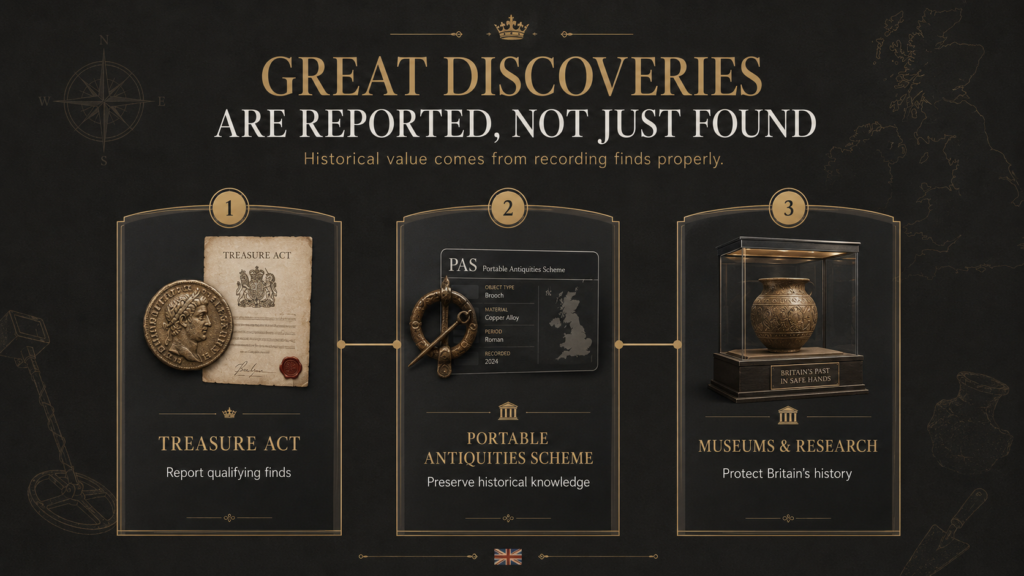
Under the Treasure Act 1996, qualifying finds in England, Wales, and Northern Ireland must be reported to the local coroner. This typically includes gold or silver objects more than 300 years old and many coin hoards. Museums are then given the opportunity to acquire the find at market value, with rewards generally shared between the finder and landowner.
New detectorists are often surprised by how straightforward UK detecting laws actually are, although it’s worth understanding the legal obligations before heading into the field.
Alongside the Treasure Act sits the Portable Antiquities Scheme (PAS). Managed through the British Museum, the PAS records archaeological finds discovered by members of the public. Its database has become one of the most valuable resources for understanding Britain’s past.
What often gets overlooked is that these famous discoveries did not become important because they were valuable. They became important because they were reported correctly.
With that framework in place, here are the discoveries that changed what we know about Britain, found by the people most would never expect.
Ordered not by financial value alone, but by historical impact, find story, and what each discovery meant for our understanding of British history.
Most detectorists dream about finding a hammered silver coin.
Seven detectorists in Somerset found 2,584 of them.
On a cold January day in 2019, the group met in the Chew Valley to help test a newly purchased detector. It was supposed to be a routine day out. The sort of weekend hunt that usually ends with a few interesting finds, a muddy pair of boots, and stories shared over a cup of tea afterwards.
Instead, the signals kept coming.
At first, it looked promising. Then it started looking unbelievable. Before long, everyone realised they were standing above something far bigger than a scattered coin spill. Beneath the field sat a hoard that had remained untouched for almost a thousand years.
What makes the discovery so fascinating is not just the number of coins. It is the exact moment in history they represent.
Inside the hoard were coins of Harold II and William the Conqueror, two kings whose names sit on opposite sides of one of the most important events in English history. One died at the Battle of Hastings. The other reshaped England forever.
History books often make 1066 feel neat and immediate. In reality, change takes time. The Chew Valley Hoard captures that transition in a way few discoveries ever could.
The weather that day certainly wasn’t helping. The group reportedly spent hours searching through rain and thunderstorms, determined to recover every coin. Anyone who has spent time detecting knows the feeling. Once something special starts appearing from the ground, leaving becomes almost impossible.
The hoard is destined for permanent display at the Museum of Somerset, where visitors can see one of the most important coin discoveries ever made in Britain.
Some discoveries add a new page to history.
The Staffordshire Hoard forced historians to rewrite entire chapters.
When Terry Herbert walked into a recently ploughed field near Hammerwich in July 2009, he wasn’t looking for fame. He had already spent nearly two decades metal detecting. Like most experienced detectorists, he understood that good finds usually come after countless ordinary days.
Then the gold started appearing.
Not one piece. Then another. Then another.
Over several days, archaeologists and specialists joined the investigation as it became clear that this was no ordinary discovery. By the end, more than 4,600 gold and silver objects had been recovered from the site.
One detail makes the story even more remarkable.
Other detectorists had searched the same field before.
Nothing had been found.
Recent ploughing is believed to have shifted soil that had remained undisturbed for more than 1,300 years. The treasure had always been there. It simply moved into range at exactly the right moment.
Looking at the hoard itself raises even more questions.
Most treasure hoards contain jewellery, household items, or coins. The Staffordshire Hoard is different. It is overwhelmingly military.
Sword fittings. Helmet fragments. Warrior equipment. Gold decorations stripped from weapons.
There is almost nothing that suggests everyday life.
That has led archaeologists to believe the collection may represent battlefield trophies or war gear taken from defeated enemies. Even today, experts continue debating exactly why it was buried.
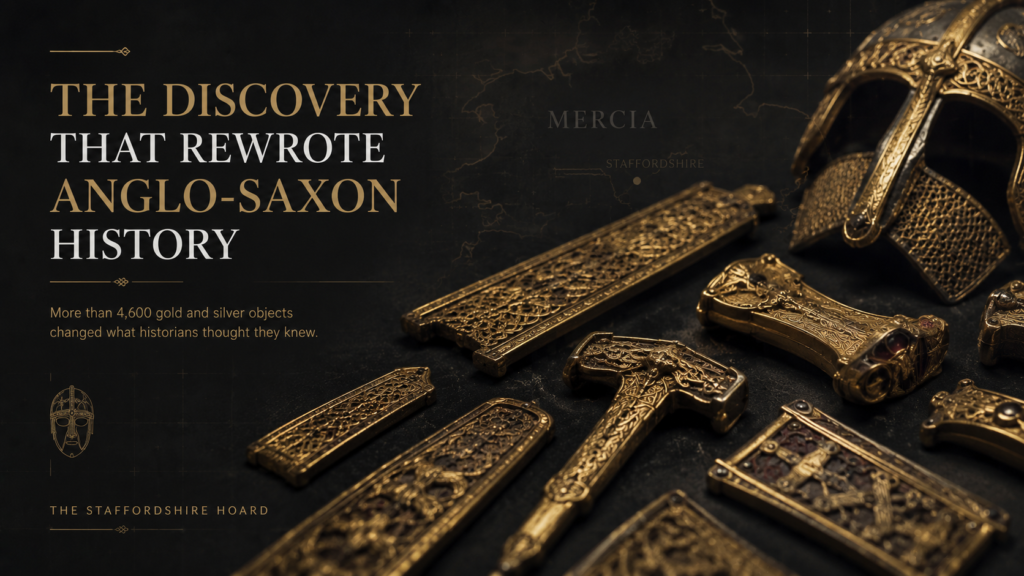
The hoard is jointly displayed between Birmingham Museum and Art Gallery and the Potteries Museum & Art Gallery in Stoke-on-Trent.
The story begins with a lost hammer.
That sounds made up, but it is completely true.
In November 1992, retired gardener Eric Lawes headed into a Suffolk field to help his friend Peter Whatling find a hammer that had gone missing. Lawes had recently been given a metal detector as a retirement gift.
The hammer was eventually found.
It just happened to be sitting above one of the greatest Roman treasure hoards ever discovered.
What emerged from the ground was astonishing:
Yet the reason detectorists still talk about Eric Lawes today has very little to do with the treasure itself.
After finding several coins and silver spoons, he stopped digging.
That decision changed everything.
Most people would have kept going. Curiosity alone would have made it difficult not to. Lawes chose the opposite approach. He contacted authorities and waited for archaeologists to arrive.
Because of that restraint, specialists were able to record the entire hoard exactly as it had been buried.
The original wooden chest had long since rotted away, but its shape could still be reconstructed. Objects remained in their original positions. Archaeologists gained information that would normally be destroyed within minutes of an uncontrolled excavation.
That is why the Hoxne Hoard remains such an important story.
The treasure was remarkable.
The decision was even more remarkable.
The complete hoard is permanently displayed in the British Museum, where visitors can see one of the finest collections from the final years of Roman Britain.
Every Famous Discovery Started With a First Detector
Eric Lawes wasn’t searching for one of the greatest Roman hoards ever found in Britain.
He was looking for a lost hammer.
That is what makes stories like Hoxne so fascinating. Nobody knows which signal will be the important one until they decide to dig.
Whether the goal is finding Roman coins, medieval artefacts, or simply spending more time outdoors, having the right equipment makes every search more enjoyable.
Browse the full range of metal detectors at UK Metal Detectors and find the machine that’s right for your next adventure.
The affordable option
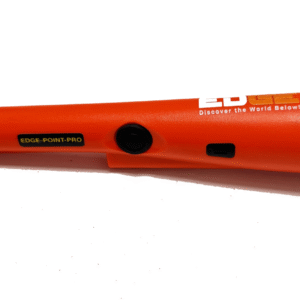
Pinpointer. Finds the target in the hole instead of the spoil.
£49.95£69.99Save £20.04
Add to basketFull detailsIn stock
Most famous discoveries happen once.
Snettisham kept happening for more than forty years.
The story began in 1948 when a Norfolk farmer was deep-ploughing a hillside at Ken Hill near Snettisham. Among the churned soil was a twisted piece of metal that looked so ordinary it was left lying beside the field. For nearly a week, nobody realised they were looking at one of the most important Iron Age discoveries ever made.
That first object turned out to be a gold torc, a ceremonial neck ring worn by the elite of Iron Age Britain. Then another appeared. Then another. Over the following decades, the same hillside continued producing extraordinary treasures, eventually revealing at least fourteen separate hoards.
What makes Snettisham remarkable is not just the quantity of gold. It is the mystery.
Archaeologists still cannot fully agree on why so much wealth was buried in one place. Some believe it was a religious offering. Others think it may have been a tribal treasury or a metalworker’s stockpile. The truth remains hidden somewhere between the artefacts and the landscape.
The most famous piece is the Great Torc, a stunning masterpiece weighing around a kilogram. Looking at it today, it is difficult to believe it was created more than 2,000 years ago without modern tools.
The finest pieces are displayed between the British Museum and Norwich Castle Museum, where the Great Torc remains one of the highlights of Britain’s Iron Age collections.
Detectorists learn quickly that unusual signals are often disappointing.
A rusty can. A buried pipe. Farm machinery.
That is why Dave Crisp probably wasn’t expecting much when his detector gave a strange reading in a Somerset field in April 2010. He had searched the same farm for years and had already found Roman coins nearby, but nothing suggested what was waiting underground.
The signal led to a small coin.
The small coin led to the rim of a pot.
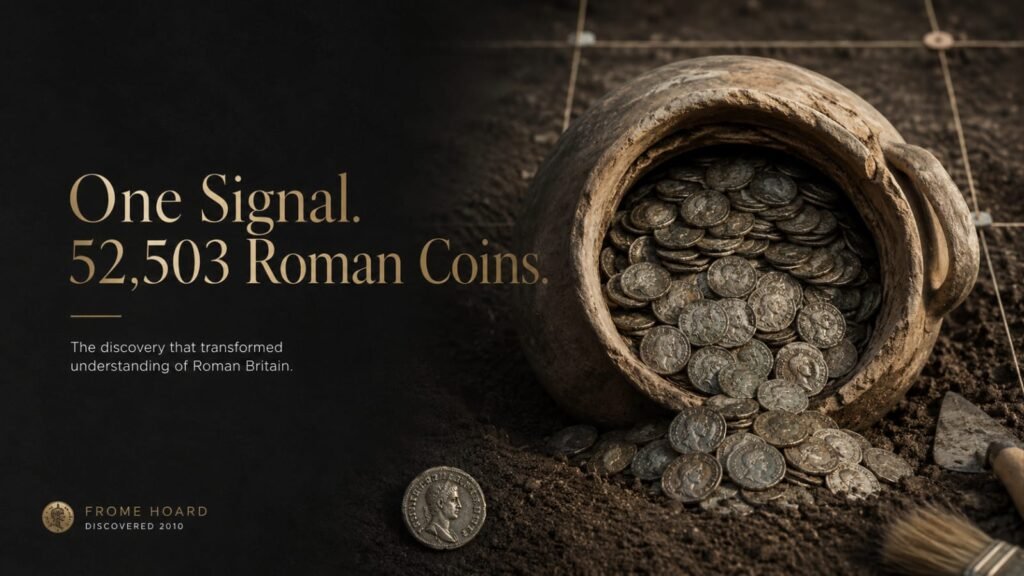
And the pot turned out to contain more than 52,000 Roman coins.
The sheer scale is difficult to picture. The vessel weighed around 160 kilograms and had remained untouched for roughly 1,700 years. Once Crisp realised what he had found, he stopped immediately and contacted his Finds Liaison Officer.
That decision preserved something incredibly rare.
Rather than being emptied in the field, the pot was lifted intact and excavated layer by layer by specialists. Every layer revealed new information about how the coins had been deposited.
The discovery also transformed understanding of Carausius, the Roman commander who declared himself emperor of Britain and ruled independently from Rome. Before Frome, evidence of his reign was relatively limited. Afterwards, historians had access to the largest known collection of his coinage.
Discoveries like these also highlight why proper cleaning and preservation matter, especially when dealing with older coins and fragile artefacts.
The hoard is permanently displayed at the Museum of Somerset in Taunton.
Every detectorist has heard the story.
The one about somebody finding something extraordinary just as they were about to leave.
Most of those stories are exaggerated.
The Middleham Jewel isn’t.
In September 1985, Ted Seaton was returning to his vehicle near Middleham Castle in North Yorkshire. The light was fading, and the day was effectively over. Then his detector sounded one final signal.
Roughly fifteen inches below the surface sat what initially looked like an ordinary object.
It wasn’t ordinary at all.
The discovery turned out to be a late medieval gold pendant set with a magnificent sapphire and decorated with intricate religious imagery. Experts quickly recognised it as one of the finest medieval jewels ever found in Britain.
What makes the story even better is what happened afterwards.
Before the trip, Seaton and his friends had agreed that any major discovery would be shared equally. When the jewel eventually sold for far more than expected, he honoured that agreement completely.
In a hobby where trust between detectorists and landowners matters enormously, that detail became almost as famous as the jewel itself.
The Middleham Jewel is displayed at the Yorkshire Museum in York.
Some finds are valuable.
Others open a door into an entire forgotten world.
The Ringlemere Cup did both.
In November 2001, detectorist Cliff Bradshaw was searching a harvested potato field near Sandwich in Kent when his machine detected gold. What emerged from the ground was a beautifully crafted Bronze Age cup, hammered from a single sheet of gold around 3,500 years ago.
At first glance, the cup seemed to be the story.
It turned out to be only the beginning.
Bradshaw suspected the surrounding mound might be an ancient burial site long before archaeologists confirmed it. Subsequent excavations revealed a previously unknown Bronze Age funerary landscape along with evidence of later Anglo-Saxon activity.
That is something experienced detectorists often notice. The object attracts headlines. The site creates real historical value.
Without the cup, archaeologists may never have investigated the area at all.
The cup is displayed in the British Museum alongside other iconic prehistoric treasures.
The sensible middle

The most powerful coin detector in the Golden Mask range.
£649.99£699.99Save £50
Add to basketFull detailsIn stock
Most detector signals come from just below the surface.
This one didn’t.
In September 2014, David Blakey was searching a field in East Yorkshire when his detector produced a powerful signal from almost a metre underground. Club members nearby encouraged him to keep digging.
Eventually, the top of a Roman pot appeared.
Inside were 1,857 Roman coins that had remained hidden since the early fourth century.
The coins themselves were important, but the real value came from the way the discovery was handled. Blakey resisted the temptation to empty the vessel and instead reported it through the proper channels.
When archaeologists excavated the pot, they discovered nine separate layers of coins. It was not a random collection. It had been built up over time, offering rare insight into how Roman people saved and stored wealth.
The latest coins featured Constantine the Great, linking the hoard to one of the most dramatic periods in Roman history.
The hoard is permanently displayed at the Yorkshire Museum.
After reading stories about detectorists, it is easy to imagine Britain’s greatest discoveries hiding beneath remote farmland.
The Beau Street Hoard proves otherwise.
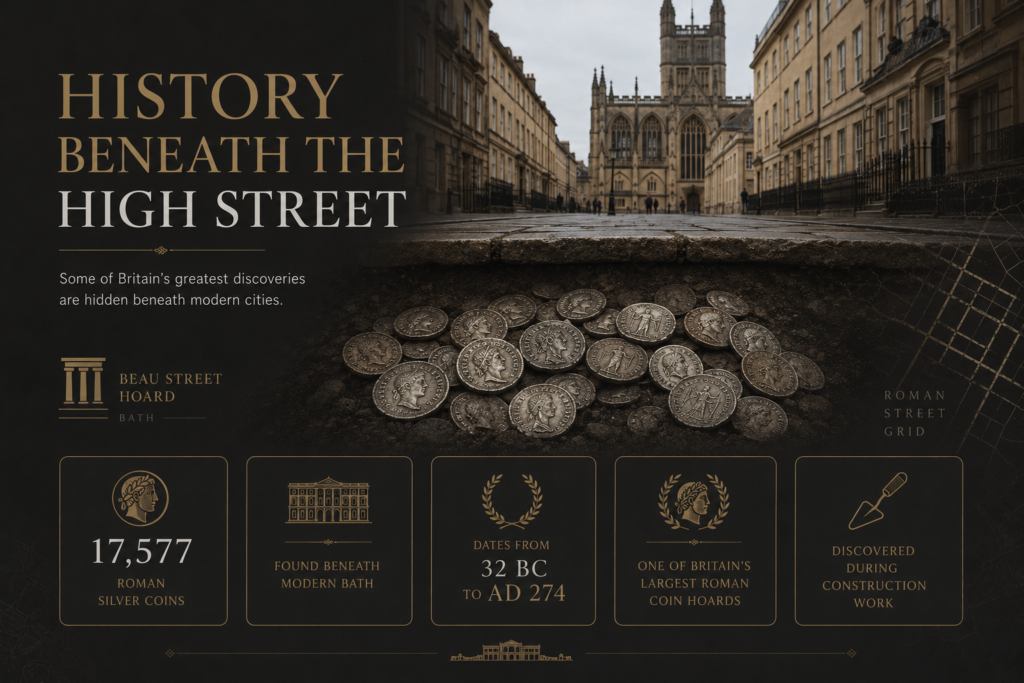
In 2007, construction workers excavating a development site in Bath uncovered four leather bags containing 17,577 Roman silver coins. The discovery ranks among the largest Roman coin hoards ever found in Britain.
What makes the find so striking is the location.
Not a windswept field.
Not a forgotten hillside.
A modern city centre built on top of centuries of history.
It serves as a reminder that Britain’s past is not confined to rural landscapes. Roman roads, villas, temples, markets, and settlements sit beneath modern streets, houses, and office buildings across the country.
The ground people walk across every day is often far more remarkable than it appears.
The Beau Street Hoard is displayed at the Roman Baths Museum in Bath.
Every discovery in this guide began with a detectorist having legal access to land and enough experience to recognise when something unusual was happening.
The machines matter. The research matters. But permission matters just as much.
Many newcomers assume great finds happen on secret locations. The evidence says otherwise. Some of the greatest discoveries in British detecting history came from ordinary farmland where relationships with landowners had been built properly and maintained over time.
The popular image of treasure hunting focuses on luck.
Looking closely at these stories reveals something different.
Dave Crisp had years of experience on the farm where he found the Frome Hoard. Adam Staples understood ancient coinage. Cliff Bradshaw recognised archaeological potential before experts confirmed it.
Luck opened the door. Preparation made it possible to walk through it.
The Hoxne Hoard remains the perfect example.
Eric Lawes became famous because he stopped digging.
That sounds counterintuitive until the importance of archaeological context becomes clear. A damaged find can sometimes be restored. Lost context is gone forever.
The most respected detectorists understand that the moment after a discovery is often more important than the discovery itself.
Every major find in this guide was made with proper landowner permission. For anyone new to the hobby, understanding how to get metal detecting permission is one of the most important skills you’ll ever learn.
That detail tends to get overlooked because it is not dramatic. Yet it appears in every success story.
Responsible detecting is not an obstacle to great discoveries. It is one of the reasons those discoveries become celebrated rather than controversial.
The serious choice

One question appears whenever a major treasure discovery reaches the news.
What did the finder receive?
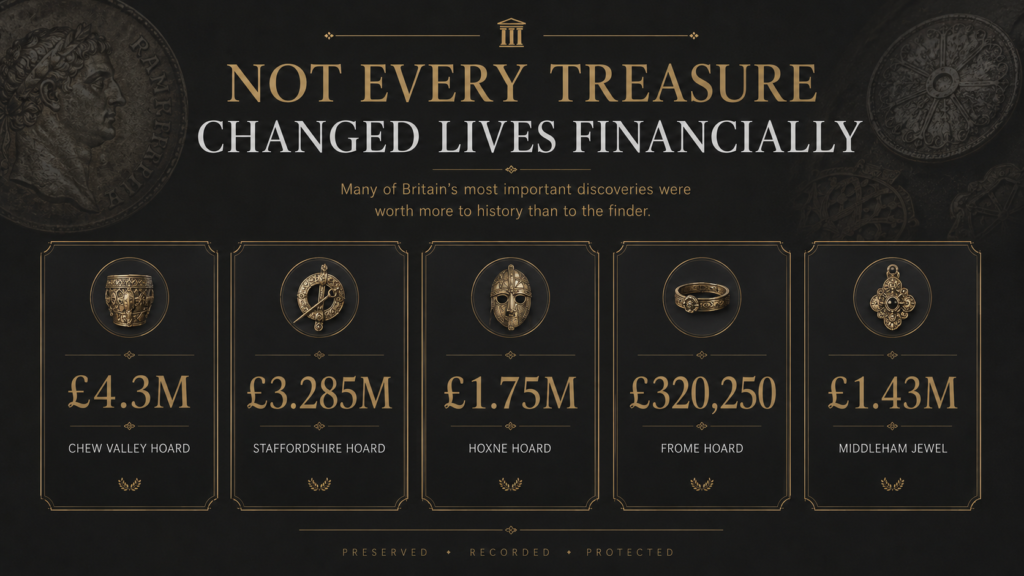
Under the Treasure Act, museums can acquire qualifying finds at market value, with rewards typically shared between finder and landowner.
Some of the figures are extraordinary:
Yet looking across these stories reveals another reality.
Many historically important discoveries generated relatively modest rewards. Some of the most significant contributions to British archaeology were worth far more academically than financially.
Most long-term detectorists understand that distinction.
One of the easiest mistakes to make is assuming all the great discoveries have already been made.
The evidence suggests otherwise.
The Portable Antiquities Scheme has now recorded well over 1.6 million archaeological finds from England and Wales alone. That’s only the material that has been officially reported. The true number is undoubtedly much higher.
At the same time, vast areas of Britain’s past remain unexplored. Thousands of Roman settlements, medieval sites, Saxon farmsteads, and prehistoric landscapes have never been professionally excavated. Even among England’s Scheduled Monuments, only a small proportion have been thoroughly investigated.
The pace of discovery hasn’t slowed either.
The Frome Hoard was found in 2010. The Wold Newton Hoard emerged in 2014. The Chew Valley Hoard was discovered in 2019 and became the most valuable Treasure Act acquisition in history.
The discoveries making headlines today are not being found with the same equipment people used twenty years ago.
Modern detectors reach deeper, separate targets more accurately, and provide far more information before a hole is ever dug. Combined with good research and proper permissions, today’s detectorists have access to technology that previous generations could only dream about.
Explore the latest metal detectors and deep-scanning systems used by serious UK detectorists.
Those aren’t distant stories from another generation.
They’re recent.
East Anglia continues to produce remarkable finds every year. Yorkshire, Lincolnshire, Somerset, Wiltshire, and Hampshire remain among the most productive counties in the country. Yet significant discoveries have been made in every corner of Britain.
The next hoard on a future version of this list could already be underground.
In fact, it probably is.
Every discovery in this guide began the same way.
Someone asked for permission.
Someone switched on a detector.
Someone decided to investigate a signal that most people would have walked past.
The next great find in British history may already be sitting beneath a field, waiting for the right person to discover it.
Whether you’re buying your first detector or upgrading to a professional-grade machine, UK Metal Detectors offers trusted brands, expert advice, and UK-based support to help you get started with confidence.
Not every signal becomes a treasure hoard.
But every treasure hoard started with a signal.
Need advice before buying? Contact the team and get personalised recommendations from experienced detectorists.
The Chew Valley Hoard is currently the most valuable treasure discovery recorded under the Treasure Act, with a valuation of £4.3 million. The hoard contains 2,584 silver pennies dating from the years immediately following the Norman Conquest.
The Staffordshire Hoard is generally considered the most famous. Discovered in 2009, it contains more than 4,600 pieces of Anglo-Saxon gold and silver metalwork and transformed the understanding of early medieval England.
Eric Lawes received a reward valued at £1.75 million after discovering the Hoxne Hoard in 1992. The reward was shared according to the arrangements in place at the time.
Under the Treasure Act 1996, qualifying finds must be reported within the required timeframe. Museums may then choose to acquire the discovery for the nation.
The Portable Antiquities Scheme is a national programme that records archaeological finds discovered by members of the public. It has become one of the most important resources for understanding Britain’s archaeological landscape.
Not sure which of these suits the ground you search? Tell us where you detect and we will point you at the right one, including the cheaper one when that is the honest answer. We use these machines ourselves.