On this page
Every detectorist knows the feeling. The signal sounds sharper than the usual scrap. The plug lifts cleanly. A dark disc appears in the sidewall of the hole, half-covered in wet soil. For a second, it could be anything: Georgian copper, hammered silver, Roman bronze, or a modern button pretending to be something better.
And then comes the part that matters more than most people realise.
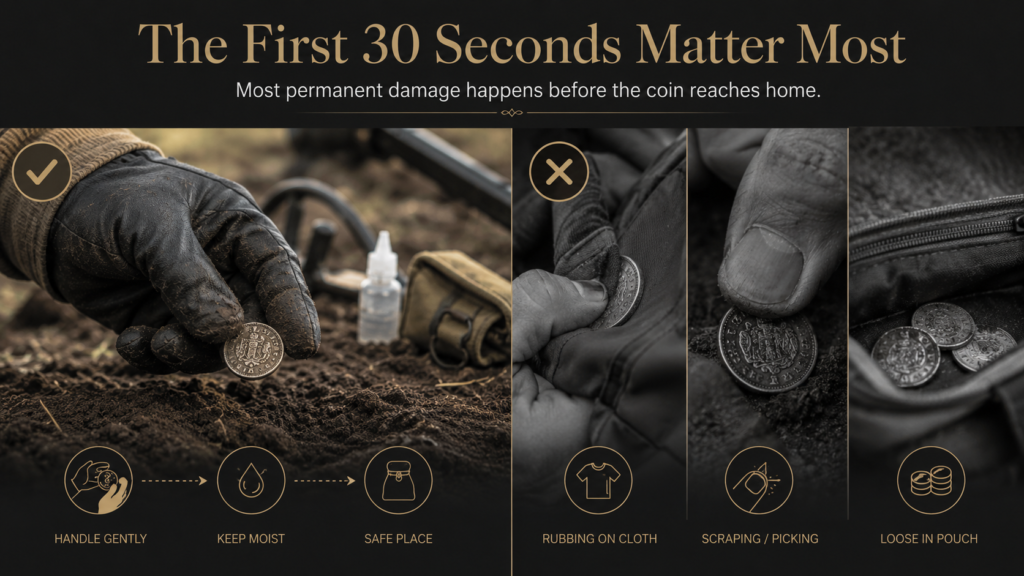
What happens in the next thirty seconds often decides whether that find keeps its detail, its historical value, and sometimes its monetary value or loses all three before it even reaches home. A surprising number of old coins are permanently damaged not by age, but by enthusiasm. Rubbing mud away on a sleeve. Scraping with a fingernail. Tossing multiple finds into the same pouch. Once surface detail is scratched away, it cannot be brought back.
Cleaning coins found by metal detecting is one of the most misunderstood parts of the hobby because people talk about it as though every coin is the same. They are not. A Victorian penny can tolerate things that would destroy a Tudor hammered silver in seconds. A Roman bronze with stable patina should be treated completely differently from a modern decimal coin pulled from a park.
The people who get consistently good results are rarely the ones using aggressive shortcuts. They’re usually the patient ones. The detectorists who slow down, identify the coin first, understand the metal they’re dealing with, and choose the gentlest method that actually works.
That is what this guide is about. Not just how to clean old coins found in the ground, but how to clean them without erasing the very history that made them worth finding in the first place.
The official guidance from the Portable Antiquities Scheme managed by the British Museum is remarkably clear: gently remove loose soil if necessary, but do not try to remove corrosion or polish archaeological finds.
That advice exists for a reason.
The crust, colour, oxidation, and patina on an old coin are not just dirt. They’re part of the object itself. On Roman and medieval coins, especially, that surface layer tells specialists how the coin survived underground, what kind of soil it sat in, and sometimes whether the coin is authentic at all. Once stripped away, that information disappears permanently.
This is the part many beginners struggle with because the instinct is understandable: people want to see the design underneath. They want the reveal. But cleaning old coins found in the ground is not restoration in the modern sense. It’s conservation. The aim is not to make a 300-year-old coin look new. The aim is to stabilise it without destroying it.
The harsh truth is that some coins look better untouched than badly cleaned.
One of the most painful things in metal detecting is realising a coin would have been valuable before it was over-cleaned.
A Roman denarius with original toning and untouched surfaces will almost always command more respect from collectors than the same coin polished bright with scratches across the portrait. The same applies to hammered silver. Once fine detail disappears, it is gone forever.
The correct sequence is always:
Identify first. Clean second.
That order matters because the cleaning method depends entirely on the coin’s metal, age, and condition. Treating every find the same way is how historically important coins end up looking like arcade tokens.
There are exceptions. Common modern coins and low-value Victorian coppers can tolerate gentler household cleaning methods without issue. But if there is any chance a find is historically significant, restraint is almost always the better decision.
Most damage happens before a detectorist even gets home.
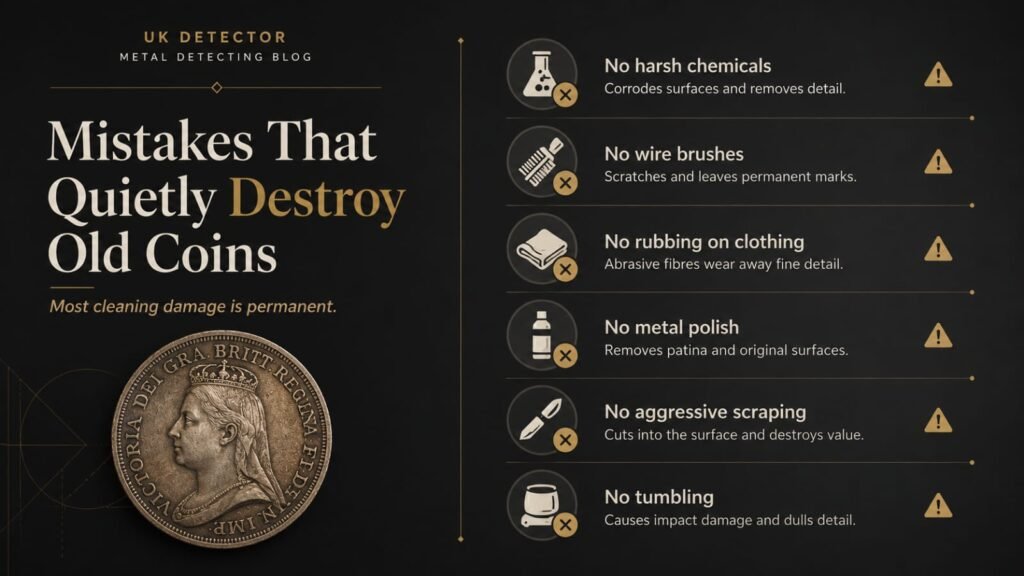
The biggest culprit is rubbing. Almost everyone does it once. A coin comes out muddy, someone wipes it across their trouser leg to see the date faster, and microscopic scratches instantly cut through the surface. On hammered silver, those scratches can remove lettering entirely.
Rushing the recovery process is one of the most common mistakes new detectorists make, especially when excitement takes over in the field. The 10 Metal Detecting Beginners Mistakes and How to Avoid Them guide covers several habits that quietly damage finds long before people realise they’re doing it.
Soil is abrasive. Even fine wet mud contains quartz particles harder than old coin surfaces.
This sounds obvious after someone explains it, but in the excitement of a good find, instinct takes over. Especially on cold or wet days, people want immediate identification. But a quick wipe creates permanent damage in exchange for temporary visibility.
The thinner and older the coin, the worse the outcome usually is.
Experienced detectorists tend to carry a small squeeze bottle of clean water in their finds pouch. A gentle rinse is usually enough to reveal basic detail without abrasion. Not scrubbing, just allowing loose soil to wash away naturally.
If there is no water available, leave the coin alone until home.
Coins should ideally be stored separately, especially silver. Loose coins rubbing together inside a pouch can damage each other just as badly as aggressive cleaning can. A simple coin capsule, small tissue wrap, or separate finds container makes a noticeable difference over time.
Even without cleaning, certain clues help immediately:
A quick visual assessment helps determine how cautious the cleaning process needs to be later.
If the coin later turns out to be historically significant, location data matters enormously. GPS coordinates, a map pin, or, at a minimum, a written field reference should be recorded before leaving the site.
That information becomes essential if the find ever needs reporting through the Portable Antiquities Scheme or under the Treasure Act.
Responsible finding care starts long before cleaning. Detectorists who are still learning where and how to search legally should also read How to Get Metal Detecting Permission in the UK, especially when recording finds from privately owned land.
A surprising amount of identification can happen before any real cleaning begins.
Most old coins respond well to patience rather than force. Often, simply soaking a coin in distilled water for half an hour reveals enough detail to narrow things down dramatically.
Tap water is not ideal here. The minerals and chlorine in ordinary water can sometimes react unpredictably with corrosion layers, especially on bronze coins. Distilled water is cheap, safe, and worth keeping specifically for first aid.
Good lighting matters more than aggressive cleaning.
Under magnification, even heavily encrusted coins often reveal fragments of lettering, outlines of portraits, or edge detail invisible at first glance. A loupe or magnifying lamp quickly becomes one of the most useful tools any detectorist owns.
Things worth looking for include:
A thin clipped silver disc with uneven edges tells a very different story from a milled Victorian shilling.
The Portable Antiquities Scheme database is one of the best resources available to UK detectorists because it contains real recorded finds from British soil rather than idealised catalogue examples.
Searching by period, metal, ruler, or description often produces near-identical examples surprisingly quickly.
For uncertain finds, local Finds Liaison Officers remain one of the most underused resources in the hobby. Most detectorists who contact an FLO end up wishing they had done it sooner.
If there is reason to believe the coin is:
Then stop cleaning entirely.
Wrap the coin carefully in acid-free tissue, keep it dry and stable, and seek professional guidance first. Some finds genuinely deserve conservation rather than home cleaning.
Recording where a coin was found matters just as much as preserving the coin itself, especially if the find later proves historically important. Detectorists unsure about reporting responsibilities or responsible recovery should read the Metal Detecting Code of Practice before cleaning or documenting significant finds.
This is where most online advice falls apart because different metals behave completely differently underground.
The method that safely improves one coin can permanently ruin another.
Copper and bronze are the hardest metals to clean well because they corrode aggressively in damp British soil. Georgian coppers, Victorian bronze, Roman sestertii, and medieval base-metal issues often emerge covered in thick green or black deposits.
Coins recovered from heavily fertilised farmland often corrode far more aggressively than finds recovered from pasture or woodland. Ground conditions make a massive difference to preservation, which is why experienced detectorists pay close attention to where they search. The Best Places for Metal Detecting in the UK guide breaks down the types of locations that consistently produce better historical finds.
Some of that corrosion is stable. Some is destructive. Learning the difference matters.
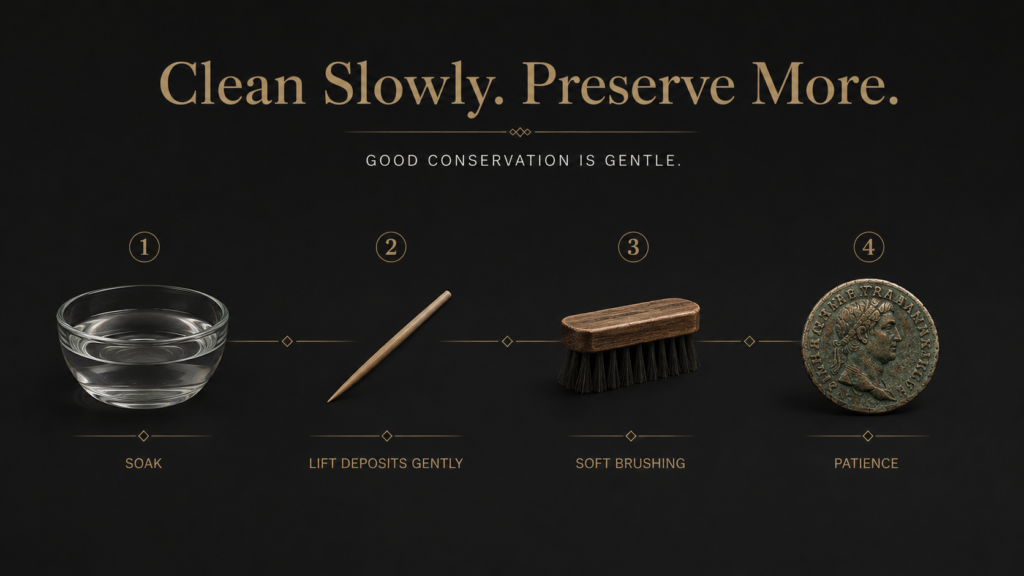
The safest starting point remains the simplest one: distilled water.
Place the coin in a glass or ceramic container filled with distilled water and leave it alone for at least 24 hours. Longer is often better. Changing the water every 12 hours gradually softens loose deposits without shocking the surface underneath.
Once deposits soften, gentle mechanical work begins.
Wooden toothpicks or bamboo skewers are ideal because they’re softer than the metal surface itself. Under magnification, deposits can be teased away carefully from recessed areas rather than scraped across the design.
This part takes patience. Some Roman bronzes improve dramatically after several weeks of slow work.
Soft natural-bristle brushes also help, particularly around lettering and portraits. Pressure should be almost nonexistent. The brush is assisting in loosening dirt away, not scrubbing corrosion off.
Among experienced detectorists, olive oil remains controversial but genuinely useful for heavily encrusted Roman bronze coins.
The process is painfully slow. Coins submerged in olive oil may remain there for weeks or months while the oil penetrates compacted deposits gradually. Over time, the hardened crust softens enough for wooden picks to work safely.
The reason some detectorists still swear by this method is simple: it preserves underlying surfaces far better than aggressive alternatives.
Patience usually produces better coins than speed.
This is where many old internet guides become dangerous.
Vinegar, lemon juice, ketchup, cola, and acidic household cleaners absolutely will clean copper coins. They will also dissolve the patina and damage the metal itself. The bright orange “cleaned” look that beginners sometimes celebrate is usually evidence that surface history has been stripped away.
Electrolysis causes similar issues on bronze with surviving patina. Once stripped, original surfaces cannot be recreated.
Silver behaves differently underground.
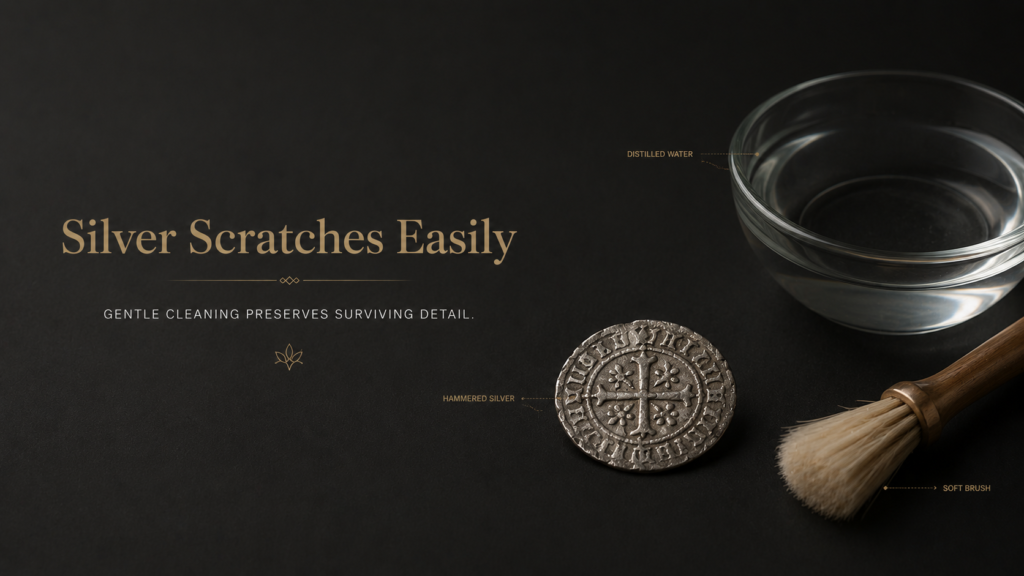
Instead of thick green corrosion, silver usually develops tarnish, black sulphide deposits, or compacted dirt layers. It is generally easier to clean than bronze, but it scratches far more easily.
The safest approach still begins with distilled water soaking.
After soaking, soft natural-bristle brushes can remove loosened soil carefully. Circular motions are safer than harsh back-and-forth scrubbing because they reduce directional scratching.
For stubborn tarnish, a very diluted bicarbonate of soda solution sometimes helps, but only in moderation. The mistake people make is turning bicarbonate into an abrasive paste and physically polishing the coin with it.
That is not cleaning. That is abrasion.
Medieval and Tudor hammered coins are fragile, even when they look solid.
Many already contain weakly struck areas from the original minting process. Aggressive cleaning removes detail that has survived for centuries.
In practice, the best results on hammered silver usually come from doing less than feels satisfying. Distilled water, wooden picks, soft brushing, and restraint consistently outperform aggressive polishing.
The official PAS conservation advice document reflects this clearly.
Roman coins are where inexperienced cleaning causes the most heartbreak.
The moment someone sees a crusted Roman bronze online transformed into a readable emperor portrait, the temptation becomes obvious. But most dramatic “before and after” examples leave out the hundreds of ruined coins created along the way.
Stable patina is part of the coin.
Collectors, museums, and specialists value original Roman patina enormously because it proves age, preservation, and authenticity. Smooth dark green, brown, or black surfaces should almost always remain untouched.
A stripped Roman bronze looks wrong immediately to anyone familiar with ancient coins.
Stable patina feels hard, even, and dry.
Active bronze disease looks bright green, powdery, and unstable. That distinction matters because stable patina should stay. Bronze disease must be treated or it spreads.
Most Roman bronzes respond best to slow distilled water soaking followed by delicate wooden pick work under magnification. Coins that appear hopeless at first often reveal remarkable detail gradually over time.
Roman denarii and other silver issues require even more caution because ancient silver alloys vary dramatically.
Some advanced cleaners use heavily diluted ammonia solutions for stubborn deposits, but only in targeted applications and only with immediate rinsing afterwards. This is not something beginners should experiment with on important finds.
When in doubt, less intervention is safer.
Modern decimal coins and common Victorian coppers are far less sensitive than ancient material.
Warm distilled water with mild washing-up liquid, followed by soft toothbrush cleaning, is generally safe for low-value examples. Even here, aggressive scrubbing still removes detail unnecessarily.
The best detectorists develop gentle habits across all finds rather than switching between careful and careless cleaning depending on value.
The affordable option
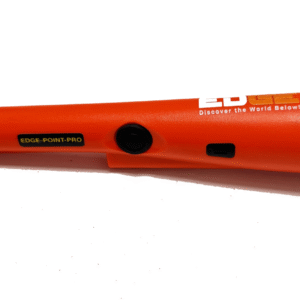
Pinpointer. Finds the target in the hole instead of the spoil.
£49.95£69.99Save £20.04
Add to basketFull detailsIn stock
Electrolysis sits in an uncomfortable place within metal detecting because it undeniably works.
Heavily encrusted coins sometimes emerge readable within minutes rather than months. That speed is exactly why so many people use it.
The problem is that electrolysis does not distinguish between harmful corrosion and historically valuable surfaces. It strips aggressively and permanently.
The coin becomes part of a low-voltage electrical circuit submerged in electrolyte solution. The reaction loosens corrosion rapidly through reduction chemistry.
Used carefully, it can rescue detail from otherwise unreadable low-value coins.
Used carelessly, it destroys surfaces beyond repair.
As a last resort on common base-metal coins with no remaining numismatic value, electrolysis has a place.
Detectorists working on completely unreadable Victorian coppers or damaged modern coins sometimes achieve decent results safely with low voltage and constant supervision.
Roman bronze with surviving patina. Hammered coins. Valuable silver. Potential Treasure finds. Anything rare.
Those categories should stay far away from electrolysis.
The damage is irreversible. Once the original patina disappears, it cannot be recreated, no matter how experienced the cleaner becomes afterwards.
A large part of preserving coins properly starts before cleaning even begins. Better target separation, more accurate depth reading, and cleaner recovery all reduce the chances of damaging finds in the ground. UK Metal Detectors supplies machines for everyone from first-time hobbyists to experienced detectorists searching for deeper historical finds across the UK.
The single piece of kit that changes how coins come out of the ground is a pinpointer. Most damage happens during recovery rather than cleaning, because people widen the hole and push a trowel straight through the find while hunting for it. A pinpointer tells you where the coin is sitting in the plug before you touch it. The Edge Pro Pointer is the straightforward one, and the Fortuna XELA is worth it if you want more sensitivity and a tougher build.
Target separation matters for the same reason. A machine that cannot tell a hammered silver from the nail lying next to it will have you digging both, and that is exactly where coins pick up scratches. If yours struggles around iron, the multi-frequency machines in the most popular range and the motion detectors separate targets far more cleanly.
Bronze disease scares experienced detectorists for good reason because it does not stop on its own.
Unlike stable green patina, bronze disease is active corrosion. Left untreated, it literally consumes the coin over time.
The colour is usually the giveaway.
Stable patina tends to appear dark green, brown, or black with a smooth texture. Bronze disease appears brighter, almost turquoise sometimes, with a powdery or crystalline look.
If green powder keeps reappearing after cleaning, that is usually active corrosion.
Chlorides trapped within the coin react repeatedly with moisture and oxygen. The reaction feeds itself continuously unless interrupted.
Coins recovered from wet coastal ground often suffer particularly badly.
The safest approach combines careful mechanical removal with sodium sesquicarbonate soaking to draw chlorides out gradually.
Drying matters enormously afterwards. Coins that remain slightly damp often relapse quickly.
Once stable, many detectorists apply Renaissance Wax as a protective barrier against future moisture exposure.
Seriously, diseased historically important coins deserve professional conservation rather than experimentation.
The sensible middle

Cleaning is only half the job.
Poor storage quietly destroys countless finds every year, especially in sheds, garages, damp lofts, and PVC holders people assume are harmless.
This is the step people rush most often.
Coins sealed before completely drying trap moisture against the surface. Corrosion then continues invisibly underneath wax or inside capsules.
Air drying for at least 24 hours is sensible. Silica gel packs nearby help stabilise humidity safely.
Renaissance Wax became popular among detectorists because museums use it for good reason.
Applied thinly, it creates a protective barrier against oxygen, moisture, and fingerprints without looking artificial. Coins retain their natural appearance rather than developing the glossy look produced by unsuitable polishes.
For serious collectors, Paraloid B-72 offers an even more conservation-focused option, though it is less accessible for casual hobbyists.
Acid-free materials matter more than people expect.
PVC flips slowly release chemicals that damage metals over time, particularly silver. Rubber bands attack silver too. Damp cardboard boxes are another common problem.
Good long-term storage usually means:
Detectorists sometimes focus so heavily on the object itself that they forget the story attached to it.
A coin without find data eventually becomes just another old coin. A coin with documented provenance becomes part of a historical record.
Date found. General location. Identification. Soil conditions. Even a quick phone photo before cleaning becomes valuable later.
Some mistakes appear so consistently in detecting forums that they deserve direct answers.
And perhaps most importantly: never confuse brightness with preservation.
Old coins are supposed to look old.
Absolutely.
Some coins are better untouched than imperfectly cleaned.
Roman gold, early hammered silver, potential hoard finds, and coins with beautiful stable patina often lose more than they gain through intervention. Professional conservators have tools, microscopes, chemical controls, and experience unavailable to hobbyists at home.
Collectors know this, too. In numismatics, originality matters enormously. Natural, untouched surfaces consistently command more respect than aggressively cleaned examples.
Sometimes the best thing a detectorist can do is recognise when restraint is the smarter skill.
The serious choice
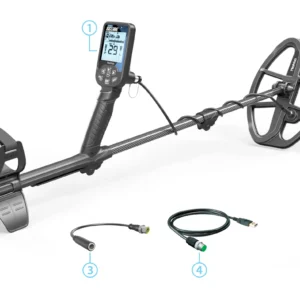
The detectorists who preserve finds best are rarely the fastest cleaners or the people chasing dramatic transformations online. They’re usually the patient ones, the people willing to leave a coin soaking for weeks rather than forcing a result in ten minutes.
Because once a surface is gone, it is gone permanently.
Every Roman bronze, Georgian copper, or hammered silver that survives careful treatment carries something bigger than resale value. It carries evidence of where it rested, how it survived, and who lost it centuries earlier.
That history survives only if the cleaning process respects it.
UK Metal Detectors supplies metal detectors for everyone from first-time hobbyists to experienced detectorists searching for deeper historical finds across the UK. If you’re looking for the right detector for your next purchase or upgrade, contact the team to explore the latest machines and offers available online.
The safest approach starts with identifying the coin and its metal first. Most detectorists begin with distilled water soaking for 24–48 hours, followed by gentle cleaning using wooden picks and soft natural-bristle brushes. Abrasives, acidic cleaners, and commercial metal polish should be avoided completely on historical finds.
The method depends on the metal type. Copper and bronze often respond well to long distilled water soaks or olive oil treatment for heavy encrustation. Silver usually requires lighter intervention. Roman coins should keep their stable patina intact whenever possible.
Yes, but carefully. Stable Roman patina should almost never be removed because it forms part of the coin’s authenticity and value. Distilled water soaking and patient mechanical cleaning with wooden tools are usually safest. Electrolysis and aggressive polishing destroy surfaces permanently.
After cleaning, coins should dry fully before storage. Renaissance Wax provides a protective barrier against moisture and fingerprints. Long-term storage works best in acid-free coin capsules or Mylar holders kept in stable indoor conditions away from damp and temperature fluctuation.
Do not clean them aggressively. Potential Treasure finds, Roman gold, hoards, and early medieval silver should ideally be assessed by a Finds Liaison Officer first through the Portable Antiquities Scheme.
Only in limited situations. Electrolysis is best treated as a last resort for heavily encrusted low-value base-metal coins. It should never be used on coins with surviving patina, valuable ancient coins, or anything historically significant because the process is irreversible.
Not sure which of these suits the ground you search? Tell us where you detect and we will point you at the right one, including the cheaper one when that is the honest answer. We use these machines ourselves.