Metal detecting in Scotland is legal, genuinely rewarding, and far less complicated than most English detectorists assume. The legal system is different from England, yes. But different does not mean difficult. It means you need to spend an afternoon understanding how it works before you go. This guide does that for you, covering Treasure Trove Scotland, how to get permission, which Scottish metal detecting locations produce the most interesting finds, where the gold actually is, and what detector you need for Scottish ground conditions.

By the end, you will know whether Scotland belongs on your detecting list. We think it does.

Why Scotland Is Worth the Trip

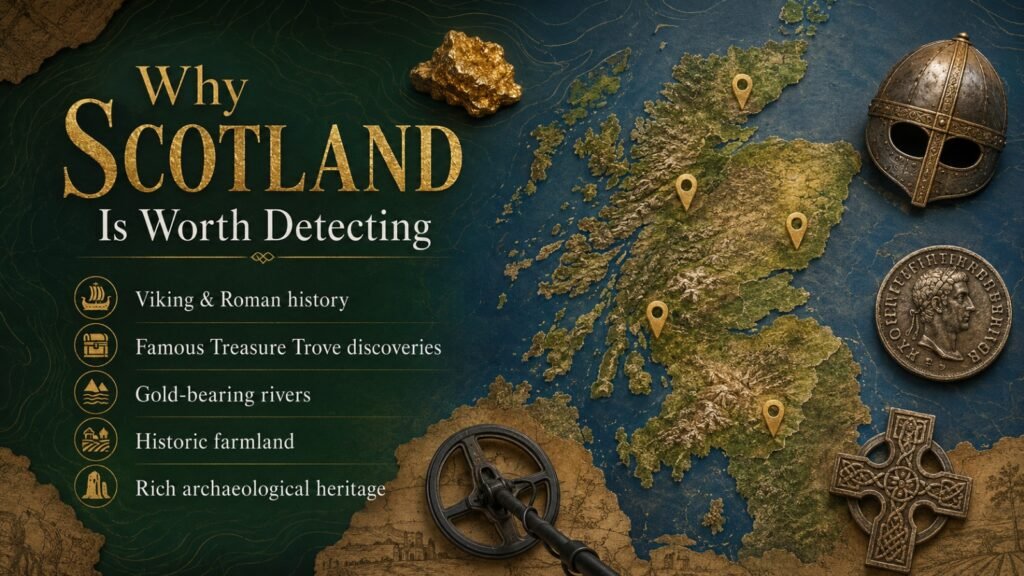
The finds record alone makes the case. In 2014, teenager David Hall found over 300 pieces of Roman hacksilver near Dairsie in Fife at a detecting rally. Dated to around AD 300, it is the earliest hacksilver hoard ever found beyond the edge of the Roman Empire. That same year, a 10th-century Viking hoard of nearly 100 items silver bracelets, brooches, an enamelled Christian cross, a gold ring, and a bird-shaped gold pin was found in Dumfries and Galloway. In 1996, detectorist Hamish Stuart found 315 Roman coins near Birnie in Moray, which led to the discovery of a second hoard of 310 coins just ten metres away, a pairing the archaeologists described as unparalleled in Scottish history.

These are not outliers. The Treasure Trove Unit at National Museums Scotland identifies Perth and Kinross, Fife, Dumfries and Galloway, and the Scottish Borders as the areas with the highest recorded detecting activity and finds productivity. Scotland carries layers of Roman occupation, Pictish kingdoms, Viking settlement, and early medieval Christian culture, all sitting in farmland that any prepared, responsible detectorist can access through normal landowner permission.

And then there is the gold. In 2018, a Scottish river produced the biggest gold nugget ever found in the UK. The finder kept the location private, but the find is authenticated on record. Gold prospecting in Scotland is not a fantasy; it is a real and accessible activity for anyone with the right equipment and the right permissions in place. More on that later.
Metal detecting in Scotland is legal, genuinely rewarding, and far less complicated than most English detectorists assume. The legal system is different from England, yes. But different does not mean difficult. It means you need to spend an afternoon understanding how it works before you go. This guide does that for you, covering Treasure Trove Scotland, how to get permission, which Scottish metal detecting locations produce the most interesting finds, where the gold actually is, and what detector you need for Scottish ground conditions. By the end, you will know whether Scotland belongs on your detecting list. We think it does. Why Scotland Is Worth the Trip The finds record alone makes the case. In 2014, teenager David Hall found over 300 pieces of Roman hacksilver near Dairsie in Fife at a detecting rally. Dated to around AD 300, it is the earliest hacksilver hoard ever found beyond the edge of the Roman Empire. That same year, a 10th-century Viking hoard of nearly 100 items silver bracelets, brooches, an enamelled Christian cross, a gold ring, and a bird-shaped gold pin was found in Dumfries and Galloway. In 1996, detectorist Hamish Stuart found 315 Roman coins near Birnie in Moray, which led to the discovery of a second hoard of 310 coins just ten metres away, a pairing the archaeologists described as unparalleled in Scottish history. These are not outliers. The Treasure Trove Unit at National Museums Scotland identifies Perth and Kinross, Fife, Dumfries and Galloway, and the Scottish Borders as the areas with the highest recorded detecting activity and finds productivity. Scotland carries layers of Roman occupation, Pictish kingdoms, Viking settlement, and early medieval Christian culture, all sitting in farmland that any prepared, responsible detectorist can access through normal landowner permission. And then there is the gold. In 2018, a Scottish river produced the biggest gold nugget ever found in the UK. The finder kept the location private, but the find is authenticated on record. Gold prospecting in Scotland is not a fantasy; it is a real and accessible activity for anyone with the right equipment and the right permissions in place. More on that later. Map of Scotland highlighting top metal detecting regions, Viking history, Roman finds, and Scottish gold areas. The Scottish Outdoor Access Code: What It Does Not Cover Scotland's Land Reform (Scotland) Act 2003 gives the public statutory access rights over most land. Walkers and cyclists can cross most Scottish countryside without landowner permission. Many detectorists read this and assume the same applies to detecting. It does not, and this is the most common misunderstanding about metal detecting in Scotland. The Scottish Outdoor Access Code does not extend to activities that involve taking objects from the land. Detecting with the intention of recovering finds falls outside those access rights. The Treasure Trove Unit states this clearly: you must obtain landowner permission before detecting anywhere in Scotland, including public parks. Crown Estate Scotland's own guidance confirms the same position. Getting permission works exactly the same way as in England. Approach the landowner, explain your plans, carry NCMD membership for insurance, and get it in writing. One important difference: Scottish landowners have no automatic legal claim over anything you find. Under Scottish Treasure Trove law, finds belong to the Crown rather than the landowner. This changes the conversation slightly. There is no default finds-split to negotiate the way there is in England, so a written agreement in Scotland tends to focus on access terms, site boundaries, and reporting responsibilities rather than who gets a share of what. Our metal detecting permission guide covers the full approach process and agreement setup in detail, and most of it applies directly to Scotland. Treasure Trove Scotland: The Law Every Detectorist Needs to Understand What is Treasure Trove in Scotland? Treasure Trove Scotland is built on bona vacantia, the Scots common law principle of ownerless goods. Under Scottish law, all portable antiquities of archaeological, historical, or cultural significance found in Scotland are subject to claim by the Crown. The Treasure Trove Unit at National Museums Scotland manages the system on the Crown's behalf. The critical difference from England is the threshold. The Treasure Act 1996 in England only covers specific categories: primarily gold or silver objects over 300 years old, and coin hoards. In Scotland, the threshold is not about material or age. It is about significance. As Treasure Trove Scotland's guidance for finders makes clear, any find of archaeological, historical, or cultural significance must be reported, regardless of what it is made of or how old it appears to be. What this means in practice The Treasure Trove Unit applies common sense. Modern coins and recent machinery fragments do not need to be reported. But the bar is genuinely broader than in England, and the Unit's direction is consistent: if you are not sure, report it. Even the most unassuming object could turn out to be something important. This is not a system designed to catch detectorists out. It is a system designed to make sure significant Scottish finds end up properly recorded and accessible to the public. Most Scottish detectorists find it straightforward. How to report a find Email the Treasure Trove Unit at treasuretrove@nms.ac.uk with photographs and a precise findspot; a National Grid Reference is preferred. Complete the reporting form from the Treasure Trove Scotland website. The Unit assesses the find. If the Crown claims it, the Scottish Archaeological Finds Allocation Panel reviews the object and may allocate it to a Scottish museum. The finder receives an ex gratia reward based on the market value of the find. In Scotland, that reward goes to the finder alone. The landowner has no automatic share unless a separate written agreement between the two of you specifies otherwise. There is no 14-day reporting window as there is in England. But prompt reporting is both legally required and the right thing to do. Report as soon as reasonably possible, and definitely before cleaning, altering, or posting about a find publicly. Simple infographic explaining how Treasure Trove Scotland works for metal detectorists reporting archaeological finds. Scheduled Monuments: Same Criminal Offence, Different Authority Scotland has over 8,000 scheduled monuments, and the rule is simple: do not detect on one without written permission from Historic Environment Scotland. Detecting on a scheduled monument without that permission is a criminal offence under the Ancient Monuments and Archaeological Areas Act 1979, the same legislation that applies across the rest of the UK. Before any new Scottish session, check PastMap at pastmap.org.uk. This is Historic Environment Scotland's online mapping tool showing the location and boundaries of all Scottish scheduled monuments. It takes five minutes. If you have any questions about a specific site, contact HES at hmenquiries@hes.scot or 0131 668 8600 before you go, not after. One thing worth knowing if you are planning a trip to the Cairngorms or Loch Lomond area: both Scottish National Parks take a cautious approach to hobby detecting on National Park Authority-managed land. Assume that land owned or managed by the Park Authority is not available, while private farmland within the Park boundary follows the usual landowner permission process. Planning a Detecting Trip to Scotland? Scottish farmland, beaches, and gold-bearing rivers all demand different detector capabilities. Choosing the right machine before your trip can make the difference between constant false signals and a genuinely productive day. Whether you're searching for Viking-era farmland finds, beach jewellery, or Scottish gold, explore our range of detectors designed for UK conditions. Gold Prospecting in Scotland: The Rivers, the Regions, and What Is Realistic Scotland has genuine, accessible gold-bearing geology distributed across several distinct regions. The Southern Uplands, particularly around Wanlockhead and Leadhills in South Lanarkshire, have the longest documented history of gold prospecting in Scotland, with finds recorded as far back as the reign of King James IV in the 16th century. The Kildonan Burn in Sutherland triggered a genuine gold rush in 1869 that drew hundreds of prospectors to the Highlands and produced enough material to sustain serious commercial interest for a full season. More recently, 2018 brought the biggest UK gold nugget on record, discovered in a Scottish river and kept private at the finder's request. The Kildonan Burn remains the most publicly known gold prospecting location in Scotland. Recreational panning there requires permission from the Kildonan Estate and should be arranged before visiting. Several Highland river systems draining gold-bearing geological formations attract serious prospectors each season, as do the rivers around Leadhills and Wanlockhead. All river prospecting requires landowner permission for riverbank access regardless of the Scottish Outdoor Access Code, which, as covered above, does not apply to activities involving the removal of finds. Finding small alluvial gold in Scottish rivers is not something a standard farmland machine handles well. Standard detectors operating at 6 to 15kHz consistently miss fine gold flakes and small nuggets, which are low-conductivity, small-mass targets that need higher operating frequencies to register reliably. The dedicated gold detectors in the UK Metal Detectors range are built specifically for mineralised ground and small gold targets; they are the right tools for serious gold detecting in Wales or Scotland, where standard machines simply leave gold in the ground. For farmland detecting across Scottish lowlands, where iron-rich soils and historic metal mining mineralisation create real challenges for standard machines, our metal detector ground balance guide explains exactly how to calibrate for mineralised ground and why preset balance often fails in these conditions. Illustration showing Scottish gold prospecting locations with rivers, gold pan, detector, and gold nugget icons. The Scottish Regions Worth Knowing About Dumfries and Galloway and the Scottish Borders These two regions sit at the top of the Treasure Trove Unit's own research into productive detecting areas, and the finds record explains exactly why. This is Roman frontier territory, Viking settlement ground, and early medieval Christian landscape all in one region. The 2014 Viking hoard from Dumfries and Galloway is a recent demonstration of what the ground holds. The Borders farmland crosses territory that saw continuous occupation from the Iron Age through the medieval period, and it is broadly accessible through conventional permission approaches with the farming community there. Fife and Perth and Kinross The Dairsie hacksilver hoard proved what Fife's Roman-period archaeology can produce in a single afternoon's detecting at a rally. The farmland here is mixed arable and pasture, accessible through standard permission routes, and the soil conditions are more forgiving than the highly mineralised western regions. Perth and Kinross was the political heart of medieval Scotland. The farmland around Stirling and Perth reflects that historical density in what it produces, with Roman finds, Pictish metalwork, and early medieval artefacts all coming from this region through responsible detecting. Moray and Aberdeenshire The two Birnie hoards demonstrated that northeast Scotland, far from the Roman military frontier, received significant Roman silver through diplomatic or trade contact with Pictish communities. This region is considered underworked relative to its potential, with large areas of farmland that have seen limited systematic detecting. For a detectorist willing to research thoroughly and approach landowners in an area with less competition, Moray and Aberdeenshire represent genuine opportunity. Our best places for metal detecting in the UK guide covers the research tools that help identify productive ground before approaching a landowner: PAS database searches, historical mapping, and LiDAR, all of which apply as usefully to Scottish ground as they do to English farmland. Illustrated Scotland map showing the best regions for metal detecting, including Fife, Borders, Moray, and Dumfries & Galloway. Scottish Beaches: The Easiest Starting Point Crown Estate Scotland manages most of Scotland's coastline foreshore and does not require a specific permit for beach detecting, provided you follow Scottish Treasure Trove procedures and the Outdoor Access Code. The practical position is straightforward: report anything with potential historical significance, fill every hole, and conduct yourself the same way you would on any responsible detecting session. Modern jewellery found on Scottish beaches is handled practically. If it is clearly a recent loss, report it to the local police as a found item. If there is any question about historical significance, report it to the Treasure Trove Unit. The system is not designed to create difficulty around everyday beach detecting; it is designed to protect genuinely significant finds. Wet Scottish beach sand carries the same salt mineralisation challenge as any UK coastal site. Highly conductive wet sand destabilises target ID readings and produces false signals on standard VLF machines. A detector with a dedicated beach or saltwater mode handles this considerably better. Pulse Induction detectors handle salt mineralisation best of all, which is why they are the machine of choice for serious beach detectorists. Our pulse induction metal detectors guide explains how PI technology handles these conditions and which machines are worth considering for Scottish coastal work. Looking for a Beach Detector? Saltwater beaches require detectors that can remain stable in wet, mineralised sand. Browse our collection of beach metal detectors built for UK coastal conditions. Can You Keep What You Find in Scotland? Unlike England and Wales, Scotland operates under the Treasure Trove system rather than the Treasure Act 1996. If a find is claimed by the Crown because of its archaeological or historical importance, it will usually be allocated to a Scottish museum. In return, the finder may receive an ex gratia reward based on the object's market value. If a find is not claimed, it is normally returned to the finder. Because every potentially significant discovery must first be reported, detectorists should never assume they can automatically keep archaeological finds. Quick Reference: Metal Detecting in Scotland Topic Scotland-Specific Detail Finds law Treasure Trove, not the Treasure Act 1996 What to report All finds of archaeological, historical, or cultural significance regardless of age or material Reward Finder only; landowner has no automatic share Report finds to treasuretrove@nms.ac.uk Treasure Trove Unit, National Museums Scotland Scheduled monuments authority Historic Environment Scotland, not Historic England Check scheduled monuments PastMap: pastmap.org.uk Outdoor access rights Do not cover detecting with intent to remove finds Landowner permission Required everywhere including public parks Crown Estate foreshore No permit needed; Treasure Trove rules apply Gold regions Southern Uplands (Leadhills/Wanlockhead), Sutherland (Kildonan Burn), Highland rivers Most productive regions Dumfries and Galloway, Borders, Fife, Perth and Kinross, Moray NCMD membership Recommended for insurance recognised by Scottish landowners Checklist infographic showing essential steps before metal detecting in Scotland including permission, Treasure Trove reporting, and checking protected sites. Scotland Rewards the Detectorist Who Does the Homework Metal detecting in Scotland is not harder than in England. It is different. The legal framework takes an afternoon to learn, and once you have learned it, you are operating in one of the most historically rich detecting destinations in the British Isles. Viking hoards, Roman hacksilver, Pictish gold, Bronze Age metalwork, and the biggest gold nugget in UK history all found by ordinary detectorists, all reported properly, all now part of Scotland's national heritage record. The detectorists who come back from Scotland having had a genuinely productive session are the ones who understood the Treasure Trove system before they arrived, had their permissions properly in place, and brought a machine suited to Scottish ground conditions rather than assuming what worked in Lincolnshire would work in the Southern Uplands. If that sounds like something worth planning, we can help with the equipment side before you go. Ready to Detect in Scotland? From mineralised Highland rivers to coastal beaches and historic farmland, Scotland rewards detectorists who bring the right equipment. Explore our range of beginner, intermediate, and professional metal detectors, or contact our team if you'd like help choosing the right machine for your next trip. Shop Metal Detectors Need Advice? Contact Our Team Frequently Asked Questions About Metal Detecting in Scotland 1. Is metal detecting in Scotland legal? Yes. Metal detecting in Scotland is legal if you have the landowner's permission and follow Treasure Trove Scotland rules. The Scottish Outdoor Access Code allows public access to much of the countryside, but it does not permit removing objects from the ground. You must obtain permission before detecting on private land, public parks, or common land. Detecting on scheduled monuments without written permission from Historic Environment Scotland is a criminal offence. 2. What is Treasure Trove Scotland? Treasure Trove Scotland is the legal system that governs archaeological and historically significant finds discovered in Scotland. Any portable object considered archaeologically, historically, or culturally important must be reported to the Treasure Trove Unit at National Museums Scotland, regardless of its material or age. If the Crown claims the find, the finder may receive an ex gratia reward based on its market value. 3. Can you find gold metal detecting in Scotland? Yes. Scotland is one of the few parts of the UK with genuine gold-bearing geology, making it a popular destination for recreational gold prospecting. Gold is found around Leadhills, Wanlockhead, Kildonan Burn, and several Highland river systems. Small alluvial gold is difficult to detect with standard VLF machines, so high-frequency or dedicated gold detectors are recommended. Landowner permission is required, and significant finds must be reported under Treasure Trove Scotland. 4. Where are the best Scottish metal detecting locations? The best places for metal detecting in Scotland include Dumfries and Galloway, the Scottish Borders, Fife, Perth and Kinross, Moray, and Aberdeenshire. These regions have produced Roman coins, Viking hoards, Pictish artefacts, and medieval finds. Detecting is only permitted with landowner permission, and all significant discoveries must be reported through Treasure Trove Scotland. 5. How is metal detecting in Scotland different from England? The biggest difference is the legal system. Scotland follows Treasure Trove law, while England and Wales operate under the Treasure Act 1996. Scotland requires all archaeologically significant finds to be reported, regardless of their age or material. Scottish finds are reported to the Treasure Trove Unit rather than the Portable Antiquities Scheme, and landowners do not automatically have a legal claim to reported finds. 6. Do you need a licence to metal detect in Scotland? No. Scotland does not require a general metal detecting licence. However, you must have the landowner's permission and follow Treasure Trove reporting requirements. Additional permission is required before detecting on scheduled monuments or certain protected land. 7. Do you need a licence to metal detect in Scotland? No. Scotland does not require a general metal detecting licence. However, you must have the landowner's permission and follow Treasure Trove reporting requirements. Additional permission is required before detecting on scheduled monuments or certain protected land. 8. Can you keep what you find metal detecting in Scotland? Not automatically. Archaeologically significant finds must be reported to the Treasure Trove Unit. If the Crown claims the object, it may be allocated to a Scottish museum, and the finder can receive an ex gratia reward. Finds that are not claimed are generally returned to the finder.

The Scottish Outdoor Access Code: What It Does Not Cover

Scotland’s Land Reform (Scotland) Act 2003 gives the public statutory access rights over most land. Walkers and cyclists can cross most Scottish countryside without landowner permission. Many detectorists read this and assume the same applies to detecting. It does not, and this is the most common misunderstanding about metal detecting in Scotland.

The Scottish Outdoor Access Code does not extend to activities that involve taking objects from the land. Detecting with the intention of recovering finds falls outside those access rights. The Treasure Trove Unit states this clearly: you must obtain landowner permission before detecting anywhere in Scotland, including public parks. Crown Estate Scotland’s own guidance confirms the same position.

Getting permission works exactly the same way as in England. Approach the landowner, explain your plans, carry NCMD membership for insurance, and get it in writing. One important difference: Scottish landowners have no automatic legal claim over anything you find. Under Scottish Treasure Trove law, finds belong to the Crown rather than the landowner. This changes the conversation slightly. There is no default finds-split to negotiate the way there is in England, so a written agreement in Scotland tends to focus on access terms, site boundaries, and reporting responsibilities rather than who gets a share of what. Our metal detecting permission guide covers the full approach process and agreement setup in detail, and most of it applies directly to Scotland.

Treasure Trove Scotland: The Law Every Detectorist Needs to Understand

What is Treasure Trove in Scotland?

Treasure Trove Scotland is built on bona vacantia, the Scots common law principle of ownerless goods. Under Scottish law, all portable antiquities of archaeological, historical, or cultural significance found in Scotland are subject to claim by the Crown. The Treasure Trove Unit at National Museums Scotland manages the system on the Crown’s behalf.

The critical difference from England is the threshold. The Treasure Act 1996 in England only covers specific categories: primarily gold or silver objects over 300 years old, and coin hoards. In Scotland, the threshold is not about material or age. It is about significance. As Treasure Trove Scotland’s guidance for finders makes clear, any find of archaeological, historical, or cultural significance must be reported, regardless of what it is made of or how old it appears to be.

What this means in practice

The Treasure Trove Unit applies common sense. Modern coins and recent machinery fragments do not need to be reported. But the bar is genuinely broader than in England, and the Unit’s direction is consistent: if you are not sure, report it. Even the most unassuming object could turn out to be something important. This is not a system designed to catch detectorists out. It is a system designed to make sure significant Scottish finds end up properly recorded and accessible to the public. Most Scottish detectorists find it straightforward.

How to report a find

Email the Treasure Trove Unit at treasuretrove@nms.ac.uk with photographs and a precise findspot; a National Grid Reference is preferred. Complete the reporting form from the Treasure Trove Scotland website. The Unit assesses the find. If the Crown claims it, the Scottish Archaeological Finds Allocation Panel reviews the object and may allocate it to a Scottish museum. The finder receives an ex gratia reward based on the market value of the find. In Scotland, that reward goes to the finder alone. The landowner has no automatic share unless a separate written agreement between the two of you specifies otherwise.

There is no 14-day reporting window as there is in England. But prompt reporting is both legally required and the right thing to do. Report as soon as reasonably possible, and definitely before cleaning, altering, or posting about a find publicly.
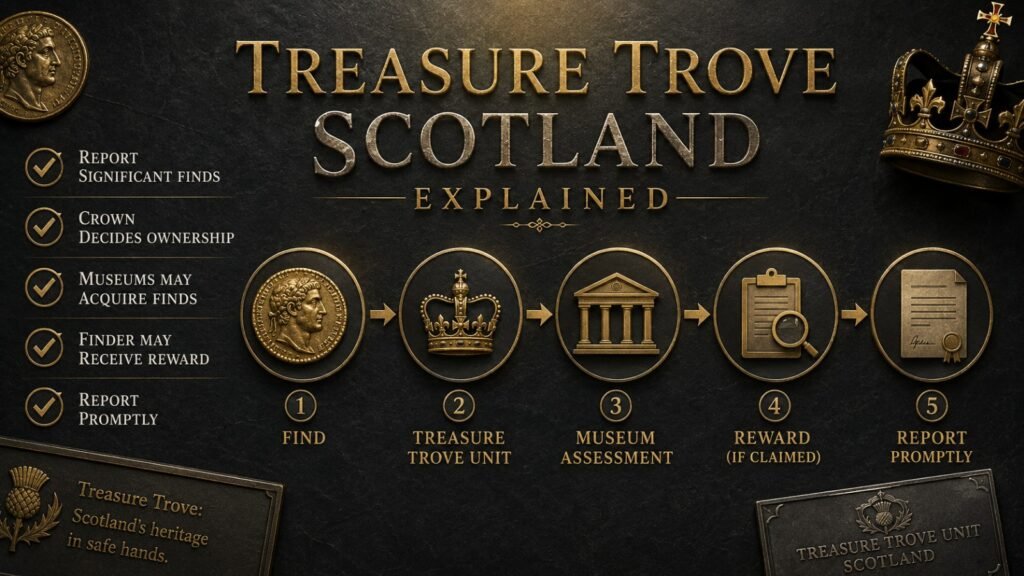
Simple infographic explaining how Treasure Trove Scotland works for metal detectorists reporting archaeological finds.

Scheduled Monuments: Same Criminal Offence, Different Authority

Scotland has over 8,000 scheduled monuments, and the rule is simple: do not detect on one without written permission from Historic Environment Scotland. Detecting on a scheduled monument without that permission is a criminal offence under the Ancient Monuments and Archaeological Areas Act 1979, the same legislation that applies across the rest of the UK.

Before any new Scottish session, check PastMap at pastmap.org.uk. This is Historic Environment Scotland’s online mapping tool showing the location and boundaries of all Scottish scheduled monuments. It takes five minutes. If you have any questions about a specific site, contact HES at hmenquiries@hes.scot or 0131 668 8600 before you go, not after.

One thing worth knowing if you are planning a trip to the Cairngorms or Loch Lomond area: both Scottish National Parks take a cautious approach to hobby detecting on National Park Authority-managed land. Assume that land owned or managed by the Park Authority is not available, while private farmland within the Park boundary follows the usual landowner permission process.

Planning a Detecting Trip to Scotland?

Scottish farmland, beaches, and gold-bearing rivers all demand different detector capabilities. Choosing the right machine before your trip can make the difference between constant false signals and a genuinely productive day.

Whether you’re searching for Viking-era farmland finds, beach jewellery, or Scottish gold, explore our range of detectors designed for UK conditions.

Gold Prospecting in Scotland: The Rivers, the Regions, and What Is Realistic

Scotland has genuine, accessible gold-bearing geology distributed across several distinct regions. The Southern Uplands, particularly around Wanlockhead and Leadhills in South Lanarkshire, have the longest documented history of gold prospecting in Scotland, with finds recorded as far back as the reign of King James IV in the 16th century. The Kildonan Burn in Sutherland triggered a genuine gold rush in 1869 that drew hundreds of prospectors to the Highlands and produced enough material to sustain serious commercial interest for a full season. More recently, 2018 brought the biggest UK gold nugget on record, discovered in a Scottish river and kept private at the finder’s request.

The Kildonan Burn remains the most publicly known gold prospecting location in Scotland. Recreational panning there requires permission from the Kildonan Estate and should be arranged before visiting. Several Highland river systems draining gold-bearing geological formations attract serious prospectors each season, as do the rivers around Leadhills and Wanlockhead. All river prospecting requires landowner permission for riverbank access regardless of the Scottish Outdoor Access Code, which, as covered above, does not apply to activities involving the removal of finds.

Finding small alluvial gold in Scottish rivers is not something a standard farmland machine handles well. Standard detectors operating at 6 to 15kHz consistently miss fine gold flakes and small nuggets, which are low-conductivity, small-mass targets that need higher operating frequencies to register reliably. The dedicated gold detectors in the UK Metal Detectors range are built specifically for mineralised ground and small gold targets; they are the right tools for serious gold detecting in Wales or Scotland, where standard machines simply leave gold in the ground. For farmland detecting across Scottish lowlands, where iron-rich soils and historic metal mining mineralisation create real challenges for standard machines, our metal detector ground balance guide explains exactly how to calibrate for mineralised ground and why preset balance often fails in these conditions.
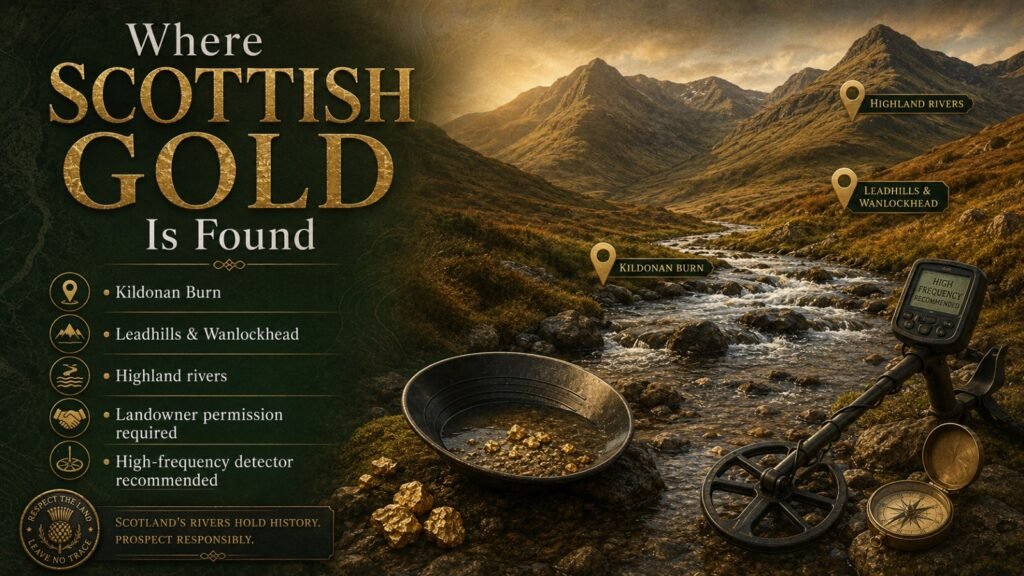
Illustration showing Scottish gold prospecting locations with rivers, gold pan, detector, and gold nugget icons.

The Scottish Regions Worth Knowing About

Dumfries and Galloway and the Scottish Borders

These two regions sit at the top of the Treasure Trove Unit’s own research into productive detecting areas, and the finds record explains exactly why. This is Roman frontier territory, Viking settlement ground, and early medieval Christian landscape all in one region. The 2014 Viking hoard from Dumfries and Galloway is a recent demonstration of what the ground holds. The Borders farmland crosses territory that saw continuous occupation from the Iron Age through the medieval period, and it is broadly accessible through conventional permission approaches with the farming community there.

Fife and Perth and Kinross

The Dairsie hacksilver hoard proved what Fife’s Roman-period archaeology can produce in a single afternoon’s detecting at a rally. The farmland here is mixed arable and pasture, accessible through standard permission routes, and the soil conditions are more forgiving than the highly mineralised western regions. Perth and Kinross was the political heart of medieval Scotland. The farmland around Stirling and Perth reflects that historical density in what it produces, with Roman finds, Pictish metalwork, and early medieval artefacts all coming from this region through responsible detecting.

Moray and Aberdeenshire

The two Birnie hoards demonstrated that northeast Scotland, far from the Roman military frontier, received significant Roman silver through diplomatic or trade contact with Pictish communities. This region is considered underworked relative to its potential, with large areas of farmland that have seen limited systematic detecting. For a detectorist willing to research thoroughly and approach landowners in an area with less competition, Moray and Aberdeenshire represent genuine opportunity. Our best places for metal detecting in the UK guide covers the research tools that help identify productive ground before approaching a landowner: PAS database searches, historical mapping, and LiDAR, all of which apply as usefully to Scottish ground as they do to English farmland.
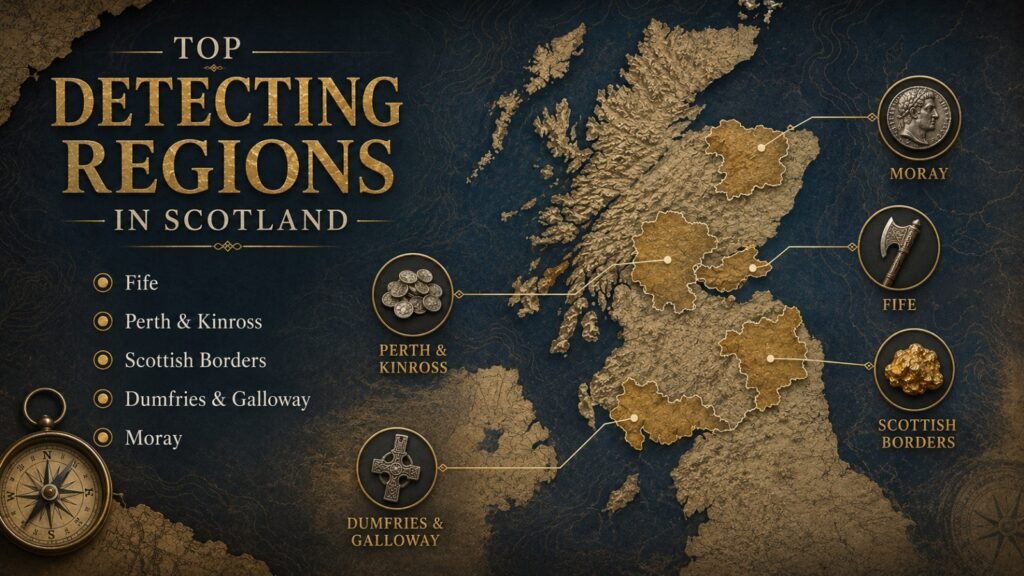
Illustrated Scotland map showing the best regions for metal detecting, including Fife, Borders, Moray, and Dumfries & Galloway.

Scottish Beaches: The Easiest Starting Point

Crown Estate Scotland manages most of Scotland’s coastline foreshore and does not require a specific permit for beach detecting, provided you follow Scottish Treasure Trove procedures and the Outdoor Access Code. The practical position is straightforward: report anything with potential historical significance, fill every hole, and conduct yourself the same way you would on any responsible detecting session.

Modern jewellery found on Scottish beaches is handled practically. If it is clearly a recent loss, report it to the local police as a found item. If there is any question about historical significance, report it to the Treasure Trove Unit. The system is not designed to create difficulty around everyday beach detecting; it is designed to protect genuinely significant finds.

Wet Scottish beach sand carries the same salt mineralisation challenge as any UK coastal site. Highly conductive wet sand destabilises target ID readings and produces false signals on standard VLF machines. A detector with a dedicated beach or saltwater mode handles this considerably better. Pulse Induction detectors handle salt mineralisation best of all, which is why they are the machine of choice for serious beach detectorists. Our pulse induction metal detectors guide explains how PI technology handles these conditions and which machines are worth considering for Scottish coastal work.

Looking for a Beach Detector?

Saltwater beaches require detectors that can remain stable in wet, mineralised sand. Browse our collection of beach metal detectors built for UK coastal conditions.

Can You Keep What You Find in Scotland? 

Unlike England and Wales, Scotland operates under the Treasure Trove system rather than the Treasure Act 1996. If a find is claimed by the Crown because of its archaeological or historical importance, it will usually be allocated to a Scottish museum. In return, the finder may receive an ex gratia reward based on the object’s market value.

If a find is not claimed, it is normally returned to the finder. Because every potentially significant discovery must first be reported, detectorists should never assume they can automatically keep archaeological finds.

Quick Reference: Metal Detecting in Scotland 

Topic  Scotland-Specific Detail 
Finds law  Treasure Trove, not the Treasure Act 1996 
What to report  All finds of archaeological, historical, or cultural significance regardless of age or material 
Reward  Finder only; landowner has no automatic share 
Report finds to  treasuretrove@nms.ac.uk Treasure Trove Unit, National Museums Scotland 
Scheduled monuments authority  Historic Environment Scotland, not Historic England 
Check scheduled monuments  PastMap: pastmap.org.uk 
Outdoor access rights  Do not cover detecting with intent to remove finds 
Landowner permission  Required everywhere including public parks 
Crown Estate foreshore  No permit needed; Treasure Trove rules apply 
Gold regions  Southern Uplands (Leadhills/Wanlockhead), Sutherland (Kildonan Burn), Highland rivers 
Most productive regions  Dumfries and Galloway, Borders, Fife, Perth and Kinross, Moray 
NCMD membership  Recommended for insurance recognised by Scottish landowners 

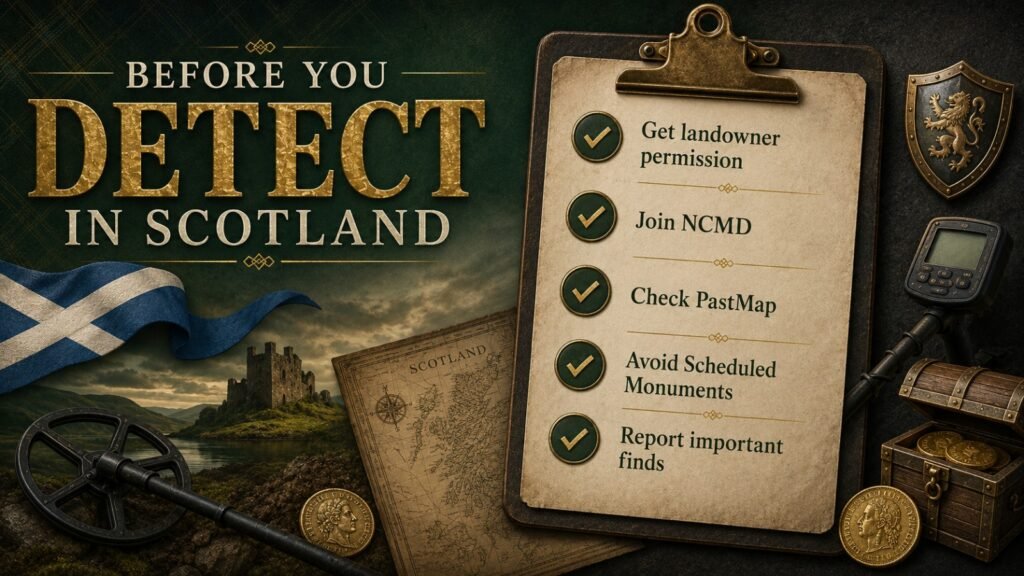
Checklist infographic showing essential steps before metal detecting in Scotland including permission, Treasure Trove reporting, and checking protected sites. 

Scotland Rewards the Detectorist Who Does the Homework

Metal detecting in Scotland is not harder than in England. It is different. The legal framework takes an afternoon to learn, and once you have learned it, you are operating in one of the most historically rich detecting destinations in the British Isles. Viking hoards, Roman hacksilver, Pictish gold, Bronze Age metalwork, and the biggest gold nugget in UK history all found by ordinary detectorists, all reported properly, all now part of Scotland’s national heritage record.

The detectorists who come back from Scotland having had a genuinely productive session are the ones who understood the Treasure Trove system before they arrived, had their permissions properly in place, and brought a machine suited to Scottish ground conditions rather than assuming what worked in Lincolnshire would work in the Southern Uplands.

If that sounds like something worth planning, we can help with the equipment side before you go.

Ready to Detect in Scotland?

From mineralised Highland rivers to coastal beaches and historic farmland, Scotland rewards detectorists who bring the right equipment.

Explore our range of beginner, intermediate, and professional metal detectors, or contact our team if you’d like help choosing the right machine for your next trip.

Shop Metal Detectors 

Need Advice? Contact Our Team

Frequently Asked Questions About Metal Detecting in Scotland 

1. Is metal detecting in Scotland legal?

Yes. Metal detecting in Scotland is legal if you have the landowner’s permission and follow Treasure Trove Scotland rules. The Scottish Outdoor Access Code allows public access to much of the countryside, but it does not permit removing objects from the ground. You must obtain permission before detecting on private land, public parks, or common land. Detecting on scheduled monuments without written permission from Historic Environment Scotland is a criminal offence. 

2. What is Treasure Trove Scotland? 

Treasure Trove Scotland is the legal system that governs archaeological and historically significant finds discovered in Scotland. Any portable object considered archaeologically, historically, or culturally important must be reported to the Treasure Trove Unit at National Museums Scotland, regardless of its material or age. If the Crown claims the find, the finder may receive an ex gratia reward based on its market value. 

3. Can you find gold metal detecting in Scotland? 

Yes. Scotland is one of the few parts of the UK with genuine gold-bearing geology, making it a popular destination for recreational gold prospecting. Gold is found around Leadhills, Wanlockhead, Kildonan Burn, and several Highland river systems. Small alluvial gold is difficult to detect with standard VLF machines, so high-frequency or dedicated gold detectors are recommended. Landowner permission is required, and significant finds must be reported under Treasure Trove Scotland. 

4. Where are the best Scottish metal detecting locations? 

The best places for metal detecting in Scotland include Dumfries and Galloway, the Scottish Borders, Fife, Perth and Kinross, Moray, and Aberdeenshire. These regions have produced Roman coins, Viking hoards, Pictish artefacts, and medieval finds. Detecting is only permitted with landowner permission, and all significant discoveries must be reported through Treasure Trove Scotland.

5. How is metal detecting in Scotland different from England? 

The biggest difference is the legal system. Scotland follows Treasure Trove law, while England and Wales operate under the Treasure Act 1996. Scotland requires all archaeologically significant finds to be reported, regardless of their age or material. Scottish finds are reported to the Treasure Trove Unit rather than the Portable Antiquities Scheme, and landowners do not automatically have a legal claim to reported finds.

6. Do you need a licence to metal detect in Scotland?

No. Scotland does not require a general metal detecting licence. However, you must have the landowner’s permission and follow Treasure Trove reporting requirements. Additional permission is required before detecting on scheduled monuments or certain protected land.

7. Do you need a licence to metal detect in Scotland?

No. Scotland does not require a general metal detecting licence. However, you must have the landowner’s permission and follow Treasure Trove reporting requirements. Additional permission is required before detecting on scheduled monuments or certain protected land.

8. Can you keep what you find metal detecting in Scotland?

Not automatically. Archaeologically significant finds must be reported to the Treasure Trove Unit. If the Crown claims the object, it may be allocated to a Scottish museum, and the finder can receive an ex gratia reward. Finds that are not claimed are generally returned to the finder.