

Metal detecting with kids UK is one of the genuinely brilliant outdoor activities available to families right now. Children are completely absorbed for two to three hours, and come home with something they found themselves buried in actual ground.
This is the complete guide for families thinking about starting. It covers what age children can begin, what the best metal detector for kids UK actually looks like, where to go for the first session, what realistic finds look like, and everything a parent needs to feel confident before the first outing.
Most outdoor activities for kids require either physical ability or prior experience before they become enjoyable. Metal detecting for children requires neither. A seven-year-old with a properly set-up machine can find something interesting within the first hour, and the experience of hearing that signal, making the dig, and holding an object that has been underground for decades or centuries is genuinely difficult to replicate with anything else.
There is a moment that happens on almost every family session. A child pulls something from the ground, maybe a Victorian penny, maybe an old button, and realises that a real person dropped that object possibly hundreds of years ago, and they just found it. That moment tends to stick with children in the best possible way. Several parents who started the hobby specifically for their children have reported that the child was the one dragging the family back out the following weekend.
Family metal detecting UK also works educationally in a way that does not feel like education. A child who finds a Georgian halfpenny wants to know when King George ruled, what that coin would have bought, and how it ended up in that particular field. A corroded Roman brooch generates questions about Roman Britain without a single worksheet. The learning happens through curiosity rather than instruction, which is why it tends to stick.
The other thing detecting does exceptionally well for children is teach patience through genuine reward. The next signal really might be the interesting one. That legitimate possibility keeps children focused in a way that surprises most parents the first time they see it.
There is no single minimum age for metal detecting. Around six to eight can be a reasonable starting point if a child can comfortably handle the detector, follow digging instructions, and stay close to an adult. Most children find the hobby most naturally engaging between eight and twelve, when patience, historical curiosity, and the ability to handle a light machine all come together. Teenagers who get into detecting often become the most committed members of a detecting family, particularly once they develop an interest in a specific historical period.
The practical consideration at younger ages is weight. A detector that is too heavy for a child becomes frustrating within the first 20 minutes. As long as the machine is light and the session is not too long, an hour and a half tends to be the sweet spot before younger children need a break and a snack; even quite young children can have a genuinely enjoyable first session.
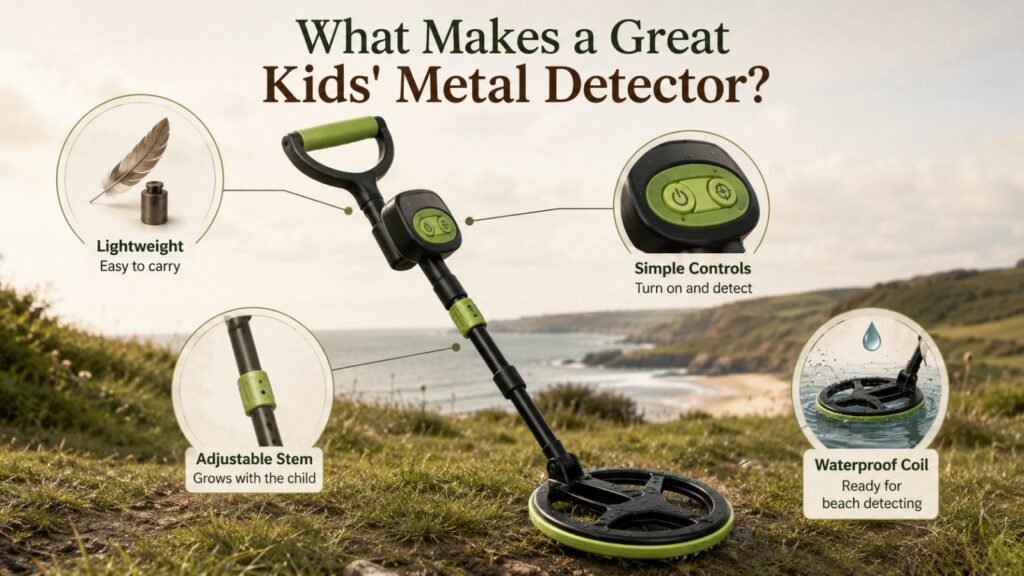
The best metal detector for kids UK is not the most technically impressive machine on the market. It is the lightest, simplest, most reliable machine a child can pick up and use without adult interpretation of every feature. Four things matter above everything else: weight, simplicity, adjustability, and whether it works on a beach.
Weight is the single most important factor. A heavy detector is an abandoned detector, and there is no way around that. Under 1.5kg is the target, and lighter is always better.
Simplicity matters because children do not want to navigate settings before they start. A machine with two or three clearly labelled modes, typically an all-metal mode and a discrimination mode, is ideal for a junior metal detector UK experience. Turn it on, pick a mode, and start swinging within 30 seconds of arriving.
Adjustability means an adjustable stem that reduces the detector to the right length for a child rather than being sized for an adult. A detector that is too long for a child becomes awkward within the first 20 minutes.
Beach capability matters because beaches are where most families start, and a waterproof coil that handles wet sand without special treatment makes beach sessions straightforward rather than stressful.
The Lander XD50 is the machine most families with children should start with, and the reasons are entirely practical. The stem is fully adjustable, which means the same machine fits a nine-year-old and a six-foot parent without any modification. It has two operating modes, All Metal and DISC, and straightforward controls that make it suitable for beginners. Its waterproof search coil can be used on both dry and wet sand. It costs £79.95, comes with headphones included, and carries a two-year warranty.
Critically, the Lander XD50 is a genuine hobby detector rather than a toy. A child can use the same machine while a parent helps interpret more ambiguous signals. It also comes with a DVD guide to finds through the ages, which families find genuinely useful for identifying what the child has found during and after each session.
The Lander XD50 is the natural step up for older children or teenagers who are genuinely engaged and want more depth and target identification capability. For everything that goes alongside the detector, the metal detecting accessories guide covers what actually matters versus what can wait until the family is more established in the hobby.
On private land, get the landowner’s permission before detecting. A public footpath gives you a right of passage, not an automatic right to metal detect. This applies to farmland, parks, woodlands, and beaches above the high tide mark. A public footpath allows walking through land and nothing else.
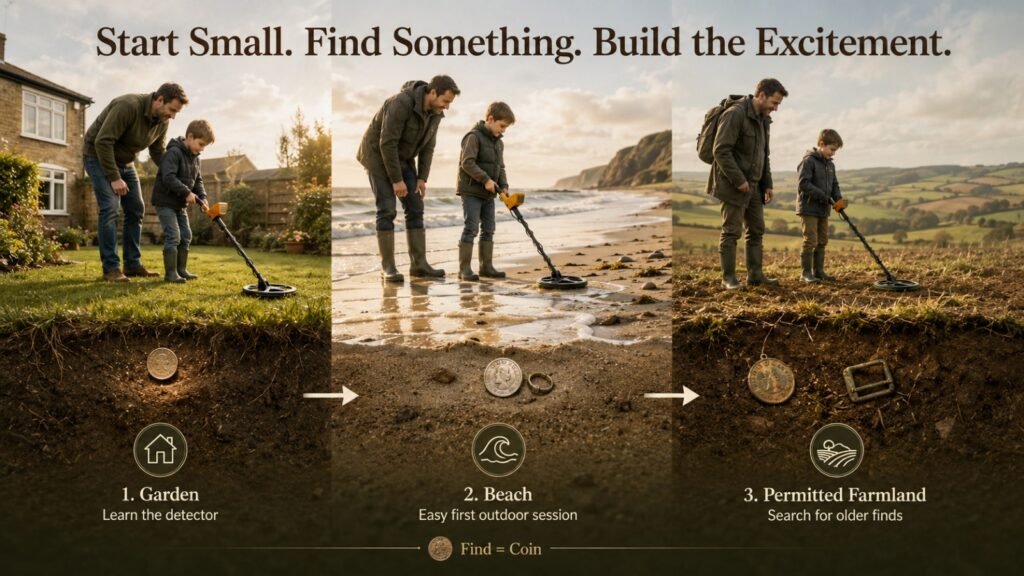
For a first family session, three straightforward options cover most families. The family’s own garden needs no permission at all and is genuinely the best place to start. A friend or family member’s garden needs only a conversation. The Crown Estate allows metal detecting without formal consent on its foreshore, generally the area between mean high and mean low water. However, this does not cover every beach, and local restrictions or third-party rights may apply. Check the relevant beach and land ownership before detecting. The Thames foreshore has separate rules and requires a permit from the Port of London Authority. Landowner permission does not override archaeological protections. Do not detect on Scheduled Monuments or other protected archaeological sites unless you have the required consent.
NCMD membership for families is worth getting once the family commits to continuing the hobby. Adult membership includes public liability insurance that most landowners require before granting farmland access, andUnder-16s can be added to an adult NCMD membership at no extra cost, subject to NCMD’s membership conditions and supervision requirements. For families who want to secure their own farmland permissions and really get into the hobby, the metal detecting permission guide walks through approaching landowners and getting written agreements in place step by step.
Before going anywhere, spend the first session at home. Bury a 50p coin and a nail at about 10cm depth and let the child find both. This single exercise teaches more about how the machine works than an hour of reading the instructions. The child learns what a good signal sounds like, what an iron signal sounds like, how to narrow down a target before digging, and what a clean recovery looks like. Families who skip this step often spend the first outdoor session frustrated with a child who cannot understand why the machine keeps making noise at things that turn out to be nothing interesting.
Crown Estate foreshore can be a convenient first outdoor option for family detecting. The Crown Estate permits metal detecting on its foreshore without formal consent, but not every beach is Crown Estate foreshore and local restrictions may apply. The finds are modern coins, jewellery, and tokens, which means clear signals and satisfying recoveries. Wet sand is straightforward to dig. Children respond particularly well to beach sessions because the finds are tangible and recognisable, the pace is relaxed, and the environment is engaging regardless of the detecting results. The Lander XD50’s waterproof coil handles wet sand reliably without any additional protection.
After a few beach or garden sessions, farmland permissions are where the most historically interesting UK finds come from. Productive farmland can offer the possibility of older finds, including Roman and medieval artefacts as well as later coins and objects. The detecting is slower and more methodical than beach work, which suits older children who have developed genuine patience with the hobby. The best places for metal detecting in the UK guide covers every major UK detecting location in detail, including what each one is likely to produce and how to access it properly.
Not Sure Which Machine Is Right for Your Child’s Age?
Choosing a first detector is easier when you know what actually matters. For younger children, weight and adjustability are important. For older children, features such as target identification and greater control may matter more.
If you’re unsure which detector suits your child’s age, experience and planned locations, speak to the UK Metal Detectors team for help choosing the right option.
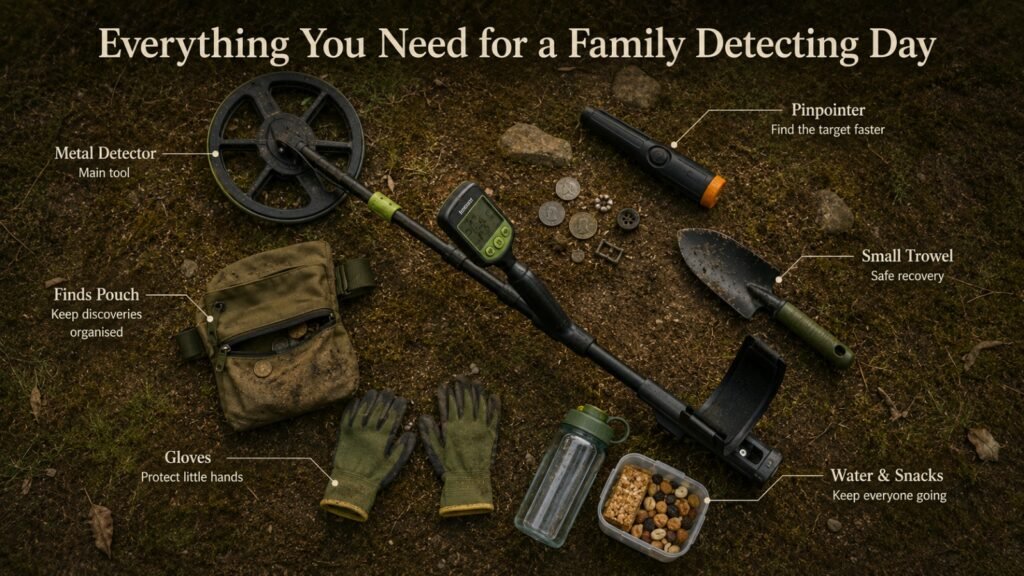
The detector, a pinpointer (children find this even more exciting than the main detector once they understand what it does; it beeps faster as it gets closer to the target), a small plastic trowel for digging, zip-lock bags or a small finds pouch to keep discoveries separate, and a phone for dropping a GPS pin on find locations.
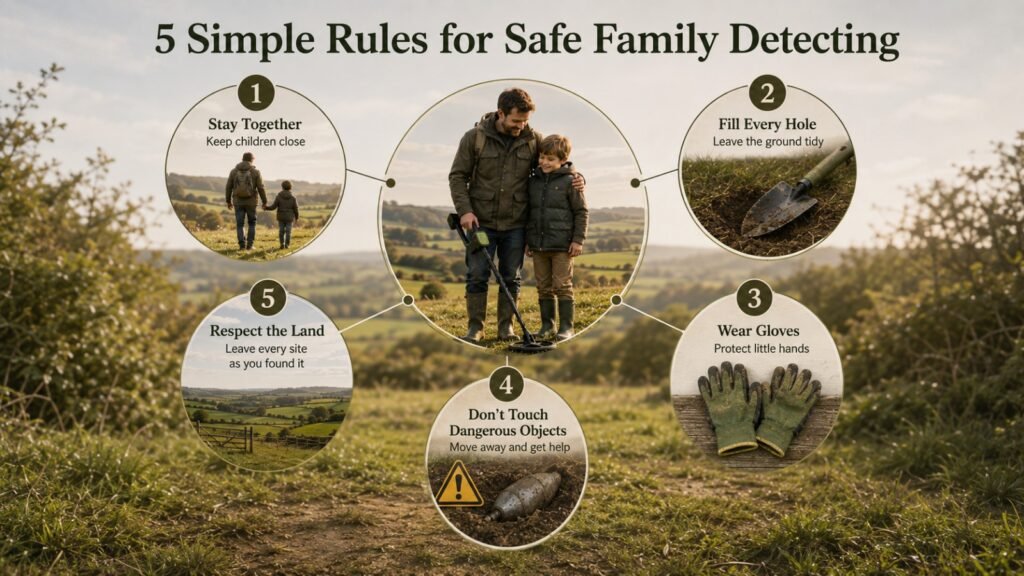
Pack water and snacks. Children detect with considerable enthusiasm for about 90 minutes and then need refuelling. Planning a natural break around that point makes the whole session more enjoyable than pushing through to the point where the child loses interest. A pair of lightweight gardening gloves for children is also worth packing. Digging into unfamiliar ground occasionally turns up sharp edges, broken glass, or rough metal. Gloves remove that hazard without reducing any of the excitement.
The beginner’s guide to using a metal detector covers the settings and technique side of things for anyone who wants to understand how the machine works before the first session rather than figuring it out as they go.
Setting honest expectations before the first session is one of the most useful things a parent can do. Nothing deflates a child’s enthusiasm faster than expecting buried treasure and spending three hours digging 20th-century bottle caps. Reframing every find as part of the learning process makes the difference between a child who wants to go again and one who considers the afternoon wasted.
On a typical beach session, children will find modern coins, jewellery dropped by holidaymakers, tokens, and miscellaneous metalwork from the last 50 to 100 years. In a garden, Victorian and Georgian copper coinage, old buttons, and household metalwork from the property’s history turn up frequently. On farmland with proper permission, all of the above plus the genuine possibility of Roman bronze, medieval buckles, and 17th to 19th century coinage becomes available.
The advice most experienced family detectorists pass on is to celebrate everything. An old button with a regimental design tells a story. A Victorian penny is genuinely old. A corroded Roman coin, even a common one, is 1,700 years old and was handled by a real person in Roman Britain. Children taught to find all of this interesting rather than only interesting if it turns out to be gold tend to develop a long-term genuine enthusiasm for the hobby.
If anything turns up that looks potentially significant, any old coin that might be gold or silver, a group of coins from the same spot, or something clearly very old, the Portable Antiquities Scheme, managed by the British Museum, is the correct route for recording it. If a find may qualify as Treasure, it must be reported within 14 days under the Treasure Act. The definition of Treasure is more detailed than simply being an object over 300 years old made of gold or silver, so seek advice from a Finds Liaison Officer if you are unsure. Explaining this process to children, the idea that their find could contribute to the historical record and potentially end up referenced in a museum, tends to make it exciting rather than daunting.

Metal detectors are completely safe for children. They use low-frequency electromagnetic fields to detect buried metal, the same basic technology as airport security scanners at lower power, with no radiation risk. Metal detecting for children is a physical outdoor activity with no more inherent risk than a walk in the countryside.
The practical safety points are about digging rather than the machine itself. Always supervise children digging in unfamiliar ground. If a find looks like ammunition, an explosive device or other potentially dangerous military material, do not touch or move it. Move away from the area and contact the police for advice. If there is an immediate danger, call 999. This is genuinely rare but worth teaching as a habit from the very first session.
Teaching children to fill every hole completely before moving on is equally important. A half-filled hole is a hazard for livestock and farm animals, and it is the single most consistent complaint from landowners. A child who develops this habit from their first session has a behaviour that will serve them, the landowner, and the broader hobby well for a long time.
| Question | Answer |
| What age can children start? | From around 6 to 8 with supervision; most engaged at 8 to 14 |
| Best metal detector for kids UK | Lander XD50 £79.95, lightweight, adjustable stem, turn-on-and-go |
| Best first location | Own garden first, then Crown Estate foreshore beach |
| Do you need permission? | Yes everywhere except own garden; Crown Estate foreshore is permissive |
| NCMD family membership | Adult membership covers under-16s at no extra cost |
| What will children find? | Modern coins and tokens typically; older artefacts on farmland permissions |
| Are detectors safe for children? | Yes, low-frequency fields, no radiation risk |
| Found something significant? | Report gold or silver over 300 years old to local coroner within 14 days |
You don’t need expensive equipment or years of experience to give metal detecting a try. Start in the garden, take your child to a suitable beach or permitted land, and let the first few finds do the convincing.
Ready to get started?
Explore the Lander XD50 and other beginner-friendly metal detectors at UK Metal Detectors, or speak to the team if you’re unsure which machine is right for your child.
Find the right detector for your family and make the first session one they’ll remember.
Metal detecting with kids in the UK is a family outdoor activity where children and adults use metal detectors to search for buried coins, jewellery and other metal objects. Families can start in their own garden before moving on to suitable beaches or private land where permission has been obtained. Children can learn about history, patience and responsible digging while enjoying time outdoors. There is no single minimum age, but younger children should always be closely supervised by an adult.
For families looking for a straightforward beginner detector, the Lander XD50 is a practical option. It weighs about 1.35kg, has an adjustable stem, All Metal and DISC modes, and a waterproof search coil that can be used on dry and wet sand. It is designed as a hobby detector rather than a toy and can be used by both children and adults. Always choose a detector based on the child’s age, height, strength, and where the family plans to use it.
Yes. Metal detecting can be a rewarding outdoor activity for children because it combines exploration, patience, physical activity and an opportunity to learn about history through real objects. Children can start with simple garden or beach sessions and gradually develop their detecting and recovery skills. Adult supervision is important, particularly when children are using digging tools or detecting unfamiliar ground.
A lightweight, adjustable beginner detector is usually a better choice than a toy metal detector. The Lander XD50 is one option for families looking for a simple machine that can be used by both children and adults. Its adjustable stem, All Metal and DISC modes, and waterproof search coil make it suitable for beginners and different detecting environments. For older children or teenagers who become seriously interested in the hobby, a more advanced detector may be worth considering.
A junior metal detector is a lightweight, easy-to-use metal detector designed to be manageable for younger users. Look for a machine with a comfortable weight, adjustable stem, simple controls, and a search coil suitable for the locations where it will be used. A detector should also provide genuine target detection rather than being designed primarily as a toy. For younger children, comfort and ease of use are often more important than having advanced features.