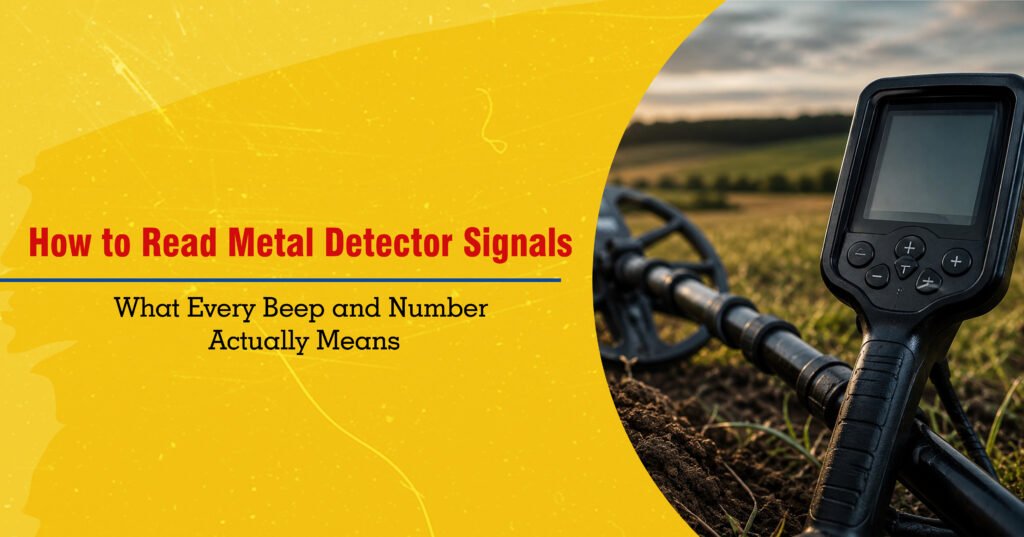


Looking to buy one? Browse our pulse induction detectors, built for mineralised ground and wet sand.
If you’ve ever spent hours detecting on a UK beach or across mineral-heavy farmland and felt like your detector was missing deeper targets, you’re not imagining it. Standard machines often struggle in these conditions. This is exactly where a pulse induction metal detector UK setup starts to show its real value.
But here’s the truth most blogs won’t tell you:
A PI metal detector is not automatically “better” than other types. It is more powerful in the right situations and frustrating in the wrong ones.
This guide is written to give you a clear, experience-based understanding of pulse induction technology. Not just how it works, but when it actually helps, when it doesn’t, and how to choose the right machine without wasting money.
By the end, you’ll know whether a PI detector is right for you and if it is, how to pick the best one for your needs.
A pulse induction metal detector works differently from most hobby detectors. Instead of continuously scanning frequencies, it sends short bursts of powerful energy into the ground and measures how that energy reacts after hitting metal.
In simple terms, the detector:
That timing is the key. Different materials affect the signal differently, and the detector uses that information to identify whether something is buried below.
To understand why PI detectors are so effective in certain conditions, you need to look at what’s happening beneath the surface.
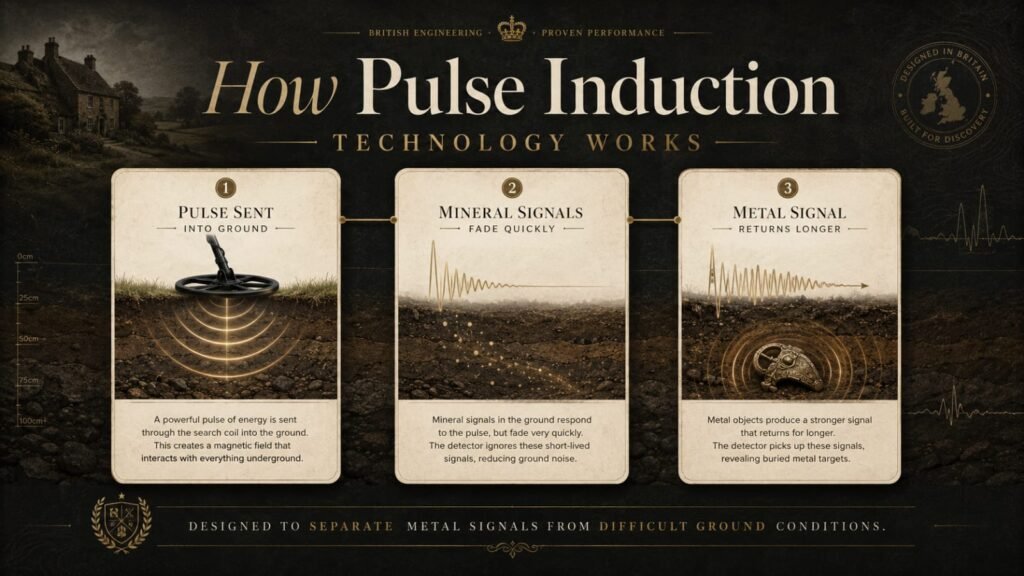
When a PI detector sends a pulse through its coil, it creates a magnetic field that briefly penetrates the ground. The moment that the pulse stops, the magnetic field collapses. If there is metal in the ground, it generates what’s called an eddy current, which produces its own signal.
Now here’s the critical part.
A PI detector is designed to ignore fast-decaying signals (from soil) and focus on slower ones (from metal).
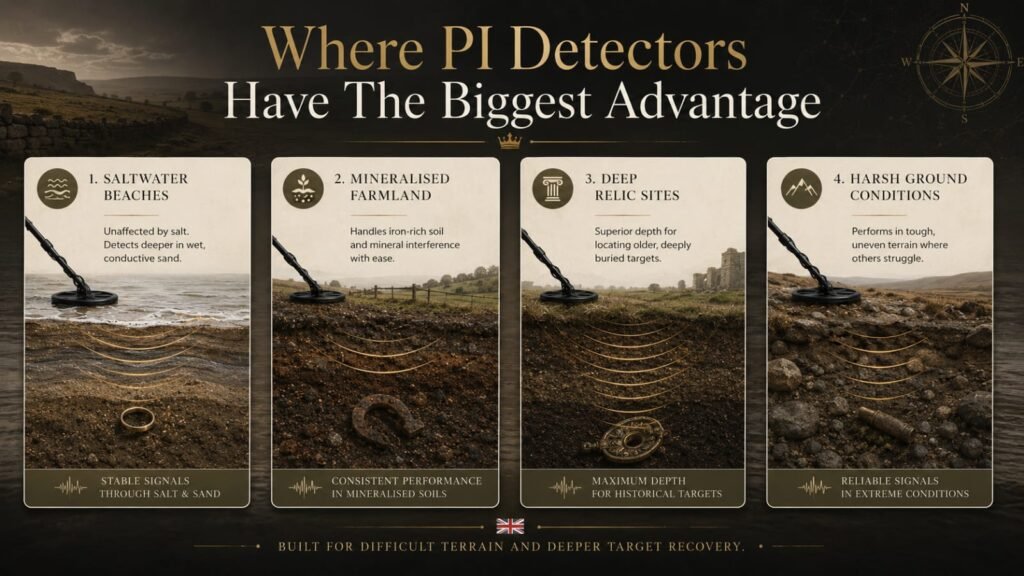
This is why PI detectors perform so well in:
In real detecting situations, this translates to fewer false signals and more consistent depth.
If you’ve only used a VLF detector before, the first time you use a PI machine can feel very different.
That’s because PI detectors are not trying to “classify” targets the way VLF machines do. Instead, they are focused on finding anything conductive at depth, regardless of type.
In practical terms:
This is why experienced detectorists often say:
“A PI detector doesn’t make detecting easier, it makes it more powerful.”
One of the biggest reasons people switch to a pulse induction metal detector UK setup is not just “more depth” in theory, but usable depth in real ground conditions.
In perfect soil, many detectors can perform well. But if you’ve spent time detecting across UK beaches or mineral-heavy land, you already know that conditions are rarely perfect. Wet sand, salt content, and iron-rich soil all interfere with signals, and this is where standard VLF detectors begin to lose efficiency. The deeper you go, the weaker and less reliable their signals become.
Pulse induction detectors approach this differently. Instead of constantly trying to balance and filter out ground interference, they are designed to ignore most of it altogether. This allows them to maintain consistent performance even when the ground is working against them.
In practical terms, this translates into real advantages in the field:
What this really means is that a PI detector doesn’t just help you find more targets; it helps you find targets that other detectorists simply cannot reach anymore.
Mineralisation is one of the most common challenges in metal detecting, especially across different parts of the UK where soil composition can vary significantly. Iron-rich ground, clay-heavy fields, and previously worked land often create inconsistent signals that can confuse standard detectors.
With a VLF machine, you’ll often notice:
A PI detector handles this situation in a much more stable way. Instead of constantly reacting to ground minerals, it effectively filters them out by design. This creates a much smoother and more predictable detecting experience.
This results in:
Over time, this consistency becomes one of the biggest advantages. You spend less time second-guessing your machine and more time focusing on actual targets.
If there is one environment where PI detectors clearly outperform most alternatives, it is the beach.
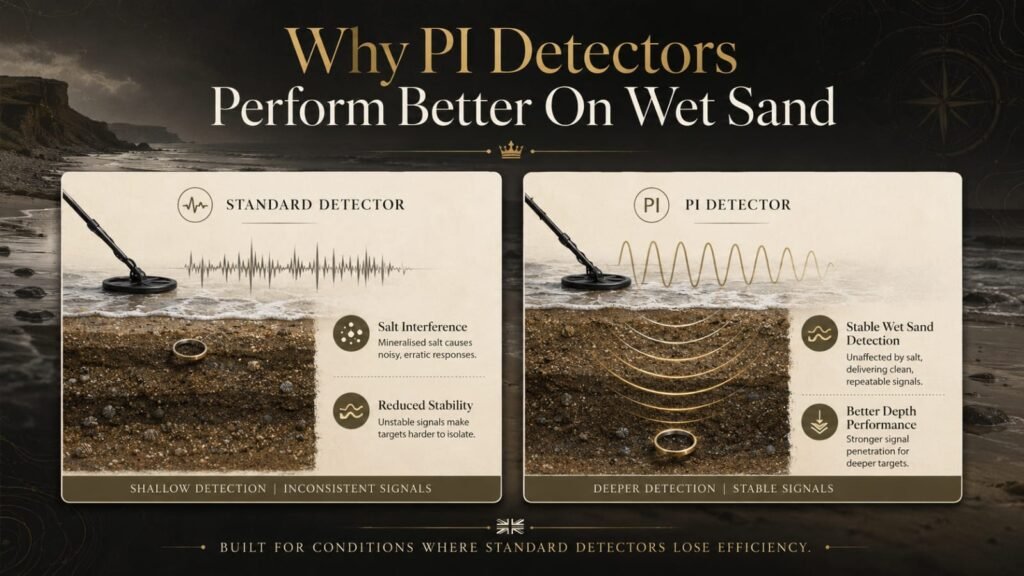
UK beaches present a unique combination of challenges. Wet sand contains salt, and saltwater is highly conductive. This creates constant interference for many detectors, especially VLF models, which can become unstable or lose depth in these conditions.
A PI detector is built specifically to handle this type of environment. Instead of struggling against salt interference, it operates smoothly and maintains signal strength even in the most challenging areas of the beach.
A PI detector:
For serious beach detectorists, this is often the point where switching to a PI detector becomes an obvious decision. It allows you to work in areas that others avoid and recover targets that remain untouched beneath deeper layers of sand.
The UK is one of the richest regions in the world for historical artefacts, but it is also one of the most heavily searched. Many popular sites have been detected for years, which means the easy, shallow targets have largely been recovered.
What remains are the more challenging finds:
These are exactly the types of targets that pulse induction detectors are designed to locate. Their ability to penetrate deeper into the ground and ignore mineral interference allows you to access finds that are simply beyond the reach of standard machines.
In real-world terms, this means you are not just detecting, you are exploring layers of history that others have missed.
Metal detecting is rarely done in controlled environments. Weather changes, ground conditions shift, and terrain can vary within a single field.
PI detectors are designed with this reality in mind. They are built to handle:
Rather than requiring constant adjustment, they offer a more stable and predictable experience across different environments.
They are not delicate machines. They are designed for consistent performance under pressure, which is why they are often preferred by more experienced detectorists who prioritise reliability over convenience.
A truly useful guide doesn’t just highlight strengths. It also helps you understand where something may not work for you, so you can make a decision based on reality, not assumptions.
This is the most important trade-off to understand before investing in a PI detector.
Unlike VLF machines, which are designed to identify and classify different types of metal, PI detectors are much less selective. Their focus is on detecting targets at depth, not on telling you exactly what those targets are.
This means they are not particularly effective at distinguishing between:
In practical use, this leads to a different style of detecting:
For beginners, this can feel inefficient or frustrating. However, experienced detectorists often accept this as part of the process, especially when the goal is to reach deeper or more difficult targets.
If you are browsing for a pulse induction metal detector for sale, one of the first things you will notice is the price difference.
PI detectors are generally more expensive because:
This doesn’t mean you should always choose the most expensive model. What matters is whether the performance advantages actually apply to the type of detecting you plan to do.
Another factor that often gets overlooked is physical usability.
PI detectors tend to be:
If you are used to lightweight detectors or prefer shorter, casual detecting sessions, this is something you need to consider carefully. Comfort directly affects how long and how effectively you can detect.
It’s important to match your detector to your goals.
If your primary focus is:
A PI detector is not the most efficient tool for the job. The lack of strong discrimination means you will spend more time digging unwanted targets.
In these situations, a VLF detector offers a more practical and efficient experience.
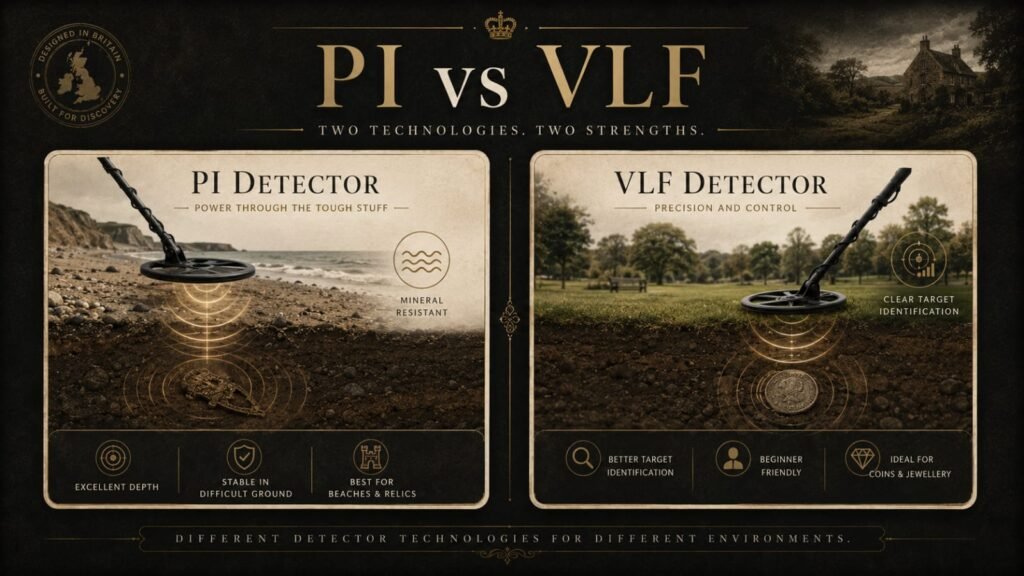
This is one of the most common decisions detectorists face, and the answer is not about which is better overall, but which is better for your specific use case.
Quick Comparison Table
| Feature | PI Metal Detector | VLF Metal Detector |
| Depth | Excellent for deep targets | Good for shallow to medium depth |
| Ground Handling | Performs well in mineralised soil | Can struggle in difficult ground |
| Discrimination | Limited | Strong target identification |
| Best Use | Beaches, relics, gold | Coins, jewellery, general detecting |
| Ease of Use | Moderate to advanced | Beginner-friendly |
Choosing the best PI metal detector makes sense when your detecting conditions demand more power and stability rather than precision.
A PI detector is the right choice if:
In these scenarios, the advantages of PI technology become very clear, especially over longer detecting sessions.
There are many situations where a VLF detector remains the better choice, particularly for general-purpose detecting.
Stick with VLF if:
Choosing the right detector is less about chasing performance and more about matching the tool to the environment and your goals.
From Cornwall to Scotland, UK beaches offer excellent opportunities for detecting, but they also present consistent challenges due to saltwater interference.
A PI detector changes how you approach these environments. Instead of avoiding wet sand or struggling with unstable signals, you can detect confidently across different beach zones.
A PI detector helps you:
This allows you to cover more ground effectively and improve your chances of finding valuable targets.
The UK’s long history makes it an ideal place for relic hunting, but it also means many sites have already been explored extensively.
Today, the remaining finds are often:
PI detectors give you the ability to access these more challenging targets, opening up opportunities that standard detectors may miss.
Certain inland areas in the UK are known for their challenging soil conditions, including high iron content and heavy mineralisation.
In these environments, many detectors struggle to maintain accuracy and depth. PI detectors, however, continue to perform consistently, making them a valuable tool for detectorists working in these conditions.
When evaluating the best PI metal detector, it’s easy to focus on specifications. However, what really matters is how those features translate into real detecting performance.
Depth is one of the defining features of a PI detector, but it should always be considered in context. The goal is not just maximum depth, but usable depth in real conditions, especially for relic hunting and beach detecting.
A well-designed ground balance system ensures that your detector remains stable even in challenging environments. This directly affects how clearly you can interpret signals and how efficiently you can detect.
It helps with:
The coil plays a major role in how your detector performs.
Choosing the right coil depends on where you detect and what you are looking for.
For beach detecting, waterproof capability is not optional. It allows you to work closer to the waterline and handle changing conditions without worrying about damaging your equipment.
Long detecting sessions require equipment that is both reliable and comfortable to use.
This includes:
Ignoring these factors can reduce your efficiency and enjoyment over time.
If you’re actively searching for a pulse induction metal detector for sale, the biggest mistake you can make is assuming that the most expensive option is automatically the best one.
In reality, PI detectors are highly purpose-driven machines. The right choice depends on how often you detect, where you detect, and what you’re actually trying to find. A beginner using a high-end gold detector will often struggle more than someone using a well-matched mid-range machine.
The smarter approach is to understand the different categories and choose based on use case, not price tag.
These are suitable for:
They offer:
Entry-level PI detectors are often underestimated, but they serve an important role. They allow you to understand how pulse induction technology behaves without committing to a high investment.
In real-world use, these detectors perform well in moderate conditions, especially on beaches where saltwater stability matters more than extreme depth. However, they are not designed for serious relic hunting or deep target recovery.
If you are transitioning from a VLF detector and want to experience PI without overcommitting, this is usually the most sensible starting point.
Ideal for:
They provide:
This is where most serious detectorists should focus.
Mid-range PI detectors strike a balance between performance and usability. They are powerful enough to handle mineralised soil, deeper targets, and regular beach detecting, while still being manageable in terms of weight, learning curve, and cost.
In practical terms, this category gives you:
If you are unsure which category to choose, this is often the safest and most effective investment.
Designed for:
They offer:
High-end PI detectors are built for specialised use, not casual detecting.
These machines are designed to push the limits of depth and performance, particularly in challenging environments such as highly mineralised ground or remote locations where gold detection is the primary goal.
However, they also come with trade-offs:
For experienced users, they offer unmatched capability. For beginners, they can often feel overwhelming and unnecessary.
The key is to only move into this category when your detecting goals genuinely require it.
Choosing the right pulse induction metal detector UK setup becomes much easier when you stop thinking in terms of features and start thinking in terms of your actual detecting behaviour.
Instead of asking “Which is the best detector?”, ask:
“What am I realistically going to use this for most of the time?”
Choose a waterproof PI detector with strong saltwater handling.
Beach environments demand stability more than anything else. A detector that performs well in dry sand but struggles in wet conditions will limit your results significantly.
A well-suited PI detector allows you to:
Focus on depth and coil size.
Relic hunting is less about convenience and more about reaching what others have missed. In many UK locations, this means going deeper and working through mineralised soil.
The right detector for this purpose should:
Look for sensitivity and performance in mineralised ground.
Gold detection places specific demands on a detector, particularly in terms of how it handles difficult soil conditions. Even though gold detecting is less common in the UK, those who pursue it need equipment that prioritises stability and sensitivity.
Start with a mid-range model that offers balanced performance.
This gives you flexibility to:
Trying to over-optimise your first purchase often leads to unnecessary complexity. A balanced detector gives you room to learn and adapt.

Many buyers approach PI detectors with the wrong expectations, which leads to frustration and poor results. Understanding these common mistakes can save you both time and money.
Each of these mistakes comes down to the same issue: choosing a detector without fully understanding how it will be used.
Avoiding these will save you both time and money.
Using a PI detector effectively is less about settings and more about technique and understanding behaviour over time.
Because discrimination is limited, you need to:
Unlike VLF detectors, PI machines require you to develop a sense of how signals behave rather than relying on visual identification. This takes time, but it also gives you more control as you gain experience.
PI detectors perform best when:
Rushing reduces accuracy and depth. A slower, more deliberate approach allows the detector to process signals properly and improves your chances of identifying deeper targets.
On beaches:
In fields:
Success in metal detecting is often less about the detector itself and more about where and how you use it. Even the best machine cannot compensate for poor location choices.
Gold detecting with a PI detector is possible, but it requires a realistic understanding of both the technology and the environment.
Gold is often found in mineralised ground. PI detectors:
This makes them the preferred choice in regions where gold is present, particularly in challenging terrains.
Gold deposits are limited, so:
Many beginners assume that buying a high-end detector will automatically lead to success. In reality, knowledge of location and conditions plays a far bigger role.
A pulse induction metal detector UK setup is not for everyone, and understanding whether it is worth the investment depends entirely on how you plan to use it.
In these situations, a PI detector offers clear advantages that can significantly improve your results.
In these cases, a simpler and more targeted detector will often provide a better overall experience.
A pulse induction metal detector UK setup is not about upgrading for the sake of it. It’s about making a deliberate choice based on the conditions you actually detect in and the results you want to achieve.
If you regularly deal with:
Then a PI detector can completely change how you approach detecting. It opens up areas, depths, and opportunities that standard machines struggle to reach.
If you’re still unsure which model is right for your needs, it’s always better to get clarity before investing. Every detector behaves differently depending on your environment, and choosing the wrong one can limit your results.
Speak to an expert and get the right recommendation for your detection goals before you buy.
The right decision here is not just about buying a better detector, it’s about improving the way you detect altogether.