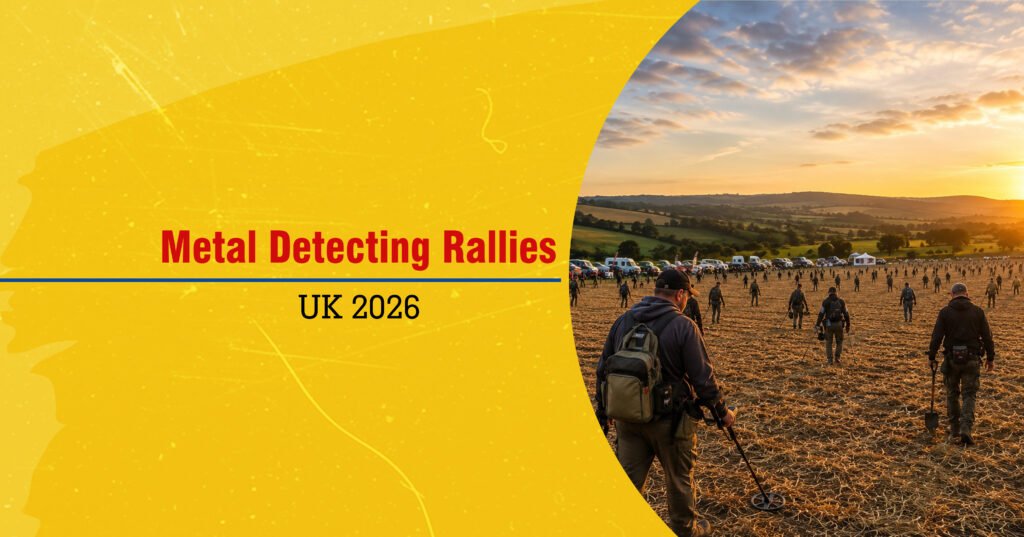
For most people, the hardest part of metal detecting isn’t the detecting itself, it’s getting onto land in the first place. You can have the best machine on the market, hours of free time, and a genuine curiosity about what’s buried under the fields near you, and still spend months going nowhere because nobody’s said yes yet. That’s where rallies come in, and it’s why they remain one of the most popular entry points into the hobby year after year.
A rally strips away that whole problem. Someone else has already done the hard part: the landowner conversation, the insurance, and the working out of where you can and can’t dig. All you have to do is buy a ticket, turn up with your kit, and start swinging.
It’s worth being honest from the start about what a rally actually is, though. The word “rally” tends to conjure images of fields stuffed with gold rings and Roman coins just waiting to be scooped up. The reality is more grounded than that. What you find on any given day depends on the ground, the weather, how many other people are searching the same field, and a fair amount of luck, just as it always does in this hobby. What’s different is the access, and on its own, that makes rallies worth understanding properly.
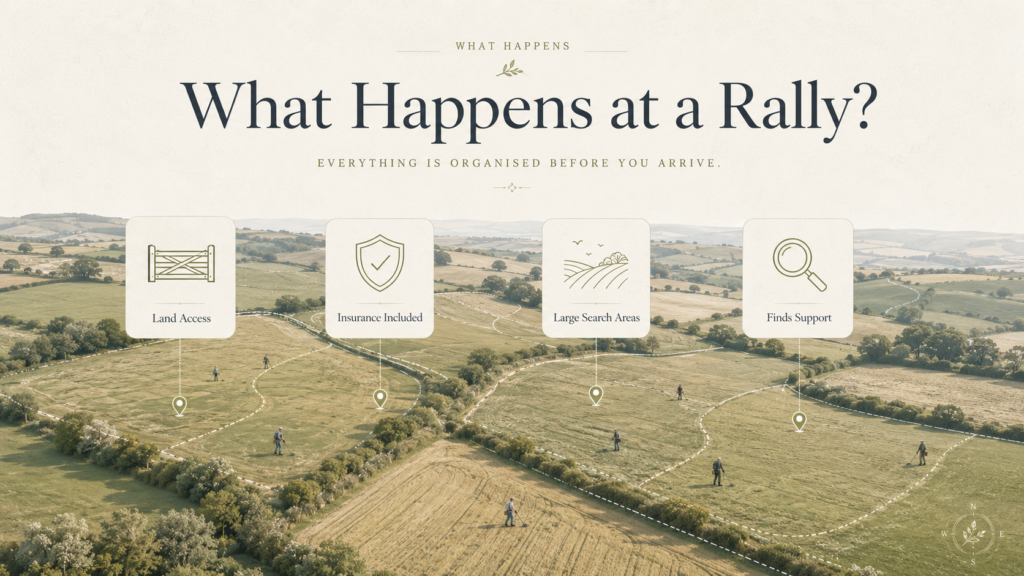
At its simplest, a metal detecting rally is a ticketed event held on land where someone else has already sorted the groundwork. The organiser has agreed access with the landowner, arranged public liability insurance for everyone attending, and worked out what happens if someone finds something that might count as Treasure. You pay your entry fee, bring your own detector and digging gear, and for the hours or days the event runs, you’re free to search the agreed area.
What you actually get for that ticket varies quite a bit. At a minimum, you’re paying for land access and basic facilities, usually toilets, and often a food van or bar if it’s a longer event. Multi-day rallies tend to include camping, and the bigger festivals add trade stands from detector manufacturers, talks, raffles, and a finds table where people gather at the end of the day to show off what they’ve dug up. That last part might sound like a small detail, but it’s one of the nicest things about a rally: standing around with a cup of tea, looking at someone else’s Georgian button or medieval strap fitting, and hearing the story of where they found it.
What a rally isn’t is a guarantee of untouched ground. Popular fields get worked hard across a weekend, sometimes by hundreds of people. That doesn’t mean finds dry up, but it does mean a rally works best as one part of your detecting life rather than the whole of it. Most experienced detectorists treat them as a brilliant addition to, rather than a replacement for, the long-term landowner relationships that genuinely productive permissions are built on, something we cover in detail in our beginners’ guide.
One thing that doesn’t change, no matter which rally you attend, is the legal framework. Anything that might qualify as Treasure under the Treasure Act 1996 has to be reported, and every legitimate UK rally will have a clear process for this, usually a finds table, event administration on hand to log anything significant, and a direct line to the local Finds Liaison Officer. It’s worth knowing this going in, mostly so it doesn’t feel like an unexpected hurdle if you do find something significant. It’s part of the day, not a complication added onto it.
Before getting into specific events, it’s worth setting one expectation: rally calendars are surprisingly late. Locations are sometimes only announced a few weeks before the event, and a wet spring can mean a field that was meant to host a rally simply isn’t usable yet. None of this is unusual; it’s just how detecting rallies operate, largely because they depend on farmland being in the right condition at the right time. Always check directly with the organiser before booking anything.
If you ask almost any experienced UK detectorist to name a rally, there’s a decent chance Detectival is the first word out of their mouth. Running since 2016, it’s grown into the UK’s biggest metal detecting weekend by a wide margin, combining access to hundreds of acres of Buckinghamshire farmland near Aylesbury with something closer to a proper festival atmosphere than most other events manage. There are trade stands from major detector manufacturers, talks from people who know their stuff, camping for those staying the full weekend, and a genuine buzz of people all there for the same reason.
It typically runs in September, with fields prepared after harvest, which, if you know anything about how ploughing and cultivation bring buried material closer to the surface, is exactly the kind of timing that gets detectorists excited. Confirmed 2026 dates and ticket details are released on the official Detectival website, and weekend tickets have a habit of selling out, so it’s not one you can leave until the last minute.
A bit further down the scale, though still very much worth knowing about, are the Rodney Cook Memorial rallies, which have been running for years as charity events raising money for cancer research. “No frills” really does describe them well. These are smaller weekenders, historically held around the Bath, Melksham, and Hungerford areas of Wiltshire and Somerset, and the focus stays squarely on detecting, camping, and a relaxed social atmosphere rather than anything resembling a trade show. From what regular attendees say, the smaller numbers make for a friendlier, more close-knit feel than the bigger festivals can offer. If Detectival sounds a bit much for a first rally, something in this style might be a gentler way in.
Another fixture on the calendar, the Minelab 500 is a mid-August weekender on Somerset pastureland that’s built a reputation for being properly family-friendly without losing the serious detecting side of things. It’s a multi-day event with food and bar facilities on site, a genuinely sociable atmosphere, and enough acreage that even with a healthy crowd, there’s room to find your own bit of space. Like most popular weekenders, the good slots don’t stay available for long once dates are confirmed.
Beyond the big-name events, there’s a whole layer of regional weekenders that often don’t get as much attention but can be just as worthwhile. These run across Norfolk, Wales, the Midlands, and the north of England, organised either by regional detecting groups or commercial organisers such as UK History Finders. The scale varies enormously, from a single field with a modest turnout to digs covering 200 acres or more. The smaller end of this scale is genuinely worth considering if your priority is less crowded ground. Fewer detectorists across a similar-sized field means less competition for signals, which, for a lot of people, translates into a more rewarding day even if the atmosphere is quieter.
And then there’s the level that most people’s first rally actually comes from: single-day events run by local clubs and charities. These tend to be the cheapest way in, often advertised through club newsletters and regional Facebook groups rather than big websites. They’re a low-commitment way to find out whether the rally format suits you before committing to a full weekend away. If you’re new to the hobby, there’s a strong case for starting here.
Make sure you’re going with the right detector in hand. Whether you’re buying your first machine or upgrading before the 2026 rally season, take a look at our range of metal detectors and our current special offers. The right detector won’t guarantee finds, but it can make a real difference to how much ground you cover and how confidently you interpret signals throughout the day.

Knowing the big names is one thing, actually finding out what’s on near you is where most people get stuck, especially if you’re not yet plugged into the wider detecting community.
The UK Detectorist events page is probably the single most useful starting point. It pulls together listings for major digs, weekenders, and charity days from across the country, and you can filter by county and month, which makes it far easier to see what’s within reach on a given weekend. The Portable Antiquities Scheme also keeps a database of officially reported rallies at finds.org.uk useful less as a “what’s on this weekend” tool and more as a way of getting a sense of just how many organised events happen across the UK each year.
For anything more local and immediate, regional Facebook groups tend to be where things move fastest. Most counties have an active detecting community online, and that’s often where club digs, last-minute availability, and smaller local rallies get posted first, sometimes before they make it onto any of the bigger directories at all.
There’s also a route into rallies that goes beyond one-off events entirely: joining a local metal detecting club. Clubs typically organise regular digs on land they already have permission to use, so as a member, you get ongoing access rather than relying on occasional big events you have to plan around and travel to. The NCMD maintains a club directory for its members, and for a lot of people, this ends up being the more consistent way to get regular time on good ground, with rallies becoming the occasional bigger outing on top.
Whichever route you go down, it’s worth checking a few things before you book: whether NCMD or FID membership is required, exactly what’s included in the ticket price, what happens if the event gets cancelled due to weather, and how the organiser handles finds reporting on site.
The short answer is yes, most organised UK rallies will ask you to have a current membership with either the National Council for Metal Detecting or the Federation of Independent Detectorists before they’ll let you in.
The reason isn’t bureaucracy for its own sake. Membership with either organisation includes public liability insurance, and that insurance is what protects everyone involved: the landowner, the organiser, and you if something goes wrong on site. Given that a rally might have anywhere from a handful to several hundred people walking across someone’s farmland with metal detectors and digging tools, it’s not hard to see why organisers want that cover in place.
NCMD membership itself is straightforward and inexpensive. It includes public liability protection across commercial rallies, private digs, and group events, and you get access to a digital membership card through the NCMD app, which is generally all you need to show on the day. One detail that often surprises people: under-16s can be added to an adult member’s account at no extra cost, as long as they’re accompanied while detecting, which makes rallies a genuinely workable family day out.
If you’re planning your first rally, sort your membership out before you book rather than after. The digital card tends to activate fairly quickly, but if you want a physical card as well, give yourself some breathing room rather than leaving it to the week before.

Packing for a rally isn’t complicated, but a few things consistently make the difference between a smooth day and a frustrating one.
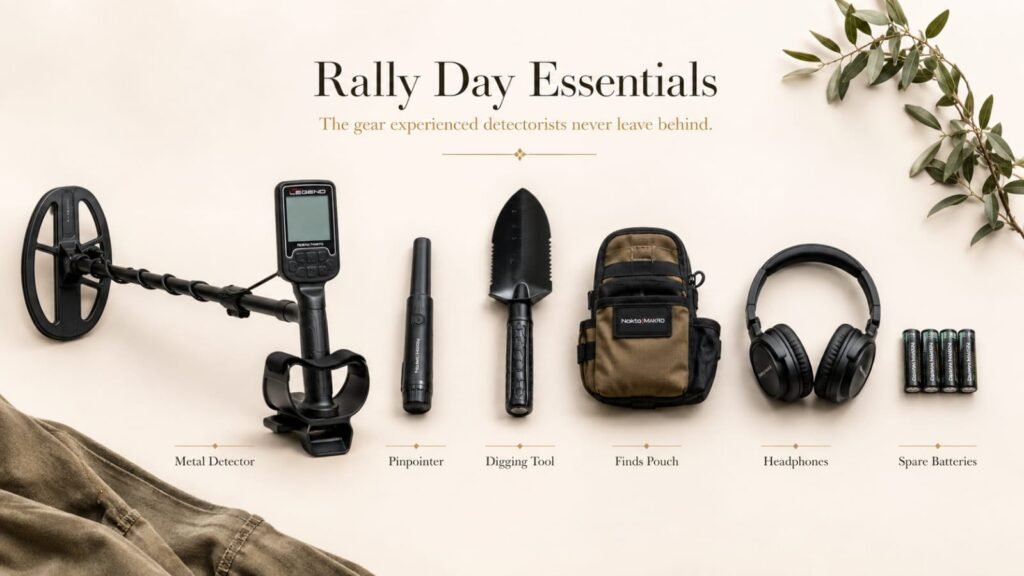
Your detector is the obvious one, but a pinpointer earns its place far more at a rally than it might during a quiet solo session. When you’re digging quickly, often near other people, and trying to keep hole sizes small and tidy, a pinpointer turns a fumbling search through a plug of soil into something quick and precise. A proper digging tool matters too, a decent trowel or spade, depending on the ground, as does a finds pouch to keep what you dig separate and organised, especially if you want to show anything at the finds table at the end of the day.
For multi-day events, weatherproof gear isn’t optional, whatever the forecast says. UK rally weather has a well-earned reputation for doing its own thing regardless of season. If the event includes camping, check what’s actually provided rather than assuming some rallies include toilets and a food van as standard, while others are genuinely bring-everything-yourself affairs.
A couple of smaller things round it out: a battery pack if you’re camping somewhere without mains power, spare batteries for the detector itself, and headphones, which matter more at a rally than almost anywhere else, simply because rally fields are noisy. Chatter, other people’s detectors, the general hum of a few hundred people in one field. Headphones bring back the clarity you need to hear what your machine is actually telling you.
The easiest way to avoid any of this becoming a problem is to check your kit a few days before you leave, not the morning of.
Turning up with the right kit is one thing, but how you spend your time on a rally field has a bigger impact on what you come away with than most people expect.
Get there early. The ground is at its freshest at the very start of an event, and by the afternoon of day one, the more obviously promising areas have already been worked over by everyone who arrived before you. If the event allows arrival the evening before, take that option.
There’s also a strong instinct to head towards wherever everyone else seems to be detecting, on the basis that if people are finding things there, you probably will too. In practice, this often works against you. Field edges, awkward corners, and bits of ground that look slightly less inviting are frequently less searched precisely because everyone else had the same instinct to avoid them. Fewer signals dug in an area doesn’t mean fewer signals to find it, just means more of them are still there.
Slowing down is another thing that sounds obvious but is genuinely easy to forget in the moment. There’s a temptation to cover as much ground as possible, because more ground covered feels like more opportunity. But a slower, more methodical sweep with proper overlap between passes picks up targets that a faster pass simply walks straight over. The people who consistently do well at rallies aren’t usually the ones covering the most acreage; they’re the ones covering their bit of ground properly.
The briefing at the start of the event is worth paying attention to as well, even if you’re itching to get started. Organisers use it to explain where the boundaries are, which areas are off-limits, and what the process is if you find something that needs reporting. Skipping it because you want to get going is one of the easiest ways to end up accidentally searching somewhere you shouldn’t.
And then there’s the social side, which is easy to underrate if you’re going to your first rally expecting it to be purely about finds. Rallies put dozens — sometimes hundreds of experienced detectorists in one place at the same time, and the conversations that happen on a rally field about settings, technique, and what’s turning up where are often worth more than hours spent reading forums at home. Friendships, club memberships, and even farm permissions have traced back to a conversation that started over someone’s find on a rally field.
Finally, if you dig up something that might count as Treasure, deal with it there and then. Every legitimate rally has a finds table and a direct line to the local FLO for exactly this situation, and reporting on the spot is both the right thing to do and, frankly, the easiest way to handle it.
This isn’t really an either-or question, even though it can feel like one when you’re starting out.
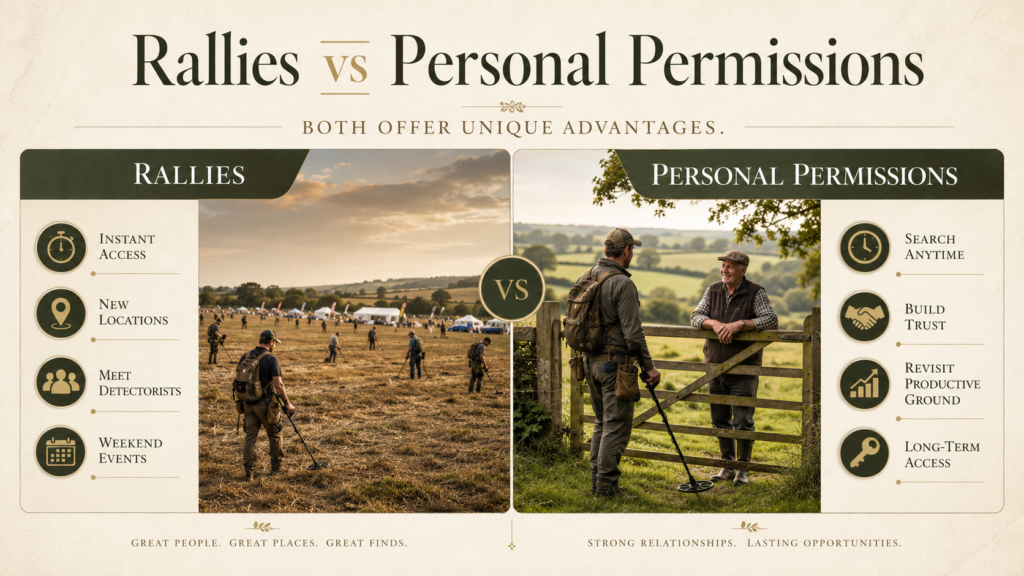
Rallies give you something your own permissions can’t, at least not quickly, immediate access to varied ground, often in areas you’d never otherwise get to search, along with a social introduction to the wider detecting community. They’re brilliant if you’re new to the hobby, if you’re travelling somewhere new and fancy detecting while you’re there, or if you simply want a weekend that combines detecting with camping and good company without any of the groundwork.
Your own permissions, built through the right approach to landowners and farmers, offer something different: a ground that gets better the more you search it, a relationship with someone who often turns out to be genuinely interested in what you’re finding on their land, and the freedom to search on your own schedule.
Most people who stick with this hobby long-term end up doing both, and not because they have to, but because each one fills a gap the other leaves. Rallies for variety, for the big social weekends, for trying somewhere completely new. Personal permissions for the steady, accumulating finds that come from really knowing a piece of land over months and years.
If rallies are your entry point into the hobby and you’re still deciding what machine to buy, our guide to the best beginner metal detectors under £300 is a good place to start.
There’s a particular feeling that a lot of detectorists describe from their first rally, less about what they found and more about the moment itself. Standing in a field early on a slightly damp morning, surrounded by other people who get exactly why a faint signal at twenty centimetres makes your pulse pick up a little.
Whether that first experience is a small single-day club dig down the road or a full weekend at something like Detectival, it tends to do the same thing for most people: it turns curiosity about the hobby into something closer to commitment.
If you’re heading to your first rally this year, enjoy every minute of it. And if at any point you want an honest chat about equipment, whether your current detector suits the ground you’ll be searching, or you’re picking up your first machine, the team at UK Metal Detectors is always happy to help.
Get in touch with our team, no pressure, just straight answers from people who identify themselves.
A metal detecting rally is a ticketed event held on land where the organiser has already arranged access from the landowner, public liability insurance for all attendees, and a process for reporting finds, including potential Treasure. Depending on the event, this might be a single day on one field or a full weekend with camping, food, and trade stands included.
In most cases, yes. The majority of organised UK rallies require either NCMD or FID membership, mainly because membership includes the public liability insurance that protects the landowner, the organiser, and you while you’re on site. NCMD membership is inexpensive, activates fairly quickly through a digital card and app, and under-16s can be added to an adult member’s account for free.
Detectival is typically held in September on farmland near Aylesbury in Buckinghamshire. Confirmed dates and ticket details for 2026 are released on the official Detectival website. Weekend tickets tend to sell out, so keep an eye on announcements.
The UK Detectorist events page is one of the most useful starting points, with listings filterable by county and month. Regional Facebook detecting groups are often the fastest source for smaller, local club digs. Joining a local club is another route in, giving you access to regular digs on land the club already has permission for.
At a minimum: your detector, a pinpointer, a digging tool, and something to keep your finds organised. Weatherproof clothing is essential whatever the forecast. For multi-day events, check what facilities are provided before assuming you need to bring everything yourself. And check your batteries the night before, it’s the thing people most often forget.